Romer Saucedo to face ordinary trial for drug trafficking, Bolivia's Prosecutor's Office confirms
The Attorney General José Armando Urioste announced that the Supreme Court of Justice president will be prosecuted in ordinary courts for trafficking in controlled substances. Saucedo fled the country with his family and could be in Brazil.
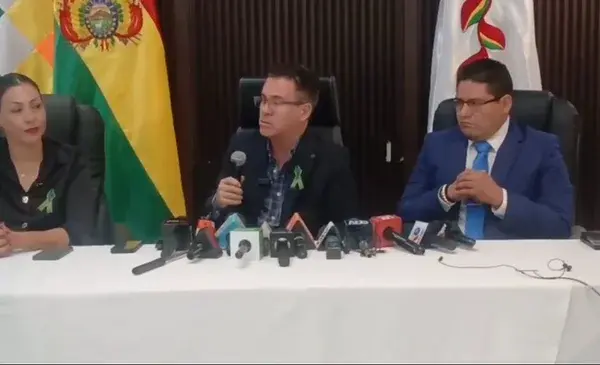
Supreme Court of Justice president in flight after arrest warrant
The Attorney General of the State, José Armando Urioste, confirmed on Monday that Romer Saucedo will be prosecuted in ordinary courts for the alleged crime of trafficking in controlled substances, according to reduno.com.bo. The decision is based on the fact that the investigated matter bears no relation to the exercise of his functions as president of the Supreme Court of Justice (TSJ).
"Of course, that is a common crime that he did not commit in the exercise of his function as president," Urioste declared.
The Prosecutor's Office thus ruled out the possibility of processing the case through a trial of responsibilities or a proceeding before the court. Urioste stressed that Saucedo's institutional status does not grant him privileges in an investigation of this nature.
"It is a crime against humanity, he has neither immunity nor privileges and it is not in the exercise of his functions," the Attorney General stated.
Saucedo left Bolivia with his family and declared himself in exile
On Wednesday, 4 November, Saucedo announced via his social media that he left the country together with his spouse and his three children. In his statement he claimed that he made the decision after considering that his freedom and the life of his family were in danger, and he declared himself in exile.
"Bolivia ceased to be a safe country. My freedom and the life of my entire family are in danger," he wrote.
The announcement came one day after the Prosecutor's Office issued, on 3 November, an arrest warrant against him for the alleged crimes of trafficking in controlled substances and criminal organisation. Saucedo further indicated that his departure from national territory does not imply a resignation from the Presidency of the TSJ, and that he will return when conditions exist that guarantee his security.
Government Minister Marco Antonio Oviedo acknowledged that Saucedo did not have a migration alert or travel restrictions in place when he left Bolivia.
Prosecutor's Office tracks fugitive in Brazilian cities
Urioste reported that the Public Ministry carried out searches and is advancing investigations to establish Saucedo's movements. According to information in the Prosecutor's Office's possession, the TSJ president could be in some city in Brazil.
"We have information that he could be in some city in Brazil and that is being investigated," Urioste indicated.
The Attorney General confirmed that the corresponding migration alerts have already been activated. Once the declaration of rebellion is initiated, he explained, the procedures for a possible extradition can be activated, though he clarified that this procedure corresponds to a later stage of the judicial process.
Other charges could be pursued through the Supreme Court
Urioste specified that facts linked to the exercise of public functions—such as the alleged crimes of active and passive bribery and other conduct related to the performance of his office—could be addressed by the Supreme Court through the corresponding institutional procedures.
"Those are indeed cases for court, but this case that has been investigated is absolutely linked to a personal motive," the Attorney General stated.
The Prosecutor's Office reiterated that the investigation for trafficking in controlled substances will continue in the ordinary judicial route, regardless of the position Saucedo holds.
Source: Google News BO — La Paz