Six international alerts preceded US sanctions against Bolivian justice
Since 2022, international bodies have documented corruption and criminal infiltration in Bolivia's judicial system. Washington identified 16 judges and prosecutors among the 28 names published.
Six warnings ignored before US restrictions
Six international alerts regarding corruption, political interference and criminal infiltration in the Bolivian judicial system preceded the current US offensive, according to a count compiled by El Deber based on official information and documents.
Between September and October, Washington announced migration restrictions for 62 people and their families as part of its policy against organised crime and corruption. Of that total, 16 were prosecutors, judges and magistrates in active or retired service.
First alert: the UN rapporteur in 2022
In June 2022, Diego García-Sayán, then UN rapporteur on judicial independence, denounced political interference, delays in justice and abuse of preventive detention after visiting Bolivia. He noted that 47% of the 1,134 ordinary judges were temporary and that seven out of every ten prisoners lacked a sentence. "The delay in justice is due to procedural codes that are too formalistic," he stated, and also identified deficiencies in management, training and corruption. The judicial budget represented less than 0.5% of the national budget.
Second alert: report on judicial elections
In December 2024, the International Commission of Jurists, the Latin American Federation of Magistrates and the Foundation for Due Process published the report Neither comprehensive judicial elections nor justice reform in Bolivia. The document questioned the selection of magistrates, the extension of mandates and risks to the independence of the judicial branch.
Third alert: the Global Organised Crime Index
In November 2025, the Global Organised Crime Index assigned Bolivia 5.12 points out of ten in criminality—0.17 more than in 2023—and 4.63 in state resilience, a fall of 0.20 points. Criminal actors integrated into the State reached 6.5 points, compared to just three for the judicial and penitentiary system to counter them. The report described institutional corruption and foreign networks active in the territory.
Fourth alert: the UN rapporteur visits La Paz and Sucre
In September 2026, UN rapporteur Margaret Satterthwaite visited La Paz and Sucre. In dialogues with authorities and civil bodies, she addressed partisan pressures in the appointment of judges and advocated for appointment by merit and independence.
On 28 September, Washington announced restrictions for 21 Bolivians and banned then Attorney General Róger Mariaca on suspicion of protecting drug trafficking. Mariaca rejected the accusation, was arrested on 1 October and is being held in preventive detention at Cantumarca. In that first batch, nine judicial operators were identified: four prosecutors, including Mariaca, and five judges or magistrates—among them Alberto Zeballos, Martín Irusta, Álvaro Nava, Albania Caballero, Rosario Flores, Rodrigo Vedia and magistrates Israel and Iván Campero.
Fifth alert: Unodc warns of foreign mafias
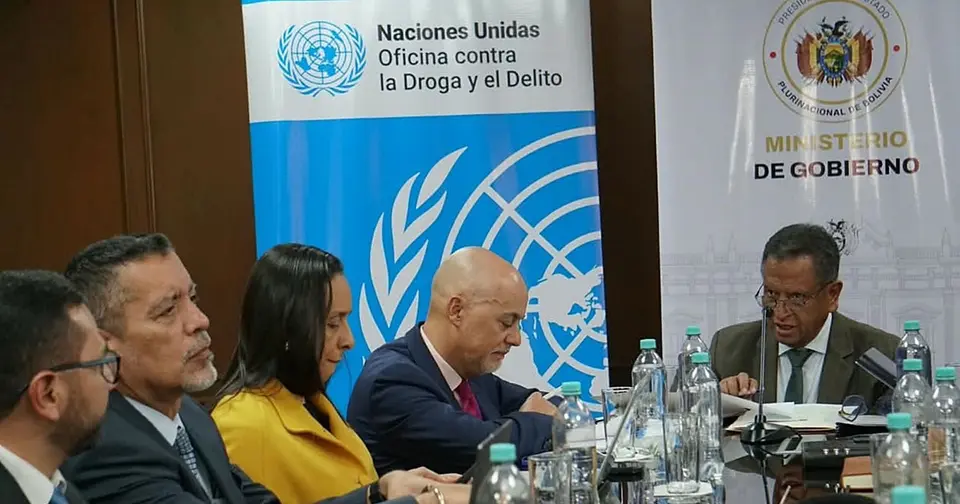
On 17 October, Mónica Mendoza, representative of the Unodc, warned of the expansion of foreign mafias and their infiltration into Bolivian justice. She described a "convergence" of drug trafficking, human trafficking, smuggling, corruption and illegal mining. She stated that denying institutional infiltration would be "very complex" for the country.
Sixth alert: Bolivia ranks 130th on the rule of law
On 21 October, the World Justice Project placed Bolivia at position 130 out of 143 countries in its 2026 Rule of Law Index, and at position 29 out of 32 in the region. Criminal justice, civil justice and corruption control are among its worst indicators.
The following day, on 22 October, the US announced restrictions for a further 40 people and published 15 names. Seven were judicial operators: four prosecutors—Juan Lanchipa, Félix Balderas, Julio Porras and Armando Rojas—and three judges—Aldo Quezada, José Ayaviri and Julio Alba. Across both batches, eight prosecutors and eight judges or magistrates were identified.
Removals, resignations and reform proposals
Interim prosecutor José Armando Urioste reported that Balderas and Porras were removed from their duties on 20 October. Quezada resigned from the Departmental Court of Santa Cruz. Presidential spokesperson José Luis Gálvez warned that "influence does not protect and the uniform does not protect".
The visa restrictions reactivated judicial reform proposals from various sectors. The rector of the Gabriel René Moreno Autonomous University (Uagrm), Reinerio Vargas, proposed amending the Constitution to elect departmental prosecutors by popular vote and subordinate the Police to the governor's command. "It does not mean that they already have a sentence," he clarified regarding those affected by the restrictions.
Santa Cruz governor Juan Pablo Velasco called for "a thorough judicial reform" and proposed digital files, traceability of proceedings and citizen oversight, as well as departmental assemblies appointing prosecutors and judicial authorities.
From the Executive, Minister of the Presidency Fernando Aramayo announced technical assistance from the UNDP and efforts with the IDB for digitalisation, institutional integrity and anti-corruption efforts. Rapporteur Satterthwaite warned that any reform must avoid partisan interference in the system.
Source: El Deber