Violent clashes in La Paz: thousands of demonstrators demand President Paz's resignation
Police and thousands of demonstrators clashed on Monday in central La Paz. Ninety people were detained and four have died since the beginning of the protests.
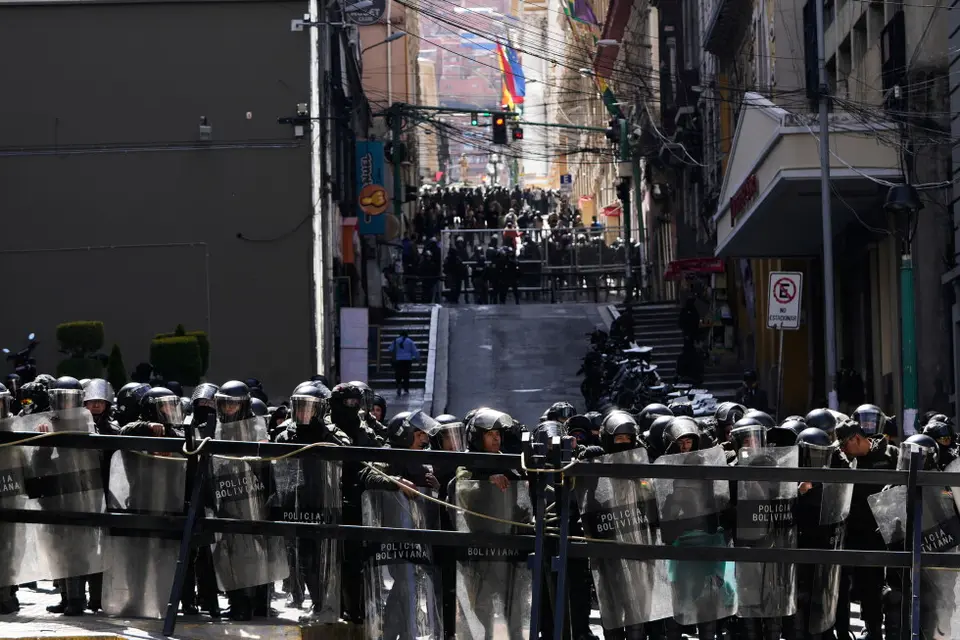
Clashes in La Paz leave 90 detained as anti-government protests grow
The centre of La Paz was the scene on Monday of violent clashes between police and thousands of demonstrators demanding the resignation of conservative president Rodrigo Paz, according to apnews.com. Among the demonstrators were followers of former president Evo Morales (2006–2020) who had arrived from the coca-growing region of Chapare, alongside members of the Central Obrera Boliviana (COB) and the main peasant union allied with Morales.
Armed with firecrackers, stones, sticks and dynamite, the demonstrators attempted to break through a police cordon to reach government buildings and the Legislative Assembly. Government officials and legislators had to abandon the buildings amid intense security measures. The government did not confirm whether president Paz remained inside the facilities.
Prosecutor Roger Mariaca reported that there are 90 detainees. A detention order also weighs against Mario Argollo, the main leader of the COB. There was no immediate count of the injured, although the Ministry of Government released images of at least two beaten police officers, one of them struck with a blunt object on the head. Local media also showed an injured demonstrator, and several journalists were affected by gas and blows during the disturbances.
Some demonstrators looted a shopping centre and a courthouse, and set fire to furniture and objects removed to build burning barricades and counter the tear gas used by police. Several citizens reported assaults by enraged demonstrators.
From El Alto, a locality neighbouring La Paz, the demonstrators marched towards the centre with slogans such as "Homeland or death, we shall overcome!" Residents of that city joined the march shouting "Resign!" "The government must listen and work with the unions and social organisations," said peasant leader Javier Santalla from a blockade point in southern La Paz.
The protests have entered their third week and include road blockades that have the capital surrounded. According to the government, four people have died since the start of the mobilisations due to not receiving medical care because of these blockades. The blockades have left markets understocked and with scarce fuel available.
Business organisations have called on the president to take a firm stance against the blockades. According to these associations, the protests and stoppages are generating losses of more than 50 million dollars daily and there are some 5,000 vehicles stranded on the roads. From Santa Cruz, the Civic Committee—which has strong influence in that wealthy region of eastern Bolivia—has called on the president to declare a state of emergency, according to its president Stello Cochamanidis.
Paz came to power in November without his own party or a majority in the Legislature, in what he described as the end of two decades of governments by the Movement towards Socialism that left "a broken country". Among his first measures he eliminated fuel subsidies, which has increased the cost of living. Experts point out that the president is lagging behind in the adjustments necessary to reverse the worst economic crisis in the past 40 years.
The president has prioritised dialogue with the mobilised groups and reached agreements with several sectors. He has ordered that police and the military act as deterrent forces, without weapons. However, with Morales's followers the government has ruled out negotiating.
Paz has received backing from the United States and several Latin American countries, and rejected statements by Colombian president Gustavo Petro, who described the Bolivian situation as "popular insurrection".
Morales is encouraging the protests from Chapare, where since 2024 he has evaded a detention order for failing to present himself before justice to answer for alleged abuse of a minor in 2016. Last Monday a second arrest warrant was added for the same cause. His coca-growing followers have taken control of an airstrip in the zone—which does not operate commercial flights—for fear their leader may be captured.
Last week, La Paz had already been the scene of harsh clashes between miners and police. By Monday evening partial calm resumed, with a citizens' march calling for peace and rejecting the disturbances.
Source: Google News BO — La Paz