Federal programme brings organised crime and environmental crime enforcement to the Amazon
The federal government launches an integrated initiative across 42 municipalities in six Amazonian states to confront drug trafficking, illegal mining and armed violence.
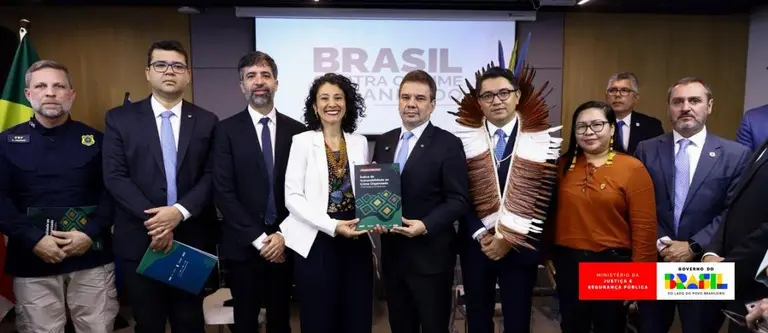
Integrated operation across six states aims to dismantle factions and protect the forest
The federal government has launched the programme "Brazil Against Organised Crime" targeting the Amazon, bringing together security forces from six states to simultaneously confront drug trafficking, illegal mining, environmental crimes and armed violence. According to gov.br, the initiative operates in seven priority regions and covers 42 municipalities in Acre, Amazonas, Pará, Maranhão, Mato Grosso and Paraná.
Minister Wellington Lima defended the logic of coordinated action during the event's opening. "For decades, each state tackled crime in its own way, with its own resources, along its own borders. The problem is that crime never respected any boundaries. While the states acted separately, the factions operated as a network," the minister said. Lima added that, for the first time, the State will act jointly and simultaneously, with a unified plan.
Four structural pillars
Coordinated by the National Secretariat for Drug Policies and Asset Management (Senad), the programme is named "Safe Territory, Sovereign Amazon" and is organised around four pillars: territorial diagnosis with intelligence production; qualified enforcement against the financial and logistical structures of organised crime; prevention and access to rights for vulnerable populations; and promotion of sustainable economic alternatives in priority territories.
National Secretary Marta Machado stated that the programme breaks with a tradition of fragmented policies in the region. "For a long time, the Amazon was addressed by fragmented policies: sometimes by the environmental agenda, sometimes by the public security agenda, sometimes by the economic development agenda, as if these dimensions could be thought about separately," Machado said. According to her, qualified enforcement, environmental protection and the guarantee of rights must go hand in hand.
Technology and decapitalisation of crime
National Public Security Secretary Chico Lucas highlighted the role of technology and information in combating organised crime, with emphasis on the region's port infrastructure, identified as a vector for factional expansion. "The proposal is that states do not act in isolation, but jointly with the Federal Government," Lucas stated.
Federal Police Director-General Andrei Rodrigues announced that the programme will raise the level of crime enforcement through the decapitalisation of criminal organisations. Rodrigues reported that, in the past year alone, Federal Police operations removed R$ 10 billion from organised crime.
Also participating in the event were the Executive Secretary of the Ministry of Justice and Public Security (MJSP), Ademar Borges; the Minister of Indigenous Peoples, Eloy Terena; and the Executive Director of the Federal Highway Police (PRF), Alberto Raposo Neto.
Balance of the Amas Plan and targets for 2026
During the meeting, the MJSP presented the results of the Amazon: Security and Sovereignty Plan (Amas), a policy in force since 2023 to combat organised crime and environmental crimes in the region. Perspectives for strengthening the initiative were debated, including the formalisation of a contract with BNDES/Amazon Fund to finance actions and budgetary supplementation for states.
The Amas Plan Management Committee held a deliberative meeting in which it discussed the Integrated Strategic Plan for BR-319 and the Integrated Operational Plans of the Legal Amazon states for 2026. The targets for the coming year focus on three fronts: strategic control of BR-319, with focus on combating illegal mining, land grabbing and wildfires; integration of state operational plans; and strengthening action against organised crime in the Pantanal.
Vulnerability index in indigenous territories
The event also marked the launch of the Vulnerability to Organised Crime Index: Indigenous Territories (IVCO-TI), developed by the Centre for Studies on Drugs and Community Social Development (Cdesc). The index results from a partnership between Senad/MJSP, the United Nations Office on Drugs and Crime (UNODC) and the United Nations Development Programme (UNDP), and aims to guide strategic decisions for protecting indigenous communities most exposed to infiltration by criminal organisations.
Source: Google News BR — Crime