Police corruption in Ecuador: criminal infiltration and weak controls expose the institution
Cases involving fuel, drugs and weapons theft reveal the penetration of organised crime within the National Police. An agreement with the US seeks to strengthen internal controls.
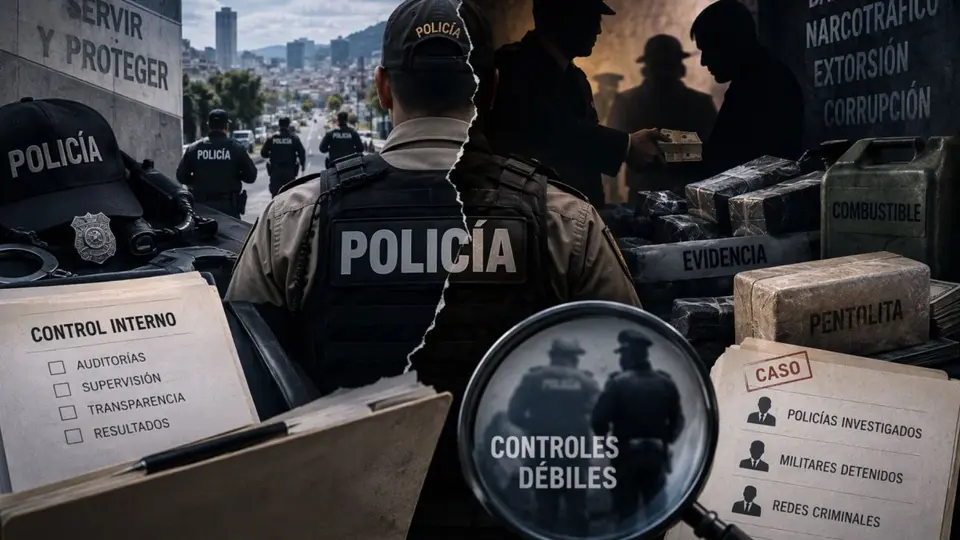
Corruption within the National Police: accumulated cases and an agreement with the US
Expreso.ec reports that Ecuadorian police officers and military personnel have been detained in multiple operations over the past two years for crimes including fuel trafficking, theft of evidence, extortion and leaking of classified information—an accumulation of cases that exposes structural gaps in the institution's internal control mechanisms.
The most recent alert emerged when investigators determined that part of the pentolite stolen from police facilities ended up outside state control. It was not the first time that a national security case had pointed inwards to the very forces charged with fighting crime.
Operations that reveal the scale of the problem
In April 2026, Operation Grand Fortress 1 resulted in the detention of five police officers, three military personnel and several civilians accused of being part of a network involved in trafficking and diverting hydrocarbons operating across different provinces of the country. The investigation pointed to a structure that had allegedly facilitated fuel to criminal economies.
Months earlier, other military personnel were prosecuted for the alleged theft and illegal transport of fuel linked to illicit activities. The findings add to the cases documented during 2025: two police officers detained for kidnapping and extortion in Guayaquil, and the theft of 321 kilogrammes of cocaine from an official police warehouse, drugs that had allegedly subsequently ended up in the hands of criminal organisations, according to an InSight Crime analysis.
Former anti-drugs chief Guillermo Palacios stated that organised crime has penetrated highly sensitive areas such as ports, airports and evidence storage facilities.
During the internal armed conflict alone, the Police investigated 124 of its own officers for various cases of corruption, including complaints of abuse of influence, sale of police weapons, extortionate kidnapping and illegal charges.
Internal controls with structural limitations
A source close to police ranks, who requested anonymity, warned that control mechanisms have fundamental flaws. "Internal control mechanisms are weak. There is no digitised inventory system for evidence in the Judicial Police warehouses and audits are scarce," the source stated.
According to the same source, US support could represent an opportunity to modernise critical processes through permanent cameras, digital monitoring, early warning systems and evidence tracking systems.
A police officer on active duty with 21 years in the institution defends, nonetheless, the Police's capacity to investigate itself. "The National Police is the only institution that purges itself. A police officer is not bribed at the moment of catching another police officer," the officer states. At the same time, the officer recognises tensions within the system: some investigations end up involving officials whose links with the suspects amount to no more than workplace contacts or telephone communications that must subsequently be clarified before judges.
The same officer raises another, less visible problem: working conditions. According to the account, many police officers face high costs for housing, food and legal defence when they are subject to legal proceedings, to which are added extended shifts, limited access to psychological support and deficient infrastructure in some police stations. "If you ask me whether there exists a system that completely protects honest police officers, I would say no," the officer states.
Police Integrity 360 agreement with the United States
On 2 October 2026, Ecuador and the United States signed the agreement called Police Integrity 360, described as one of the most ambitious attempts to strengthen the institution's internal oversight. The agreement provides for polygraph, psychological, toxicological and financial evaluations, as well as digitisation of records and the creation of control and confidence centres in Guayaquil and Manta.
Several of the elements flagged by internal sources as necessary—digital monitoring, evidence tracking, early warning systems—form an explicit part of the agreement.
Experts warn of absence of specific policies
For security expert Jean Paul Pinto, the problem has reached a point where it threatens the effectiveness of any state strategy. "In the new security plan there is nothing about this subject. There are no specific policies or strategies against infiltration," the expert stated.
Pinto considers that phenomena such as prison massacres and information leaks to criminal organisations are direct symptoms of an infiltration that the State has not addressed with concrete instruments. The question reopened by the agreement with Washington remains without definitive answer: whether internal controls have the real capacity to detect in time agents who are collaborating with organised crime, or whether the damage is already done before they act.
Source: Google News EC — Crime