Tusi and synthetic drugs: organised crime in Ecuador goes beyond cocaine
Organised crime in Ecuador operates with cocaine but also with tusi, Medellín's pink drug. Routes adapt and synthetics open new markets.
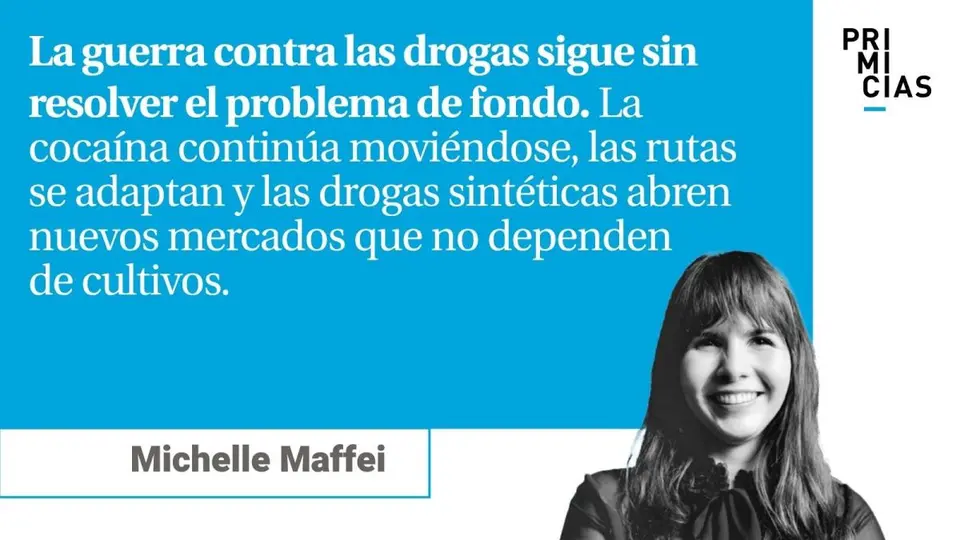
Tusi and synthetic drugs expand criminal business in Ecuador
Organised crime in Ecuador does not depend solely on cocaine, according to reporting from primicias.ec. Criminal groups also operate in markets linked to other substances, including 2C-B, known as tusi or pink cocaine, despite containing no cocaine. Its origin is traced to Medellín, a city that presents itself as a model of peace culture but maintains, at the same time, high-intensity criminal governance.
Tusi appeared in Medellín in 2010, within rave culture. It is produced mainly from residues of low-quality drugs, which can generate more serious effects than other substances. The vast majority of its users do not know exactly what they are ingesting: it generally combines ketamine, MDMA and caffeine, although its composition varies. It is more expensive than cocaine and easier to obtain and consume.
A business for reusing low-quality substances
The United Nations Office on Drugs and Crime (UNODC) links the emergence of tusi with a possible expansion of the ketamine market. In general terms, this drug functions as a mechanism for reusing synthetic substances of poor quality and maximising their commercial value. In some cases, tusi can contain fentanyl, a substance that can be lethal.
In Ecuador, tusi consumption constitutes a public health problem. It has been detected throughout the country and particularly notably in Montañita. Its sale is straightforward: it can be found on social networks such as TikTok and Instagram.
Direct links with Colombian organised crime
The use of tusi is not merely a health issue. It reflects the direct ties that national organised crime groups (GDO) maintain with criminal structures in Colombia. Many local crime leaders end up being located on Colombian territory. What happens there has repercussions here.
Despite the war on drugs driven by the United States in South America, Colombia remains the principal producer of cocaine and other substances. Caribbean routes remain active. Institutional discourse suggests that the Caribbean is safer than the Pacific, but that claim is questionable: much of the drug seized in that region stems from joint operations with the United States. Without those operations, those quantities simply would not have been detected.
Concealment methods have also become more sophisticated. Among them is so-called "black cocaine": the white substance is chemically transformed to resemble coal and evade controls.
Ecuador leads cocaine seizures towards the European Union
Data from the Global Initiative Against Transnational Organised Crime (GI-TOC) for the period January 2019 to June 2024 place Ecuador at the head of countries of origin for cocaine shipments seized en route to European Union ports, with 306,423 kilograms seized. Brazil appears in second place with 97,257 kilograms, and Colombia in third with 77,696 kilograms.
These figures suggest that production has not stopped. With caution, the evidence points to the possibility that it could be increasing.
Forced eradication does not resolve the underlying problem
The government of Gustavo Petro did not manage to improve the panorama of coca cultivation and trafficking in Colombia. His successor, De la Espriella, will turn towards forced eradication, which could open the door to a greater presence of United States military personnel. However, the coca replanting rate reaches 80%, driven by profitability close to 99%.
At the same time, the focus on crops leaves out of the analysis the increase in synthetic drugs. These do not require plantations and can be produced in bunkers or underground facilities, making them practically invisible to traditional interdiction schemes.
Routes adapt, markets diversify
Cocaine continues to move. Routes change when they close. And synthetic drugs open markets that do not depend on land or climatic conditions. As long as organised crime groups find ways to maximise their profits, purely military instruments have proven insufficient to stop them.
Source: Google News EC — Crime