Mexican and Albanian cartels intensify drug-related violence in Madrid
The National Police and Civil Guard report an escalation of violence between drug trafficking organisations in Madrid, with growing settlements of Mexican and Albanian cartels competing for markets and criminal resources.
Extreme violence in drug trafficking networks
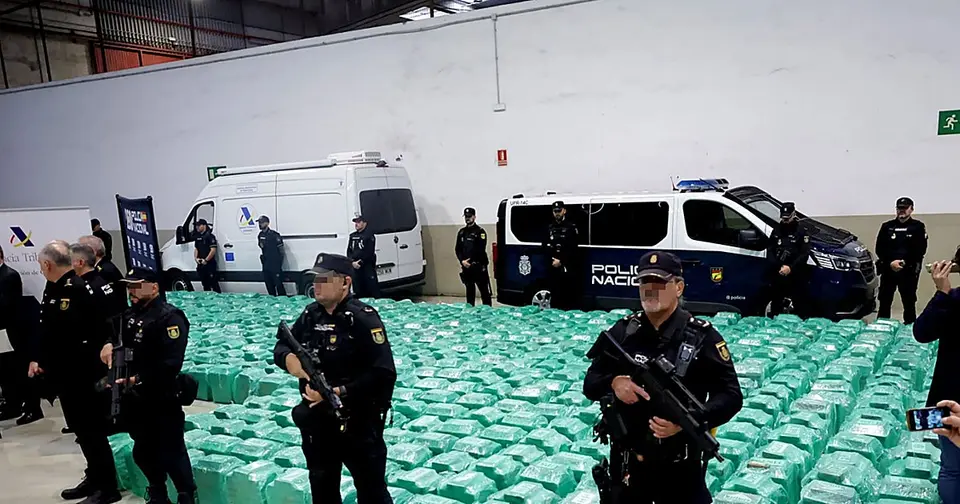
According to ABC, the National Police and Civil Guard describe a dramatic increase in clashes between criminal organisations related to drug trafficking. This violence operates on two fronts: the visible one in the streets and the invisible one, perpetrated between mafias as they struggle for control of routes, merchandise and territory.
Investigators point to two main causes. Firstly, the increasingly large establishment of cartels from countries previously removed from Spain: Albanian and Mexican organisations that are reformulating their criminal operations. The Mexican cartels, in particular, are expanding their niche towards fast-growing synthetic substances. Secondly, the recent increase in cocaine prices has reduced available supply, generating a cascade of coordinated thefts, kidnappings and settling of scores between gangs.
Kidnapping and torture in Carabanchel
A recent case illustrates the current intensity. On the night of Halloween 2025, in the Madrid district of Carabanchel, Juan María G. P., known as 'Niño Juan', a man in his thirties from Pinto raised in Orcasitas and Almendrales (Usera), was kidnapped and tortured. This individual had specialised in armed robberies since he was a minor and worked as an intermediary in high-value operations, including thefts from foreign art museums.
After holding him in a hideout between Toledo and Madrid—probably in the Calypo Fado urbanisation, where multiple police investigations have operated—his captors demanded information about a shipment of between 1,200 and 1,300 kilos of cocaine that had disappeared months earlier in Mérida (Badajoz). The detainee, Juan José C. M., known as 'Morros' and a former partner of the victim, spent barely days in prison: 'Niño Juan' refused to report him and to cooperate with police. He had learned the lesson of being able to preserve his life.
Criminal omertà complicates investigations
This code of silence is the most widespread characteristic in these circles and the one that mainly impedes the work of security forces. For this reason, it is extremely difficult to quantify these facts statistically. According to information available to ABC, in early 2026, crime organised experts in Madrid had six investigations open related to drug theft and settling of scores.
A veteran in the fight against drug trafficking explains: "If in the 1980s and 1990s criminals dedicated themselves to robbing banks, now that financial institutions barely hold cash, what is stolen is cocaine". A substance that formerly hovered around 12,000 euros per kilogram and which currently reaches 20,000. "But costs have to be covered. For example, bribes to customs and port officials, both at the source and in Spain. There are corrupt officials who pocket 20 per cent at each end of the route," adds another source.
Cocaine shortage fuels theft between mafias
Less drugs in circulation affects the entire ecosystem: those sending shipments, mid-level distribution groups and street vendors. A police source sums up the pattern: "Word spreads of who has merchandise. They give it a 'turnaround'; they kidnap the wife or a child and send photos to intimidate, demanding 10 kilos for their release; or they end up shooting each other. One traffics and ten steal".
Investigators also warn that these gangs frequently possess "more means than the Security Forces"—one need only observe what happened in the Campo de Gibraltar. The experts' forecast is not optimistic: "In Ecuador you currently cannot live because of organised crime. In Spain, before long, it could be the same, because they are partly being allowed to act freely".
Mexican and Albanian cartels consolidate presence
United States pressure against drug trafficking has forced Mexican cartels to seek new markets. They increasingly find more difficulties in their "natural market" and for this reason they are already making themselves felt strongly in Europe through Spain. Renovated branches of the Sinaloa Cartel, Jalisco and heirs of Beltrán Leyva already operate in Spanish territory.
"Besides the most important Colombians who were already in Madrid, now there are Albanians and Mexicans, who love the American lifestyle and settle in residential areas such as the axis of Las Rozas-Majadahonda-Pozuelo de Alarcón-Boadilla del Monte. Those villas remind them of houses in the United States," explain the sources. They have also been detected in northern neighbourhoods of the capital—Las Tablas, Sanchinarro and El Cañaveral—where members of Tren de Aragua, the most powerful gang in Venezuela and a threat in the United States, have even been identified.
Fentanyl: a new synthetic threat
In November 2025, at Barajas Airport, the National Police stopped the arrival of a flight from Mexico City. Among the passengers travelled Alejandro 'N', identified by Mexican intelligence services as linked to the Jalisco Nueva Generación Cartel (CJNG), specifically to its branch processing chemical substances in a laboratory in Guadalajara. That laboratory produced fentanyl, a lethal opioid which, according to the sources consulted, "has already been detected in Spain" beyond medically prescribed doses.
"It has been found in small quantities, arrivals mainly in postal shipments," they add. Information from the DEA and other intelligence services suggests that fentanyl represents an emerging threat of unknown scale in the country.
Source: ABC