Secondary school blockades in France: 305 police officers injured, ministry denounces urban violence
One day of secondary school blockades has left 305 law enforcement personnel injured in France. The Interior Ministry now views the incidents as acts of organised crime, not legitimate protest.
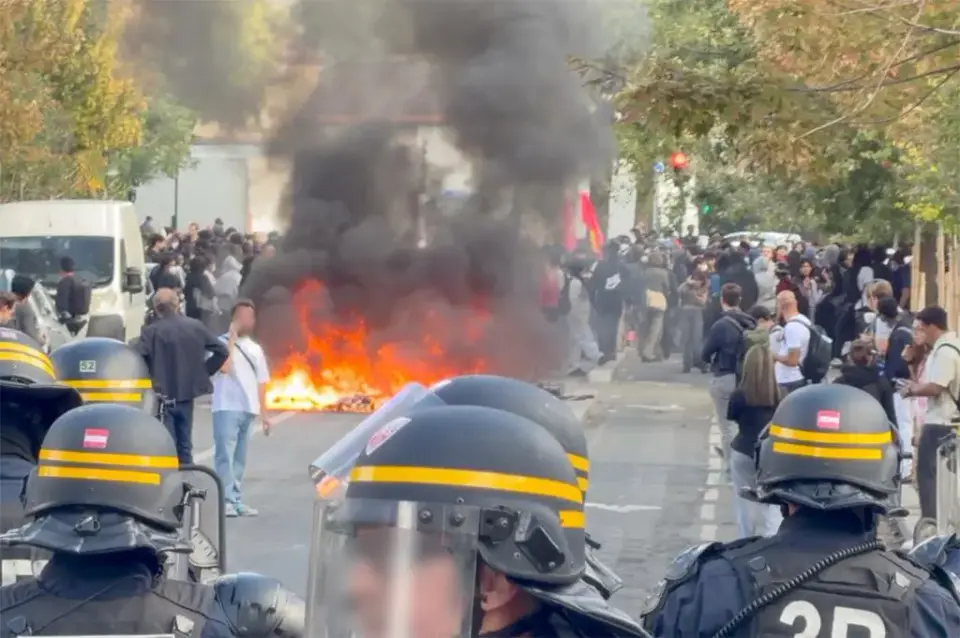
Escalation of violence during secondary school blockades
The Interior Ministry issued a critical assessment on Thursday evening of a new day of secondary school mobilisation, which left 305 police officers and gendarmes injured. In twenty-four hours, this figure had nearly quadrupled compared with the previous day, when 83 officers had been injured. The authorities recorded 1,949 arrests across France.
The movement, launched on 24 September via social media and encrypted messaging platforms, took place in more than one thousand schools, of which 222 were blockaded. According to Actu17, damage and fires affected numerous towns: Nice, Dijon, Besançon, Toulouse, Bordeaux, Montpellier, Rennes, Strasbourg and Rouen were among the affected sites. In Nantes, the Nelson-Mandela secondary school caught fire on Thursday morning around 8 a.m.
Ministry designates incidents as urban violence
The Interior Ministry noted a "worsening of the situation" and stated that it "no longer bears any resemblance to the legitimate expression of secondary school demands but now displays all the characteristics of urban violence". The ministry points to the presence of "individuals who came to cause destruction" and "opportunistic looters", and lists mortar fire, use of weapons against law enforcement, damage to public furniture, fires in public buildings and looting of shops.
In Coulommiers, a police officer was wounded in the hand by mortar fire. In Marseille, a police superintendent and an officer were burnt following the use of an agricultural bomb. A gendarme was struck on the legs with an iron bar in Saint-Quay-Portrieux. In Issy-les-Moulineaux, a gendarme officer was assaulted by a hostile crowd. In Gien, a soldier was struck in the face by mortar fire.
Attacks on emergency services
Firefighters were also targeted. In Lormont, individuals attacked them with knives. In Toulouse, five police and gendarme vehicles were damaged. A naval firefighters' truck was looted and set on fire outside the Saint-Exupéry secondary school in Marseille.
In Bordeaux, the town hall façade was targeted in an attempted arson. Transport network circulation experienced temporary disruptions in Nice, Marseille, La Rochelle and Orléans. The ministry emphasises that "across the territory, at each site, dozens or even hundreds of masked individuals confronted law enforcement for several hours".
Government reaction and political support
The ministry "condemns in the strongest terms this unbridled violence, instrumentalised in part for political ends by elected representatives of the Republic". Several deputies from La France insoumise expressed their support for the movement, although the official statement named no elected representatives.
A crisis meeting was held on Thursday at 7 p.m. at the ministry in the presence of regional prefects, directors general of the national police and gendarmerie, the police prefect and officials from intelligence services.
Increased deployment of law enforcement
The ministry asked prefects to mobilise mobile police units. In 48 departments, reinforced operational coordination protocols (CORAT) were implemented, allowing for transfer of forces between police and gendarmerie to intervene in violent gatherings. The 1,949 arrests were principally for offences against public authority, unlawful assemblies and violence.
The Interior Ministry instructed prefects to "mobilise the mobile police units necessary for the restoration of republican order" and to use "all administrative police tools" to prevent disorder. The ministry praised the commitment of law enforcement, who acted "with responsiveness, proportionality and judgement to stop the disorder and maintain public order".
Source: Actu17