Tempe trial: Survivors testified about the collision – Molcho parents absent
The parents of Erietta Molcho failed to testify at the Tempe trial. Two survivors described in detail the moments of the collision.
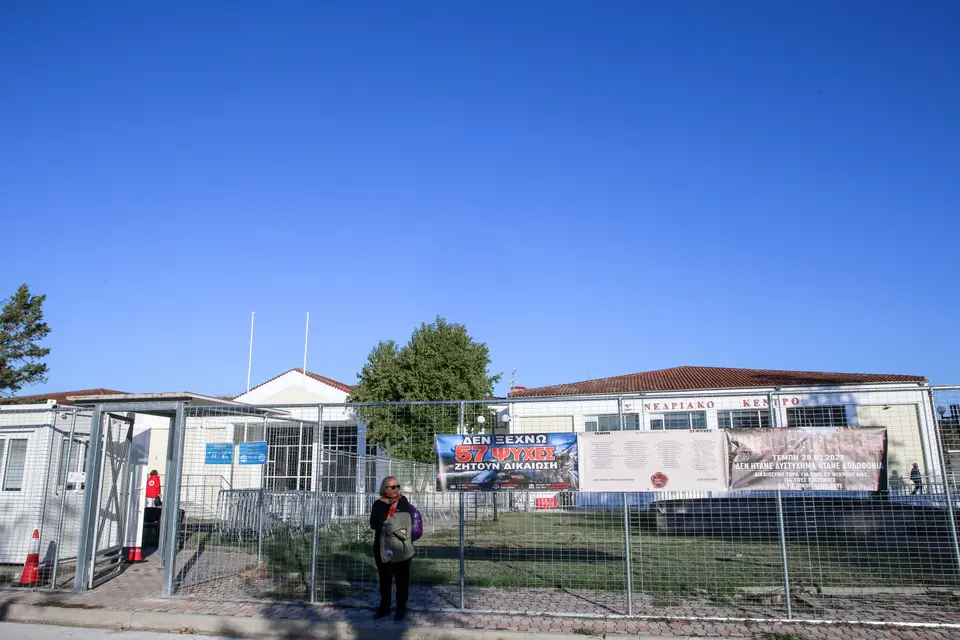
Molcho parents absent – survivors testified about the Tempe collision
The parents of Erietta Molcho did not appear at today's hearing of the Tempe trial, despite their testimony being scheduled, according to To Vima. Their lawyer conveyed to the court that Albertos Molcho and Maria Magireli attempted to prepare themselves to speak, but ultimately were unable to do so.
The family's lawyer announced to the court that a non-profit foundation was established in the name of Erietta the previous week, which is due to commence operations soon. He also mentioned the creation of a named University Chair in Artificial Intelligence at Aristotle University of Thessaloniki in her memory. Erietta was studying architecture. The lawyer also handed to the members of the panel an album containing works that she had created during her lifetime.
Karatsouni's testimony: "I began moving away by crawling"
The hearing began with the examination of Aristides Karatsouni, who was given priority as an injured party. Sitting in a chair in front of the bench, with a calm and steady voice, the survivor described the moments of the collision.
He was travelling from Athens in the first compartment of the second carriage. He was watching a film on his mobile phone when he felt sudden braking and fell forward. Objects were being hurled and passengers were hitting one another. He only managed to put his hand in front of his face before losing consciousness.
"When I opened my eyes I was there, lying down and finding it difficult to comprehend what had happened," he testified. He was struggling to breathe and could not stand upright. He described the smoke, blood, earth and the smell of burnt metal that he still remembers. "I realised that I was not in a position to get up, so I began moving away from there by crawling."
Two days later, a man who was at the scene contacted him and told him that he had been considered dead, had been covered with a jacket and they had continued to help others. After regaining consciousness, he saw fire spreading and heard voices asking for help.
When asked by the presiding judge whether he had heard an explosion, he replied: "My brain has not recorded anything like that." The noise he perceived he characterised as the sound of a collision. In the intense cold, a girl gave him a piece of clothing from her suitcase. With the help of a young passenger, he reached the road, where an ambulance crew collected him.
"I lowered the mirror and saw a face I could not recognise as myself," he said, referring to the moments when he had begun to lose hope. He was taken to the University Hospital of Larissa with head trauma, fractures of the spine and neck, broken ribs and a lung contusion. He clarified that he had not suffered burns.
Xanthopoulos's testimony: Attempt to save Iphigenia
Aristophanes Xanthopoulos, a survivor and partner of Iphigenia Mitska who was killed in the collision, testified about his attempt to extricate her from the third carriage. They were travelling in seats 65 and 67, with their backs towards the direction of train travel – Iphigenia by the window, him in the aisle.
Initially he did not realise that a collision had occurred. He saw Iphigenia with half her body inside the carriage and the other half outside the window. "In one motion I ran and tried to lift her, but she was wedged in some metal sheets. I started calling for help." A fellow passenger from the seats behind them helped him and together they managed to move her.
"I was trying to understand if there was any chance she was alive. I was calling Iphigenia, Iphigenia," he testified. They placed her near the exit. The fellow passenger found his mobile phone and Aristophanes called his father, who urged him to get out and seek help.
He got out through a window and met firefighters, whom he informed that there were people trapped in the third carriage. According to his testimony, the firefighters followed him and he indicated the carriage to them, but they did not allow him to proceed: "They said I was seriously injured." They transported him on a stretcher to the ambulance. He himself had suffered fractures to his limbs and burns.
Answering the presiding judge's questions, he mentioned that the lights went out and that there was smoke and a strong, unusual smell that had remained even in his clothes. He testified that he saw fire beneath their carriage – and that this was the reason he attempted to move Iphigenia. When asked by lawyers whether the firefighters he met carried out fire-extinguishing operations, he answered in the negative.
Testimony about Giorgos Kyriacides
With a broken voice, Dimitrios Kyriacides spoke about his father, 66-year-old Giorgos Kyriacides from Kordelio, Thessaloniki, father of two children and grandfather to seven grandchildren. He described a man who, even when working in America, returned frequently. "I felt him close to me while he was away for a long time," he testified.
When Dimitrios was ten years old, his father returned permanently to Greece and remained close to his children even after they had families of their own. "His loss cannot be filled," he testified, noting that the family is trying to keep his memory alive through shared stories.
Source: To Vima