Fürcht Pál and Magyar Péter: prosecutorial politics after the change of government
On Sunday, Magyar Péter was still criticising Fürcht Pál; on Monday, he was already referring to him as a future witness. Telex details the power restructuring taking place at the prosecution service.
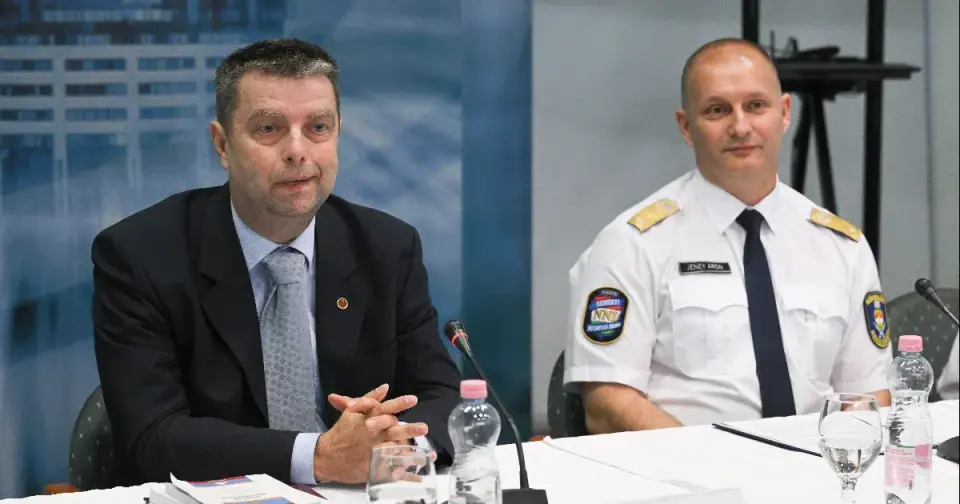
Magyar Péter and Fürcht Pál: a turnaround in one day
On Sunday evening, Prime Minister Magyar Péter criticised Fürcht Pál in a Facebook post – Fürcht, who led the Central Investigation Prosecutor's Office (KnyF) until June – but on Monday in parliament, he referred to him as a future witness who might know a great deal about politically sensitive cases. Telex analysed the rapid turn of events in detail.
In recent months, Fürcht had presented himself to the public as a "repentant prosecutor": he had begun openly stating that the Office of the Prosecutor General had regularly intervened in politically sensitive cases over the years. However, in his Sunday post, Magyar accused him of actually carrying out political orders himself – primarily in cases connected with the Schadl affair. This is the matter that was discussed in a secret recording of a conversation between Magyar and his former wife, Judit Varga, the justice minister at that time, which was later made public.
In the post, Magyar Péter also claimed that in 2024 Fürcht had attempted, as a political provocation on Fidesz orders, to construct a crime against him that could have prevented him from running in the election.
Fürcht's response and the SMS exchange
Fürcht responded that same evening through his legal representative, Lóránt Horváth: he stated that he was "prepared to be available before any competent authority within the framework of official proceedings". On Monday, Magyar reported in parliament that in the meantime he had exchanged SMS messages with Fürcht, and had received the essential statements from him by phone.
The name of Lóránt Horváth is incidentally not unfamiliar in connection with this matter: he represents the Ukrainian money transporters appearing as injured parties in the golden convoy affair. A disciplinary proceeding is currently ongoing against Fürcht within the prosecution service.
Péter Polt's shadow over the prosecution service
Telex recalls that all prosecution service leaders over the past 16 years have come from the circle of Prosecutor General Péter Polt – Fürcht was no exception. Polt maintained particularly close relations with Interior Minister Sándor Pintér and also kept in contact with Antal Rogán.
At some point, Fidesz leadership came to see Polt as no longer paying sufficient attention to matters important to the government. This was even alluded to by Varga Judit herself in the secretly recorded conversation in her flat, in which she told Magyar Péter that Polt "was not in control of the situation". The dissatisfaction ultimately led to Polt being removed in May 2025 – the transition was managed by his move to the Constitutional Court – but since everyone in a leading position during his tenure was considered his man, his successor could also have come from this circle.
Internal power games
According to Telex's information, Tiborn Ibolya was initially considered as Polt's successor – someone who was on good terms with Fürcht Pál within the prosecution service. However, Ibolya – as one of the side threads of the Schadl affair – came into conflict with Zoltán Bolcsik, a trusted figure of the Pintér circle, who at that time headed the National Security Service. The Pintér circle subsequently blocked Ibolya's nomination. Several other names were put forward – including Fidesz-linked Bencé Tuzson – but ultimately Gábor Bálint Nagy became the successful candidate, also on Polt's recommendation.
After the Tisza Party's two-thirds victory, something changed at the prosecution service. The KnyF suddenly became more active, and Fürcht fell out with Gábor Bálint Nagy, Polt's successor, over the golden convoy affair. According to Telex, Fürcht's 180-degree turn is interpreted differently by various people: some see genuine remorse behind it, whilst others believe that certain people within the organisation could see that Nagy's days were numbered, and tried to gain good standing with the new government for their own survival. A third view holds that Fidesz influence and Polt's shadow still hang over the prosecution service, so meaningful change should not be expected if a new leader emerges from within.
Péter Fejes, the compromise candidate
President András Baka ultimately nominated Péter Fejes as prosecutor general – a person who does not come from within or without in the usual sense, as he is being activated again from retirement. According to Telex, this simultaneously provides an answer to the dual dilemma of internal loyalty and external pressure.
For Magyar Péter and the Tisza Party, Fürcht could be an important source of political information if the former prosecutor is willing to comment in future – and can support his claims with evidence. The remarks dropped in the parliament corridors and the evening Facebook post together form another chapter in the internal prosecution service restructuring that has been taking place since 12 April and is difficult to follow.
Source: Telex