Morandi Bridge collapse in Genoa: verdicts awaited for 57 defendants
The trial over the collapse of the Morandi Bridge in Genoa, which claimed the lives of 43 people in August 2018, is approaching conclusion with verdicts awaited for 57 defendants, including former managers, engineers and consultants.
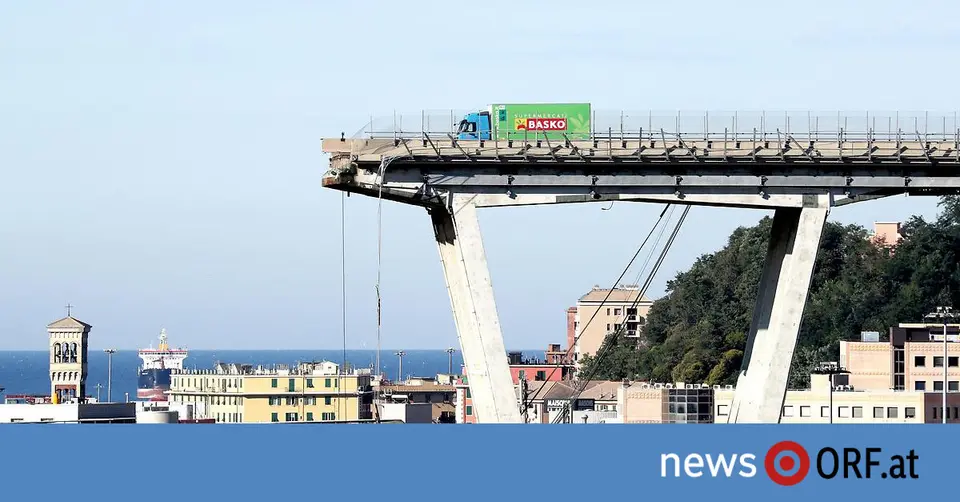
Morandi Bridge collapse in Genoa: verdicts awaited for 57 defendants
On 14 August 2018, in the heart of summer, the Morandi Bridge on the Genoa motorway collapsed during heavy rain. Forty-three people lost their lives in that tragic accident. On Thursday, verdicts are expected for the 57 defendants in the trial, which has now been ongoing for approximately four years.
The charges include manslaughter, wilful injury, obstruction of official acts, falsification of documents and wilful omission of workplace safety measures. Among the defendants are former managers, engineers and consultants from the motorway company Autostrade per l'Italia, as well as from the firm Spea, which was responsible for monitoring the infrastructure. Officials and consultants from the Italian Ministry of Transport are also involved.
According to the Genoa prosecutor's office, the majority of the defendants had become aware of the risk of collapse of the viaduct, which was built in the 1960s, but had not acted to prevent it. It is further alleged that maintenance had been kept to a minimum in order to maximise dividends to shareholders, despite structural damage having been known for some time. The defence contends instead that the collapse was caused by a design defect that was neither detectable nor preventable through ordinary maintenance.
The prosecutor has sought a combined total of almost 400 years' imprisonment for 56 of the 57 defendants. The highest sentence, 18 years and six months, was requested for the former chief executive of Autostrade per l'Italia, Giovanni Castellucci. The latter has already been in prison for over a year, having received a final sentence of six years for the collapse of a viaduct at Acqualonga in 2013, in which 40 people died.
Approximately one and a half years after the start of the trial, in July 2022, Castellucci and nine other former managers reached an agreement with over 190 civil parties, paying sums as compensation. However, the defendants' lawyers stressed that such an agreement does not in any way constitute an admission of guilt, but rather an "act of solidarity".
The investigation established that the collapse was caused by the breaking of the load-bearing cables of the ninth pylon, which had deteriorated over decades due to a corrosive environment. The accident highlighted serious failings in the management of Italian infrastructure. During the collapse, the road surface gave way and vehicles fell from approximately 40 metres in height, in some cases onto dwellings below. Hundreds of people were left homeless.
The Polcevera viaduct, commonly known as the Morandi Bridge after its designer Riccardo Morandi, connected the east and west of Genoa. The four-lane motorway represented an important transit route towards France and the Port of Genoa, Italy's largest port. The structure, inaugurated in 1967 after approximately five years of construction, handled up to a thousand lorries per hour, in addition to a far greater number of cars.
In August 2020, a new structure designed by renowned architect Renzo Piano, named Ponte San Giorgio, was inaugurated, replacing the collapsed viaduct.
Source: ORF.at
Source: ORF