Death of Abderrahim Fakir in Bologna: his family demands truth and justice
A 42-year-old Moroccan died during his arrest by police in Bologna. An investigation has been opened and his family demands that justice be served.
Death of Abderrahim Fakir during an arrest in Bologna: investigation opened, indignation in Morocco and Italy
According to Google News MA — Crime (fr), Abderrahim Fakir, a 42-year-old Moroccan, died after being pinned to the ground by two police officers during his arrest in Bologna, in northern Italy. The Italian prosecutor's office opened an investigation on Monday, the day after the tragedy. The deceased's family demands truth and justice: "He was kind", "he had stable employment", "he didn't cause any trouble", his relatives have repeated since news of his death was announced.
The video that provoked indignation
Excerpts from a video filmed by a resident, widely distributed by Italian media, show the victim being subjected to a prone restraint for several minutes. Having arrived in Italy at the age of 5, Abderrahim Fakir cried out for help repeatedly whilst the two officers held him face down on the ground. Two men in ambulance uniforms, present at the scene, remained motionless. The victim, groaning, subsequently appeared lifeless, his face against the asphalt, whilst the police officers tied his hands and feet. One of them tapped him on the shoulder to check if he was still conscious. He was not.
The Bologna police prefecture stated in a statement that footage from the body cameras of the two officers had been transmitted to the judiciary. The police had intervened after residents reported a man in a state of "violent anger".
Italian political reactions
Italy's government chief, Giorgia Meloni, reacted on X, describing what happened in Bologna as "unacceptable". "It is necessary that any possible responsibility be established with the utmost rigour. The truth must be sought to the very end, without prejudice and without indulgence towards anyone", she wrote. The centre-left mayor of Bologna, Matteo Lepore, called for "full light to be shed" on the events.
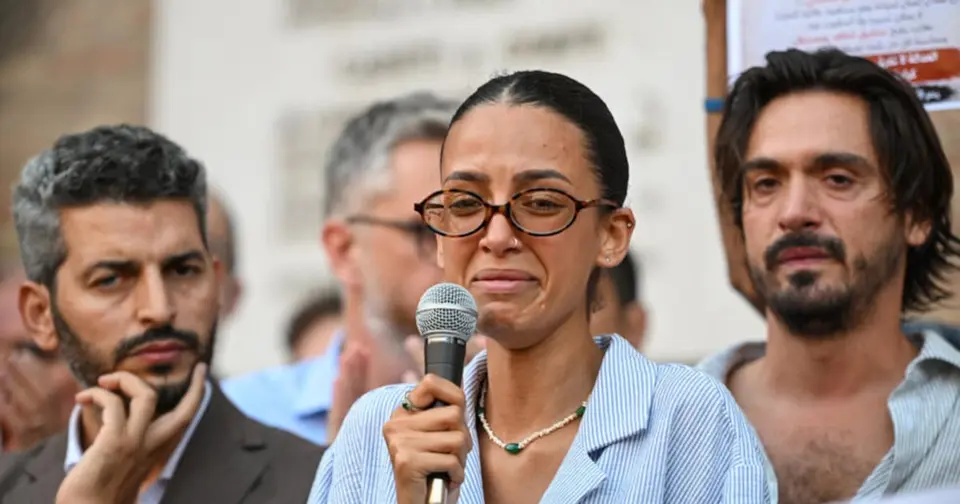
A gathering bringing together several hundred people took place on Monday in the city centre, according to local media. Protesters held banners demanding "justice and truth for Fakir" and denouncing "murderers", in an atmosphere mixing anger and solemnity.
Opposition senator Ilaria Cucchi, whose brother died in detention in 2009, expressed her revulsion at certain messages of "solidarity" addressed to the police, accusing the coalition government of having "encouraged this type of behaviour" through "policies entirely motivated by hatred and racism".
Testimony from his lawyer
Barbara Spinelli, a lawyer registered with the Bologna bar, specialising in asylum law and co-president of the European Association of Lawyers for Democracy and Human Rights, was contacted by Le360. She indicates that she intervened last year to assist Abderrahim Fakir in a request to renew his residence permit.
"We do not yet know the details, but what we know is that he died while he was in the hands of the police", she states. She emphasises that the restraint technique applied is "heavily criticised by the European Court of Human Rights, because the risk of death is very high with this method".
Spinelli describes a man at the opposite end of the spectrum from the image some sought to convey. "His whole family is here, he behaved towards me with great respect. He had great dignity and he was truly responsible, both towards his work and towards his colleagues. He was a very kind person", she recalls.
She notes that he had lived in Italy for more than thirty years, where he had grown up, studied and worked, but that the fear of expulsion had never left him. "I am deeply saddened by what happened to him... Truly, no one should experience what he experienced", she says.
A precedent overlooked: the Magherini case
The lawyer draws a parallel with the case of Riccardo Magherini, who died in Florence in 2014 after being restrained by four carabinieri whilst he begged for help. The European Court of Human Rights had condemned Italy in that case. "This technique must not be used when the person is in a state of agitation, and Italian police must receive specific training and apply the principle of proportionality", Spinelli argues.
She also mentions the investigation opened into the paramedical staff present at the scene, who she says remained without acting. "There is a need for humanity in this world. I am truly shocked", she says. She concludes by calling for public debate to be refocused on human rights: "Racism is transversal, it affects everyone. Racist discourse does no one any good."
The appeal from the family's lawyer
Fabio Anselmo, designated by the family to represent them, published a statement on Facebook calling for the deceased's name not to be forgotten. "Let us remember this name. He died during a police arrest, whilst he was immobilised on the ground. The images show his body crushed on the asphalt, the weight of the officers on his chest, his face pinned against the ground", he writes.
Anselmo likewise recalls the Magherini precedent and poses a question he deems impossible to avoid: "Why did a man die precisely whilst he was being held to the ground, in a position which, in the images, appears to have prevented him from breathing?" The investigation by the Bologna prosecutor's office is ongoing.
Source: Google News MA — Crime (fr)