Genoa verdict: trial over Morandi bridge collapse, 43 deaths and 57 defendants
Eight years after the disaster, the Genoa court concludes the major trial. A total of 400 years in prison requested for manslaughter and other offences.
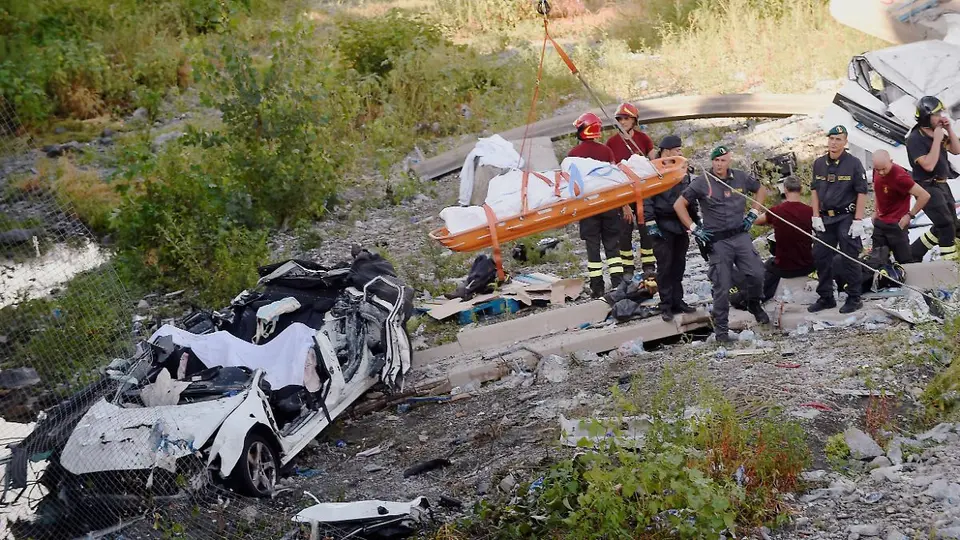
Genoa verdict: trial over Morandi bridge collapse, 43 deaths and 57 defendants
The Genoa court issued its verdict today in the major trial relating to the collapse of the Morandi viaduct, which occurred on 14 August 2018. That morning, shortly before noon, a section of the carriageway gave way, causing numerous vehicles in transit to plummet. The tragic toll: 43 people lost their lives. Images of the collapse rapidly circulated around the world.
Nearly five years after the opening of proceedings, the ruling comes after 382 hearings held within a temporary structure in the courtyard of the courthouse. The prosecutors had collectively sought 400 years of imprisonment for the 57 defendants, charging them with multiple counts of manslaughter, serious injury, endangering traffic safety and falsification of documents.
Investigations by the examining magistrates revealed serious negligence: during the 51 years that elapsed between the opening of the infrastructure (1967) and the structural failure, there is no record of adequate maintenance work on pillar number nine, the one that collapsed. The structural vulnerability had already emerged: reinforcement work had been carried out on twin pillars ten and eleven. Similar work had been planned for pillar nine, but was never executed.
In the dock sit mainly managers from Autostrade per l'Italia (Aspi) and its subsidiary Spea, along with representatives from the Ministry of Infrastructure. Only a minority agreed to answer questions from the court, while a larger group opted for spontaneous statements. Giovanni Castellucci, former head of Aspi, is the recipient of the most severe request: 18 years, as he is deemed responsible for postponing work on the critical pillar. His lawyers contest this account, arguing that the failure should be attributed to a hidden structural defect — corrosion of steel bars inside the concrete — rather than negligent management.
Castellucci is already in prison following a conviction for another incident: in 2013, in Puglia, a bus crashed through the protective barriers of a viaduct causing 40 deaths.
The companies Aspi and Spea avoided trial thanks to a settlement of 29 million euros with the prosecutor's office. At the time of the disaster, both belonged to the Atlantia group, owned by the Benetton family, which sold its stakes to the Italian state in May 2022 under public pressure.
The majority of the victims' families accepted compensation offered by the company, totalling more than 60 million euros. Two families refused, including that of Egle Possetti, president of the committee of victims' relatives, who lost four close relatives. She chose to take civil action to influence the court's decisions. "We hope for exemplary convictions, but for those who remain the essential thing is that the truth finally emerges," she declared. "Unfortunately, no one will be able to return our loved ones to us."
In the immediate vicinity of the trial location, a memorial to the victims has stood since 2020, alongside the new viaduct, designed by renowned Genoa architect Renzo Piano.
Source: n-tv