Drug offences in Kėdainiai district: 64 incidents, majority on J. Basanavičius Street
From the start of the year to 5 November, 64 criminal offences related to drugs have been recorded in Kėdainiai district. Suspicions have been raised against approximately 50 people.
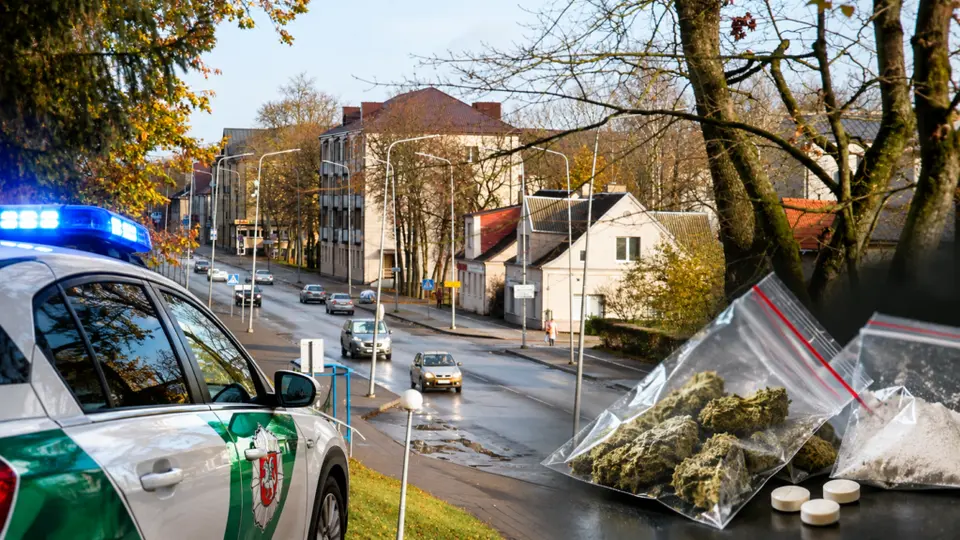
Drug cases in Kėdainiai district – 64 offences: most incidents on one street
From 1 January 2026 to 5 November, the Kėdainiai district police registered 64 criminal offences related to unlawful possession of narcotic or psychotropic substances. This is one offence more than in the same period last year, when there were 63 such cases. The data was provided to muge.eu by the Kėdainiai district police commissioner's office in response to a request from the news portal's editorial team.
Police officers emphasise that there is no significant increase in the number of criminal offences – the year-on-year difference does not provide grounds to speak of a growing trend.
Public places and vehicles – the most common detection locations
According to police data, approximately 44 per cent of all drug-related incidents recorded this year were detected in public places – streets, courtyards and other open spaces. Approximately 30 per cent of cases involved substances found in vehicles, approximately 17 per cent in residential premises. The remaining cases were identified in other locations.
Plant-based narcotic or psychotropic substances are most frequently detected – they account for approximately 55 per cent of all recorded incidents.
On 3 and 4 November, materials showing signs of narcotic or psychotropic substances were detected during checks of vehicles and their drivers. Police indicate that these cases were identified not through a separate targeted operation, but during routine checks.
J. Basanavičius Street – the most incidents
The information provided by the police highlighted a specific location in Kėdainiai city – J. Basanavičius Street, where the majority of offences related to narcotic substances were recorded this year.
However, police officers emphasise that a higher number of recorded offences on a specific street does not in itself mean that narcotic substances are more prevalent there than in other parts of the city. The more active police work and checks conducted in that area may have influenced this.
Suspicions – approximately 50 people, no minors among them
Suspicions have been raised against approximately 50 people for criminal offences related to narcotic or psychotropic substances committed in Kėdainiai district this year. Approximately 13 per cent of them are under 25 years old.
Police indicate that no suspicions against minors for such offences have been raised in the district this year. However, officers draw attention to the fact that statistics on recorded criminal offences alone do not allow for conclusions to be drawn about whether drug use among young people is increasing or decreasing.
Around 10 investigations – into distribution
This year, approximately 60 pre-trial investigations were opened in Kėdainiai district regarding unlawful possession of narcotic or psychotropic substances. Of these, approximately 10 investigations were opened regarding the distribution of these substances.
How many investigations have been completed, how many have been referred to court and how many individuals have received guilty verdicts cannot be determined from the data provided by the police.
Police emphasise that the number of detected criminal offences is also influenced by the activity of the officers themselves – targeted and preventive measures, proactive checks, and information received from residents. Therefore, a higher number of registered incidents does not necessarily indicate increasing drug use or distribution in the district.
21 lectures in schools, patrols near educational institutions
Although no suspicions against minors for drug-related offences have been raised this year, special attention has been paid to prevention. In the first half of 2026, community officers conducted 21 preventive lectures in educational institutions in the district and implemented five activities under the "Drugs – NO" initiative.
Students are informed about the risks of using narcotic, psychotropic and other psychoactive substances and electronic cigarettes, legal responsibility and possible consequences for the future.
The Kėdainiai district police commissioner's office cooperates with the municipal authority, educational institutions, the Public Health Bureau, the Education Support Service and child protection specialists. In implementing the 2024–2027 programme for reducing and preventing the use of dependency-inducing substances, officers conduct public and non-public patrols near educational institutions and youth gathering places.
Concerns over electronic cigarettes among minors
The attention of institutions is required not only for narcotic or psychotropic substances – police also draw attention to the use of electronic cigarettes among minors. According to police assessment, responding to offences already committed is not enough: it is important to identify risky behaviour among young people as early as possible and involve families and specialists in prevention.
Residents are invited to report to police about possible drug distribution in the district.
Source: Google News LT — Crime (lt)