Manuel Pinho released after nearly five years of house arrest in EDP case
Lisbon's Central Criminal Court ordered the release of former minister Manuel Pinho, who is banned from leaving the country. The decision results from a sentence reduction by the Supreme Court of Justice.
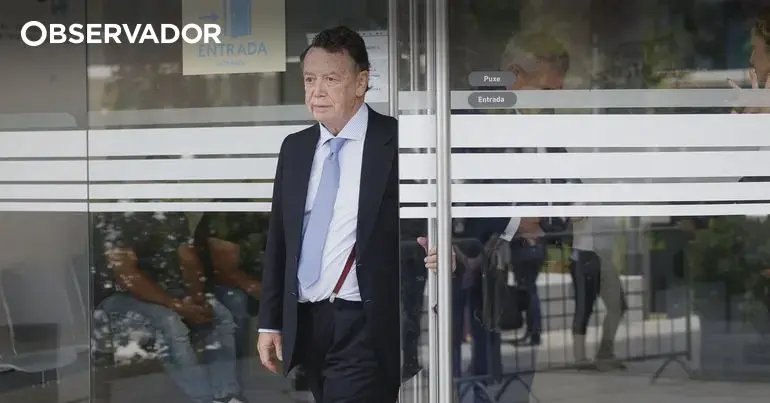
Former minister leaves house arrest but is banned from leaving Portugal
Former Minister of the Economy Manuel Pinho was released on Friday after nearly five years of preventive detention at home in connection with the EDP case, according to information accessed by observador.pt. Judge Ana Paula Rosa of Lisbon's Central Criminal Court also determined that Pinho is prohibited from leaving the country.
The decision follows an alteration of the sentence by the Supreme Court of Justice (STJ), which reduced the conviction from 10 years of effective imprisonment to eight years and six months, for two counts of passive corruption for unlawful acts, one count of tax fraud and one count of money laundering. This reduction automatically resulted in the maximum period of preventive detention being exceeded in accordance with the law.
The law establishes that the maximum period of preventive detention cannot exceed half of the effective sentence imposed. As Pinho had been imprisoned at home for nearly five years, the limit corresponding to half of the new sentence — eight years and six months — had already been surpassed.
Lawyer Ricardo Sá Fernandes had requested his client's immediate release shortly after the STJ's decision. Both the Public Prosecution Service and Judge Ana Paula Rosa ruled in favour of the defence, declaring the "measure of restraint of Obligation to Remain at Home applied to defendant Manuel Pinho ceased". In its place, a ban on departure to foreign countries was imposed.
The sentence of eight years and six months has not yet become final: Sá Fernandes had already announced an appeal to the Constitutional Court, which determined the suspension of sentence execution and the consequent closure of the criminal case against the former minister at this stage.
Lisbon's Criminal Court and Lisbon's Court of Appeal — whose factual conclusions the STJ did not contest — established as proven that Manuel Pinho was corrupted by former banker Ricardo Salgado to benefit companies of the Espírito Santo Group (GES). In return, Pinho allegedly received approximately 15,000 euros per month, paid through the so-called "blue bag" of GES in accounts in Switzerland opened in the name of various offshore companies. These payments occurred throughout the entire period when Pinho held office as Minister of the Economy in the government of José Sócrates and continued after his departure from the executive.
In a statement sent to news outlets, the former minister stated that the end of house arrest restores "legality" and ends an "intolerable disproportionality", expressing a "feeling of profound gratitude". "Today's decision does not erase the years of unwarranted confinement or the persecution and unjust suffering endured by my family, but it puts an end to an intolerable disproportionality. The full restoration of material truth and honour continues now with total serenity and firmness before the Constitutional Court and international bodies," he wrote.
Pinho added: "After nearly five years subject to a measure depriving me of freedom at home without a final sentence — a situation without parallel in democratic Europe — legality has today been restored with my restoration to full freedom. There is no place for celebrations, but rather a feeling of profound gratitude." The former minister expressed words of appreciation to his family and to the "many true friends" who, he said, "never abandoned us".
Source: Google News PT — Crime (pt)