Rimavská Sobota commemorated the deportation of nearly a thousand Jews 82 years ago
A solemn commemoration was held in Rimavská Sobota for the deportation of Jewish residents on 5 June 1944. Nearly a thousand people were taken away to the station during the night and later deported to Auschwitz-Birkenau.
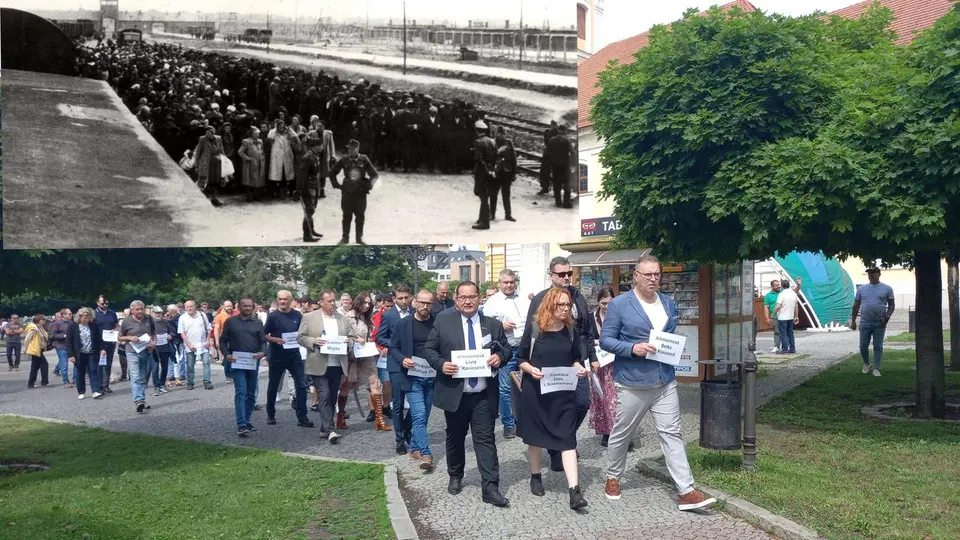
Night march through city streets: 82 years since the deportation of Jews from Rimavská Sobota
According to Nový Čas, on Friday 5 June, dozens of people walked from Rimavská Sobota's town square through the city streets to the railway station — the same route their ancestors had walked on the fateful night of 5 June 1944. Each participant in the commemoration carried a piece of paper with the name of a person who was part of the transport from southern central Slovakia to a concentration camp.
"The deportations of 5 June 1944 cut deeply and irreversibly into the fates not only of the Jewish population. Nearly a thousand people disappeared from the city. Neighbours, shopkeepers, doctors, children," said Miroslava Čierna from the civic initiative Rimavská kaviareň, which organised the event.
Three collection camps and cattle wagons
Three collection camps — so-called ghettos — existed in Rimavská Sobota, where residents marked with the Star of David were concentrated. One was located on Tomašova Street, another on Bartóková Street, and a further one in the building of the grammar school. On the night of 4 to 5 June, approximately a thousand people were taken to the railway station. Responsibility for the deportations was borne by the then mayor, local police, the army and ordinary residents of the city.
The deported were subsequently transported to a collection camp in Salgótarján, and on 13 June 1944 from there deported to the Auschwitz-Birkenau concentration camp. A day later, the county chief reported to his superior that Rimavská Sobota had been "cleansed of Jews".
"Although there is general awareness of historical transports from other towns in Slovakia, very few people today know about the mass night march through the streets of Rimavská Sobota," Čierna added.
The testimony of Kornélia Wirtschafterová
A living witness to the transport is Kornélia Wirtschafterová, who was 17 years old at the time of the deportation and survived four concentration camps. She was unable to participate in Friday's commemoration due to health problems. Her recollections are preserved in a book authored by Oľga Bodorová, the former director of the Gemersko-malohontské Museum in Rimavská Sobota.
Kornélia Wirtschafterová described the fateful night as follows: "The work of destruction began on a summer evening from 4 to 5 June 1944. Around 11 p.m. that night, all Jews were woken. Women, men, children, infirm elderly men and women. The ghetto began slowly to empty. With harsh shouts in Hungarian — 'Move, Jews' — armed gendarmes drove sleepy people from the temporary camp. Armed gendarmes led the ordered column through side streets towards the distant railway station. Many stumbled in the darkness, looking to see whether they could find a rescuer among the locals. All glances, all silent pleas went unanswered. The streets were deserted in the night hours. No one intervened."
Wagons awaited at the station — but not passenger ones. "They were cattle cars that just a few days earlier had been transporting livestock. People looked on in incomprehension. Gendarmes with bayonets on their rifles forced them to climb quickly into the wagons. It smelled of cattle. The smell was unbearable," Wirtschafterová continues in her recollections. As many people as possible were crammed into one wagon — approximately 85 people were allotted two buckets. One with water, the other empty, serving as a toilet. This supply was meant to last three days. Then the wagons were sealed and the long train with about 12 wagons began to move.
The second generation: "The whole family died during the war"
The commemoration was also attended by Mária Rybárová from Rimavská Sobota, whose parents were part of the transport from southern central Slovakia. Both managed to survive the Holocaust. "My mother survived the Holocaust, she was in Auschwitz. My father lost his entire family there. He was already married by then and also lost his 12-year-old daughter. No one from my mother's or father's side survived," said Mária Rybárová.
After their return, her parents met each other and began a new life together — and so Mária was born. "My parents taught me that I had nothing to be ashamed of. And if someone had inappropriate things to say, I should speak up — and I always did. Children my age did not know what a Jew was. I told them: you have grandparents, relatives, you have somewhere to go on holiday, I have no one because my whole family died during the war. That always settled it," she added.
Her parents did not speak much about what they had endured. "I think they wanted to spare us and probably found it difficult to speak about it themselves. We felt that we could not ask when they were not speaking," Mária Rybárová explained.
Deportations in the context of the HSĽS regime
The first transport dispatched by the Hlinka Slovak People's Party (HSĽS) regime left on 25 March 1942 from Poprad — deporting nearly a thousand young Jewish women and girls from various districts of eastern Slovakia directly to Auschwitz. The HSĽS regime proceeded to deportations after years of systematic anti-Jewish policy linked to the Aryanisation of property, as a result of which two-thirds of Jews living in Slovakia by the end of 1941 had no means of livelihood. Representatives of the Populist regime approved the deportations on the basis that Slovakia would pay the Third Reich a set fee for each person deported.
Source: Nový Čas