348 kg of cocaine and marijuana seized from lorry at Danube Bridge 2 near Vidin
Customs officers discovered the narcotics in a hidden compartment and amongst pallets of pistachios. The detained driver is a Bulgarian citizen.
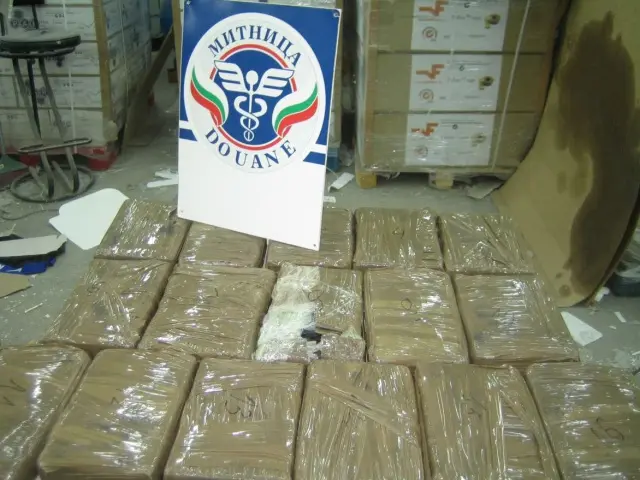
Lorry carrying pistachios concealed 348 kg of narcotics at border checkpoint near Vidin
Bulgarian customs officers have seized over 348 kilograms of cocaine and marijuana from a lorry registered in Bulgaria at the "Danube Bridge 2" border checkpoint near Vidin, according to Novinite.com, citing the Customs Agency.
The inspection was carried out late in the evening of 8 October, when officers controlling vehicles entering from Romania stopped the lorry. According to its transport documents, it was carrying a consolidated shipment from Spain for various recipients in Bulgaria and Greece.
Following an initial inspection, the lorry was directed to Vidin Customs for more thorough examination.
False bottom and vacuum-sealed packages
During the detailed inspection, officers discovered a specially constructed false bottom extending along the entire length of the trailer. In the hidden compartment, 16 packages of white powder were found, with a total weight of 19.324 kilograms. A field narcotics test showed that the substance was cocaine.
The search of the cargo continued with the assistance of a specially trained customs dog named Hera. The animal reacted to part of the shipment, whose transport documents indicated it was destined for a recipient in Greece.
When officers removed the packaging film from the pallets, packages of pistachios were discovered in the upper rows of the boxes. The lower two rows, however, concealed vacuum-sealed packages containing dried green plant material.
During the search, 190 packages of marijuana weighing 329 kilograms were seized, bringing the total quantity of confiscated narcotics to over 348 kilograms.
Driver detained and refuses to give statement
The driver of the lorry — a Bulgarian citizen — has been detained. Deputy regional prosecutor of Vidin Vladislav Vlashev reported that the individual refused to give a statement to investigators.
The case was presented at a briefing on 12 October by Vlashev, Ivo Poakov — head of the "Anti-Drug Trafficking" department at the Territorial Directorate of Customs Ruse, and Volodya Bogdanov, director of the same directorate.
Preliminary criminal proceedings have been initiated, which are being conducted by an investigating customs inspector under the supervision of the Regional Prosecutor's Office in Vidin. The case is being prosecuted under Article 242, Paragraph 2 of the Penal Code — an offence related to cross-border trafficking of high-risk narcotics without the necessary authorisation. The prescribed punishment is deprivation of liberty from 10 to 15 years and a fine of €50,000 to €100,000.
The court is expected to rule on the preventive measure for the detained driver. Physicochemical expertise and evaluation analyses of the seized substances are also pending, to establish their exact type, quantity and value.
Record quantity for Vidin region
Poakov stated that the 329 kilograms of marijuana represent the largest quantity discovered in a similar case at the Vidin border checkpoint.
He also recalled that earlier this year joint operations by customs officers and the General Directorate for Combating Organised Crime led to the seizure of over 500 kilograms of marijuana in the area of Danube Bridge near Ruse.
Bogdanov explained that the inspection is part of enhanced compensatory measures introduced by the Customs Agency following Bulgaria's accession to the Schengen Area. The measures aim to combat drug trafficking, smuggling and other customs violations despite the elimination of routine checks at internal Schengen borders.
The investigation continues. The origin of the narcotics, the identity of the recipients and all circumstances surrounding the organisation of the shipment are yet to be established. Enquiries are also being made into whether the companies involved in the transport had complicity in the offence.
Source: Novinite.com