Sabotage at substations: suspect from Gevelsberg confesses in two letters
An alleged saboteur has confessed in two handwritten letters to attacks on electricity supply in Brandenburg and North Rhine-Westphalia. Police are searching for the German born in 1977.
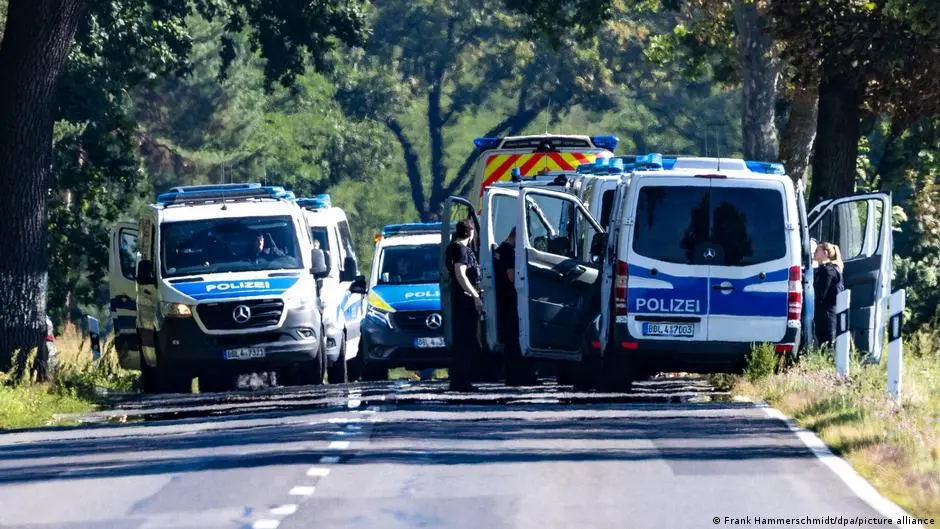
Confessional letters on power grid attacks – police search for German from NRW
Following a series of alleged sabotage attacks on electricity supply in Brandenburg and North Rhine-Westphalia, police are searching for a German national from Gevelsberg. As reported by Deutsche Welle, investigators believe two handwritten confessional letters from the man to be authentic – supported by detailed perpetrator knowledge contained within them.
In a first letter, the author states that he caused "short circuits in the electricity grid around the Jänschwalde and Schwarze Pumpe power plants". As a motive, he cites resistance to fossil fuel power generation, which he describes as a crime. He accuses the media and the state of inaction. According to an attached sheet, he describes the technical execution of the acts in detail – a central reason why investigators do not question the authenticity of the letters.
Furthermore, the author references the Middle East conflict and accuses Germany of supporting a "genocide in Palestine". He states that he planned and carried out the acts alone, without involving anyone else.
In a second letter, he claims responsibility for further attacks on electricity supply in Gohr, Bergheim-Rheidt, Dormagen and Weisweiler in North Rhine-Westphalia. Both letters bear a full name as a signature. Whether this actually corresponds to the author remains unresolved according to investigators.
The alleged perpetrator is believed to be a German born in 1977 from Gevelsberg. Police already searched his place of residence on Thursday but did not find him there.
Operations in Weisweiler and Dormagen
Following clues from the confessional letters, numerous emergency services descended on the Weisweiler power plant near Aachen on Friday. Forensic officers in protective suits and breathing apparatus examined several spots in a field and in a bush in the immediate vicinity of the power plant and a substation in Eschweiler. Police confirmed only that they were pursuing "leads" there; results of the examination were not initially disclosed.
On Thursday evening, a pedestrian had discovered a suspicious object at a substation in Dormagen. According to police, it is believed to be a type of launching device – similar to those previously found at substations in Bergheim near Cologne and near the Jänschwalde power plant in Brandenburg. These devices were used to fire conductive material into power lines to trigger short circuits.
All-clear was given, however, after an operation in Ganderkesee in Lower Saxony: police there merely found an open switchgear cabinet at night. A comprehensive inspection revealed neither damage nor persons on the premises.
Federal Interior Ministry sees connection to elections
The Federal Interior Ministry considers it possible that the increased frequency of sabotage attempts is connected to upcoming state elections. A ministry spokesperson stated in Berlin that in the context of the elections there is an "expectation that this can increase". Elections are being held in Saxony-Anhalt this Sunday, and in Berlin and Mecklenburg-Western Pomerania on 20 September.
In response to the attacks in Brandenburg, the state interior ministry announced a new security centre for the protection of critical infrastructure. "The signs are pointing to both attacks being part of a coordinated assault on our energy supply," said Brandenburg Interior Minister Jan Redmann.
More than 165 suspected sabotage cases this year
Christian Bruch, chief executive of Siemens Energy, warned that Germany's energy infrastructure is being attacked more heavily than in other European countries. "We must acknowledge that critical infrastructure cannot be fully protected. In my view, the threat level has increased significantly over the last twelve to eighteen months," Bruch told the German Press Agency. He called for rapid development of a civil operations plan to respond to crisis situations and pointed to possible hybrid attacks as the background.
A research consortium comprising Süddeutsche Zeitung, WDR and NDR has access to a confidential threat assessment from the Federal Criminal Police Office (BKA). According to this, authorities have registered more than 165 suspected sabotage cases in Germany this year – as of end of August – including espionage activities.
Source: Deutsche Welle