Explosive devices at power substation in Brandenburg – sabotage attempt on electricity grid
Homemade explosives were found at a substation in Turnow-Preilack. Minister President Woidke speaks of an "attempted attack".
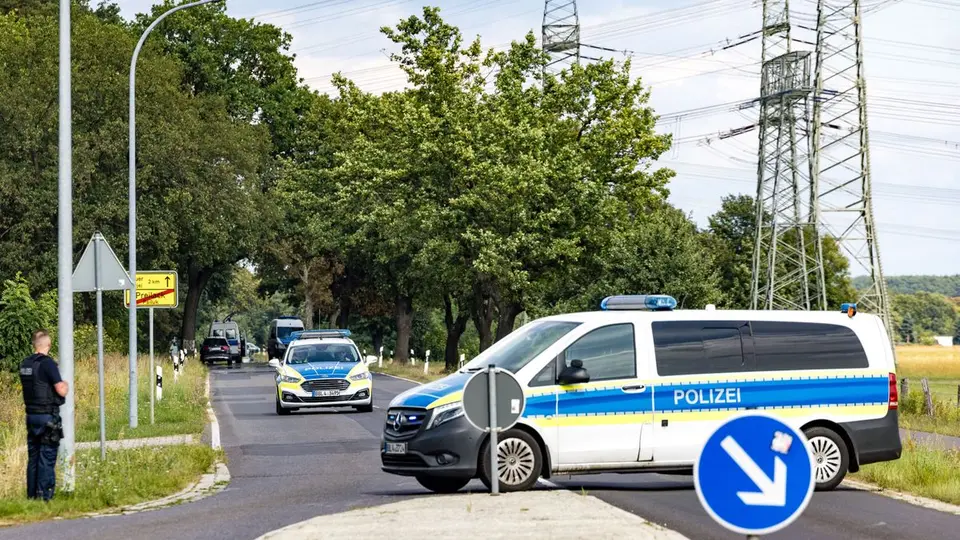
Sabotage attempt at Brandenburg substation near Jänschwalde power plant
Homemade explosive devices have been discovered at a power substation in Turnow-Preilack in Brandenburg. As reported by DER SPIEGEL (Justice & Crime), police have cordoned off the facility extensively; bomb disposal experts were deployed on site.
Brandenburg's Interior Minister Jan Redmann (CDU) described the incident as systematic. "In two cases, it was possible to introduce conductive material into the high-voltage line," Redmann explained. The aim had been to cause a short circuit through this material. In further cases, this unfortunately did not succeed, according to his statement.
Homemade projectiles resemble New Year's Eve fireworks
Transmission system operator 50Hertz stated that, based on current findings, these were homemade projectiles resembling commercially available New Year's Eve fireworks. "Additional projectiles that had not yet been launched were found on site," the company said in a statement. Police also confirmed small, homemade explosive devices.
Redmann also reported a visible fireball – presumably the result of a short circuit in a high-voltage line that went into the ground. A detonation of an explosive device could not be confirmed so far.
Jänschwalde power plant: Block B fails
Energy company Leag, which operates the Jänschwalde coal-fired power plant, is treating the incident as a deliberate attack. The electricity generated at the power plant is fed into the 50Hertz network via the affected substation. "As a result, there was a technical failure of Block B at the power plant," a company spokesman said. A connection between the failure and the devices found is being examined.
General electricity supply was not affected at any time, according to 50Hertz. Police detected a possible case of property damage to a line at around 8 a.m. on Tuesday. Evidence was secured. The Brandenburg State Criminal Police Office has taken over the investigation.
The "Märkische Allgemeine" reported, citing security and business circles, that emergency personnel found and defused several devices consisting of rockets equipped with explosives.
Woidke condemns "attempted attack"
Brandenburg's Minister President Dietmar Woidke (SPD) condemned the act as an "attempted attack". "The alarmingly high frequency of such incidents shows that we must resolutely protect our infrastructure," he stated. Through the swift and sensible action of the emergency personnel and employees on site, worse was prevented. No one was injured.
The Preilack substation in Spree-Neiße district is located near the border with Saxony and distributes electricity generated in Jänschwalde both regionally and across larger areas. The power plant itself was constructed between 1976 and 1989 as the last power plant built by the GDR; all power plant blocks are to be finally shut down by the end of 2028.
The circumstances of the incident and a possible motive of those responsible remained unclear at first. Interior Minister Redmann later spoke of sabotage.
Series of attacks on electrical infrastructure
The incident is part of a series of similar sabotage acts. In January, suspected left-wing extremists set fire to high-voltage lines near a power plant in south-west Berlin. Around 45,000 households and more than 2,200 businesses and firms, including hospitals and care homes, were without electricity for days. The so-called Vulkan groups claimed responsibility for the arson attack and cited the fight against capitalism as their aim.
In March 2024, a group set fire to an electricity pylon that also supplied the Tesla factory in Grünheide near Berlin. The plant's production was halted for days as a result.