Ecuador seizes over 160 tonnes of drugs in 2025: value reaches $24.56 billion in international markets
Ecuador's Interior Ministry has recorded over 160 tonnes of alkaloids seized up to the fourth week of September. In Oceania, that cargo could reach $24.56 billion.
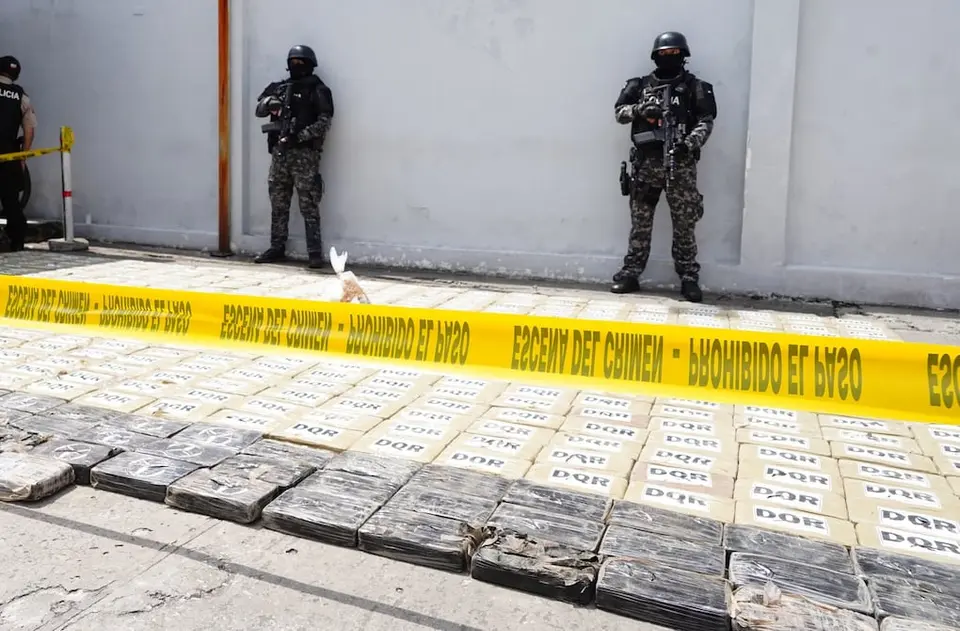
160 tonnes of drugs seized in Ecuador: weight equivalent to 100 automobiles
Buried in rural plots in Manabí, concealed in export shipments at Posorja port or stored on farms in Santa Elena: these have been the scenarios of recent seizures carried out by the Security Bloc, which in successive operations has seized at least four tonnes of drugs in each intervention. According to reports from eluniverso.com, Ecuador's Interior Ministry has accumulated over 160 tonnes of alkaloids seized in 2025 so far, as of the fourth week of September.
A National Police source indicated that quantifying that figure is complex, but offered a visual reference: it would be approximately equivalent to the weight of 100 light vehicles or 80,000 concrete blocks, material sufficient to construct about 80 small homes, estimating 1,000 blocks per unit. "Beyond the number, the comparison allows us to understand the magnitude of the problem facing the country," said the specialist source.
Figures approaching those of previous years
Current records are approaching those of previous years. In all of 2025, 227 tonnes were seized, while in 2024 the figure reached 294 tonnes, according to official data.
Cocaine is the main irregular substance seized. It enters through clandestine routes from neighbouring countries, primarily Colombia, and is stored in collection centres before being dispatched by sea or air to North America, Europe and other regions of the world. In recent years, Ecuador has been classified as a transit country and characterised as a hub for drugs coming from Colombia bound for those markets.
Value in international markets: up to $24.56 billion
The police source consulted warned that the value of what was seized varies depending on the type of substance, its purity and the destination country. The estimates, according to their words, reveal "the enormous profitability of this business": in the domestic market, the 160 tonnes would have an approximate value of 364 million dollars; in the United States, about 4.8 billion; in Europe, around 7.48 billion; and in Oceania, up to 24.56 billion dollars. "The further the drug travels, the greater the economic value that organised crime obtains," explained the source.
As for prices per kilogramme, cocaine hydrochloride is at around 1,400 dollars at the northern border and 1,200 dollars at the southern border. Cocaine base paste registers around 600 dollars per kilo in the north and 900 in the south. Heroin reaches 6,500 dollars per kilo in the north, while marijuana ranges between 600 dollars in the north and 700 in the south.
Minister Reimberg: "The route has become expensive"
Interior Minister John Reimberg highlighted in a recent radio interview that the continuous operations of law enforcement are directly impacting the economy of organised crime. "Today the kilo of drugs is for more than double the price when moving from Colombia to Ecuador. Why does that happen? Because the route has become expensive due to the controls we are putting in place," he said.
Reimberg characterised that increase in logistical cost as a "thermometer" that shows that criminal networks are forced to seek alternative routes through other countries, given that Ecuador "has made that work difficult which they previously had easy". The official also stressed that, by hitting the logistics, not only is it prevented that the substance reaches its destination, but the return of illegal money that finances local gangs is halted. Ecuador is also sharing intelligence with other nations about suspicious cargo to weaken structures from the outside.
Joint patrols with the United States in the Pacific
As part of international cooperation with the United States, two vessels equipped with aircraft, along with the Ship Jambelí, patrol national and international waters to monitor drug trafficking and other crimes. In the Pacific, American units have intercepted over eight vessels linked to Los Choneros, which would have operated as motherships for speedboats transporting drugs.
Defence Minister Gian Carlo Loffredo explained in a recent interview with eluniverso.com that the increase in maritime interdictions would generate a direct effect on the continent: as the sea becomes riskier for gangs, they would reduce their shipments via that route, causing a "backing up" of drugs on land and a consequent increase in seizures in Ecuadorian territory. "What is going to happen is that the drugs are probably going to back up in the continental part," said Loffredo, highlighting the deterrent role of the patrols.
Source: Google News EC — Crime