Ten arrested after opening fire on Civil Guard officers in Huelva coastal waters
A drug trafficking speedboat fired on a Customs Surveillance Service patrol vessel during a night pursuit. The subsequent operation resulted in the seizure of six tonnes of hashish.
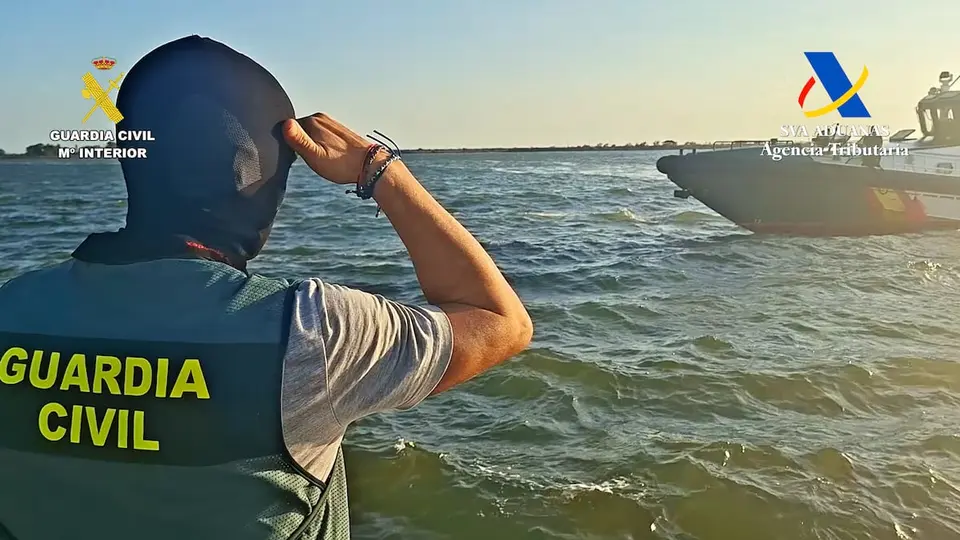
Ten arrested after opening fire on officers in Huelva waters
The Civil Guard has dismantled a criminal organisation whose members fired on a Customs Surveillance Service patrol vessel during a night pursuit off the Huelva coast, according to El País. The subsequent operation resulted in ten arrests and the seizure of almost six tonnes of hashish.
The incident occurred in the early hours of Monday to Tuesday this week. The customs team located a semi-rigid boat allegedly transporting drugs and began tracking it. The crew members performed evasive manoeuvres which the Civil Guard described as "extremely dangerous", placing "the officers' lives in grave danger". To hinder the patrol vessel's navigation, they threw some of the bundles they were carrying overboard. Subsequently, they opened fire on the officers.
The officers returned fire and wounded one of the drug traffickers. The patrol vessel suffered damage and was forced to abandon the pursuit. The criminals managed to escape and shortly afterwards left their wounded colleague on a beach on the Cádiz coast; from there he was taken to Puerto Real hospital.
The following morning, the Civil Guard headquarters in Huelva launched an operation to locate the vessel and its crew. This Thursday, officers boarded the boat and arrested nine people, as well as intercepting a second support vessel at sea. The tenth arrest was the wounded trafficker who had been abandoned on the Cádiz shoreline. The investigation remains open to determine the individual responsibilities of each organisation member and their specific participation in the attack.
Escalation of drug trafficking in Huelva and Andalusia
Data from the Centre for Intelligence against Terrorism and Organised Crime (CITCO) shows that hashish seizures in Huelva province doubled to 43 tonnes during 2025, indicating the growing significance of drug trafficking in the area. Violence against security forces has followed the same trend.
Three months ago, in May, two Civil Guard officers died when two vessels from the Huelva Headquarters' Maritime Service collided whilst pursuing another drug trafficking speedboat. The Unified Association of Civil Guard Officers (AUGC) issued a statement at the time accusing the Interior Ministry of ignoring "warnings" about the risk faced by officers in the fight against drug trafficking.
A few weeks later, in June, another group of drug traffickers fired long-range weapons at the Civil Guard during a failed hashish unloading in the Punta Umbría estuary, on the Huelva coast, with no casualties. Lucas Lavilla, AUGC spokesman in Huelva, reiterated on that occasion the situation of "risk" that officers face in the face of "extreme violence" from drug trafficking, whose access to weapons—from handguns to assault rifles—has continued to grow. Police sources point out that organisations use these weapons primarily to protect themselves from rival groups and prevent so-called vuelcos—drug thefts between gangs—although they also use them against security forces.
The phenomenon extends across Andalusia as a whole. Also in May, the Audaz patrol vessel of the Customs Surveillance Service was rammed by a semi-rigid boat during a pursuit off the Almería coast. In November 2025, a 45-year-old National Police investigator was seriously wounded after receiving several long-range weapon shots—which pierced his bulletproof vest—during an operation against drug trafficking in Isla Mayor, Seville. The officer belongs to the Special Response Group for Organised Crime (Greco) in Jerez de la Frontera.
One of the most serious incidents in recent times occurred in Cádiz province, when a drug trafficking speedboat rammed a Civil Guard zodiac in Barbate port, causing the death of two officers and leaving four others wounded. Those responsible for that attack will be tried by a jury.
Source: El País