Paris fast-track trials after riots: pupils, homeless people and professionals in court
Following the unrest of 17 October, French courts are ruling at speed on approximately 2,700 defendants. NZZ was present at Paris criminal court.
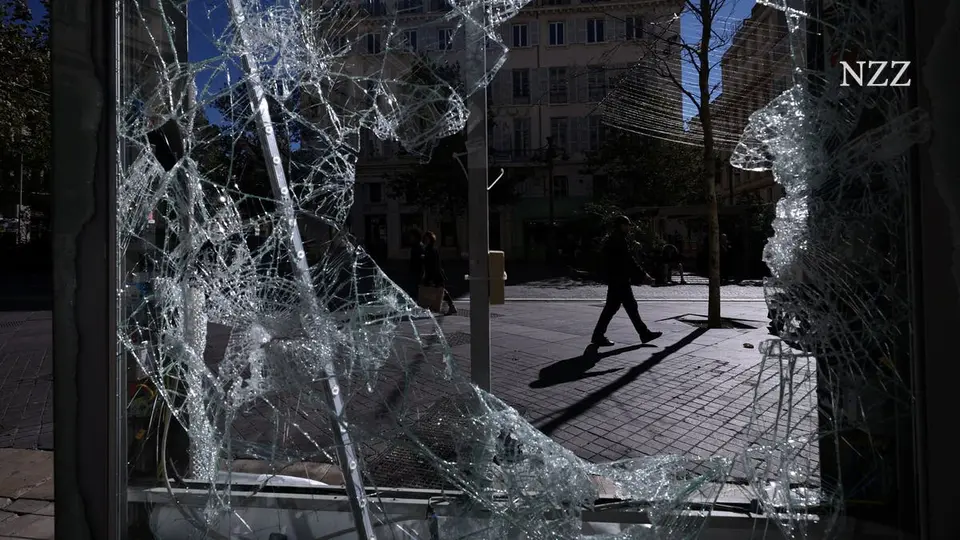
Four courtrooms, hundreds of cases: Paris judges at speed
Room 6.01 on the sixth floor of the Tribunal de Paris, an afternoon shortly after the riots of 17 October: when his name is called, the young man looks questioningly at the police officer. Only after a nod does he step up to the microphone. Grey hooded sweatshirt, black jogging trousers, bleached streaks in his dark curls. His voice is barely audible.
NZZ reports on how Paris criminal court is ruling in accelerated proceedings — the so-called comparutions immédiates — on alleged looters and vandals. The court has set aside four courtrooms for this purpose. Already in the morning, long queues form in the corridors.
An 18-year-old with shop plans and stolen groceries
A., 18 years old, with no criminal record, stands before the court because he stole food from a Monoprix supermarket. He has admitted to the act. The judge pauses: "So you have completed your baccalauréat and want to open your own shop?" — "Yes, Madame." — "And how would you feel if someone came into your shop and stole goods from there?"
A. is one of approximately 2,700 defendants who were taken into police custody following the riots. He had initially hidden his booty and later retrieved it; recordings of the riots were found on his mobile phone. According to the prosecutor, he is alleged to have written in a message that there was "more to take". The prosecution is seeking six months on probation and community service.
His defence lawyer disagrees: her client had incriminated himself, friends had drawn him in, and the 48 hours in custody had already been a severe burden on him and his family. The judge takes this up: "Do you know that your mother was unable to speak during questioning?" The verdict: four months on probation and 60 hours of community service.
Two young men from Montargis and a dubious client
D. and S., whose families are from Senegal, travelled from the small town of Montargis to Paris on the evening of 17 October. During the night of the riots, they attempted to break into a flat in the 14th arrondissement. Someone had promised them several thousand euros for this, both explain. Who the client was supposed to be remains unclear.
The judge describes what happened: three men dressed in dark clothes and masked smashed a window pane with a stone. Residents alerted the police, and two suspects were arrested. D. and S. admit to the act but claim to have found nothing of value.
The 20-year-old D. already has several prior convictions, including for drug offences. "Didn't prison cure you of easy money?", the judge asks. She shows little patience with his answers: "Do you even understand what I am saying to you?" His lawyer explains that D. has no residence permit and therefore cannot legally work — with the break-in, he was trying to support his family.
S. is 18 years old, has no prior convictions and has completed his baccalauréat. He explains in court that he wants to become an architect. The prosecutor welcomes his ambitions but asks whether he thought about his professional future during the break-in. The prosecution's request: 15 months imprisonment each, with S.'s sentence suspended. The court judges more leniently — S. receives two months on probation, D. must serve 12 months in prison.
Vodka, gaps in memory and a smashed pâtisserie window
Next, R. and B. stand before the judges. They are accused of smashing the shop window of a well-known Parisian pâtisserie. R., 36 years old, with no criminal record, works as a parcel delivery driver; a tall, lanky man with a striking neck tattoo. Next to him is 19-year-old B. in an orange T-shirt.
Both deny the charges. B. explains that he drank so much vodka that night that he can remember hardly anything. R. also reports on a drunken night: he had been near the Place de la République, had met acquaintances there — what happened after that, he does not know. In any case, he does not recognise himself in the CCTV footage.
The prosecutor counters: a witness had described a tall man with blonde hair and a full beard. A few minutes after the recorded incident, both men were arrested nearby.
Severity as a political signal, pressure as legal reality
In these fast-track proceedings, often only a few days pass between police custody and verdict. France's government sees comparutions immédiates as a means of demonstrating resolve. The judges must examine evidence and the life circumstances of the accused under considerable time pressure.
Defendants have the right to request more time for their defence — but then risk remaining in pre-trial detention until the new hearing. Many therefore forgo this. Since the start of the proceedings, predominantly young men throughout the country have had to answer for their alleged involvement in destruction and looting: pupils, professionals, homeless people. Many stand before a court for the first time; others are already familiar with prison.
The cases this afternoon are exemplary of what the judiciary is currently dealing with: people with very different life stories, united by one night in which control and consequence — at least temporarily — seemed to have been suspended.
Source: NZZ