IGPN in Guadeloupe: 15 procedures against police officers, 22,000 complaints pending
The police inspectorate has recorded around fifteen judicial files targeting officials in Guadeloupe since January. More than 22,000 complaints from citizens remain unprocessed locally.
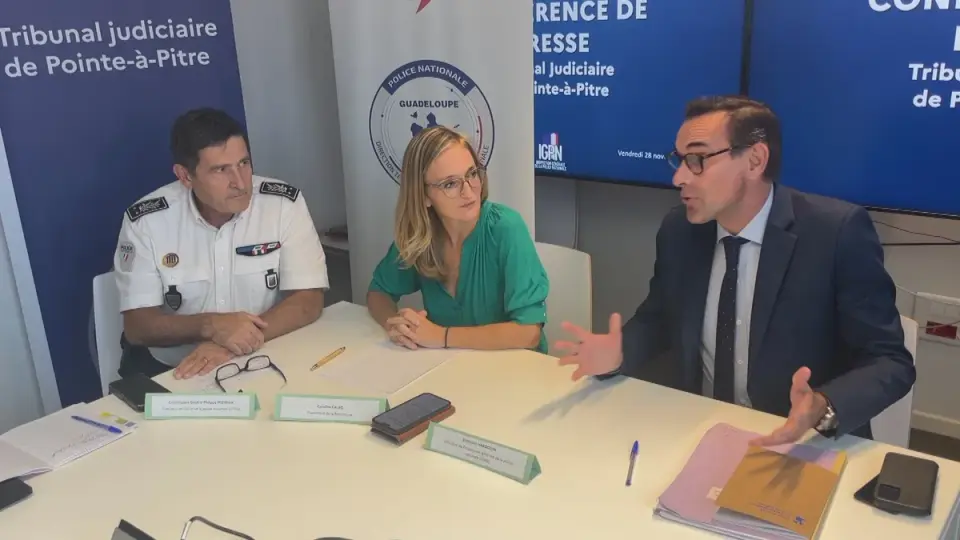
Assessment of the IGPN in Guadeloupe: figures in line with the national average, but a worrying backlog of complaints
According to la1ere.franceinfo.fr, the director of the General Inspectorate of the National Police (IGPN), on a visit to Guadeloupe, presented his institution's assessment on Friday 28 November 2025 at a press conference held at the judicial court premises in Pointe-à-Pitre. The prosecutor of the Republic in Pointe-à-Pitre was also present, alongside the territorial director of the national police (DTPN).
Since the beginning of the year, around fifteen judicial proceedings have been initiated against police officers assigned to Guadeloupe. This figure remains in line with the national average: in 2024, the IGPN opened 914 judicial proceedings nationwide.
No use of lethal weapons in 2024
On the question of police violence, the director of the IGPN, Stéphane Hardouin, highlighted a positive point: "In 2024, in Guadeloupe, we have not had any use of lethal weapons; this is a point that deserves to be highlighted, because we know there are weapons, there is violence... and I must say that this is a result which, in a certain way, shows that the situation is under control, by police officers who are often experienced. When they arrive in Guadeloupe, or Martinique, it is rarely their first posting."
Corruption: heightened vigilance in the face of drug traffickers
In a context of the development of criminal organisations linked to drug trafficking, the fight against corruption is among the IGPN's priorities. Hardouin stated that there is no "generalised and systemic corruption within the national police" in the Overseas territories, whilst acknowledging the need for heightened vigilance in the face of the capacity for harm of drug traffickers: "the risk must be taken into account," he admitted.
The director particularly mentioned specialised justice officers, exposed by their contacts with sources: "What we must do, no doubt, is strengthen internal control. This is what we are working on."
22,000 complaints in abeyance
Whilst the disciplinary assessment is deemed satisfactory, the management of complaints filed by citizens presents a far less favourable picture. The DTPN acknowledged that 22,000 cases are currently awaiting processing at the local level. Some cases have been pending for several years, others have been handled only very partially.
Facing this backlog, a prioritisation strategy has been put in place. The DTPN detailed it in these terms: "We have implemented a strategy that is intended to be virtuous, with an increase in the processing of flagrant offences and, obviously, at the same time, without delay, a processing of old cases, of the deep stock as we say, which, for some, concern serious facts that would have deserved to be handled more quickly. We will endeavour to prioritise them and handle them as best we can, given the seriousness of the facts and of the victims who are not recognised as such."
Lack of personnel, a national issue
This situation is directly linked to the shortage of staff, a reality regularly denounced by police unions. The DTPN acknowledged the deficit whilst qualifying it: "We never have enough police officers, particularly in judicial matters. The issue is national." He mentioned alternative avenues — reorganisation of services, partnership with the municipal police and recourse to video surveillance — to compensate, with staff levels remaining constant, for current shortcomings.
Reinforced police presence on the ground is also presented as a means to reduce the number of violent incidents and, consequently, the volume of complaints to be processed. "There will be fewer complaints if the incidents do not occur," the DTPN concluded.
The objective nevertheless remains ambitious: to significantly improve the processing of cases without an increase in human resources in the short term.
Source: Google News GP — Crime