Murder beside Via Baltica: an unusual challenge for Lithuanian detectives with no witnesses
A man's body was discovered in the Kaltinėnai district in April 2016. The victim had been shot in the head, had no identification documents, and the investigation led detectives to international leads.
Murder beside Via Baltica: an unusual challenge for Lithuanian detectives with no witnesses
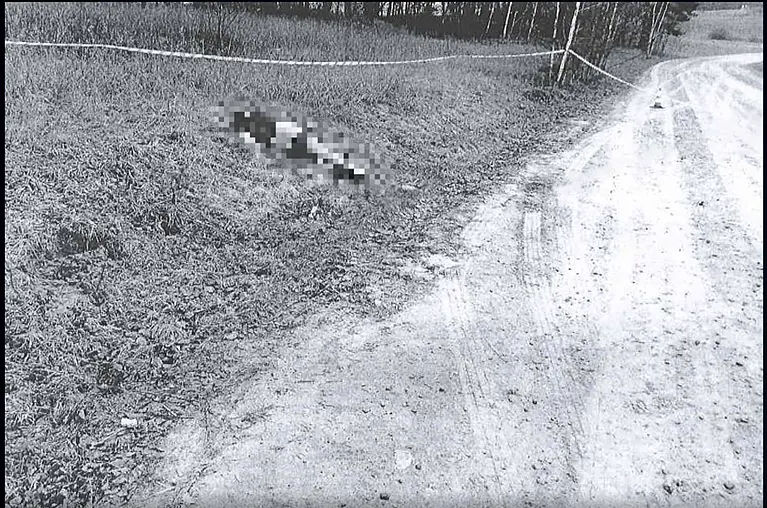
On 12 April 2016, a resident who called the emergency number 112 reported a macabre discovery beside a gravel road near the motorway to Western Europe. In Kaltinėnai municipality lay the body of a man, dressed only in underwear. Initially, police officers considered the possibility of suicide or an accident, but experts quickly established the cause of death – a gunshot wound to the head.
Police officers in Marijampolė district had to delve into a case of a type that had not been investigated anywhere in the country before. The victim had no documents on him that would help reveal his identity. No witnesses came forward either – the nearest house was beyond a forest, and a business was on the other side of the road.
"When we arrived, the person looked as if he was sleeping. Blood was flowing from his head. After ten to fifteen minutes, we noticed that the body's colour had changed. That showed that the violence had occurred recently," said Donatas Merkevičius, the chief investigator of the Organised Crime Investigation Department at the time.
Criminalists considered numerous hypotheses: perhaps there had been a conflict at an entertainment venue, perhaps it was connected with gang activity, perhaps someone was trying to conceal other crimes. Airidas Remeikis, who held the position of senior investigator at the time, explained that without clear evidence, organised crime groups are always considered.
The officers did not recognise the face of the murdered man – he did not belong to local criminals. A gold cross with Slavic lettering found under his shirt and tattoos visible on his body revealed that the victim could have been from the East. The A5 motorway, running nearby, is the main transit route from Scandinavia to the west of the continent, so it was not ruled out that the man was simply a travelling passenger.
An important breakthrough occurred when tyre tracks from a vehicle were discovered. Marks visible at the roadside showed tyre impressions with the letter "C" – these are high-pressure tyres that are not mounted on cars but on cargo vans or trucks adapted for vehicle transport. The traces indicated that a vehicle had turned around and the body was likely thrown from it. One strange detail – the main tyre impression was duplicated, as if driven over by another wheel.
Once reaching the paved road, the marks disappeared. The investigators wondered whether the killer was still within the country's territory. With only one witness, they managed to narrow down a window of three to four hours: in the morning, a man passed by and saw nothing, and upon returning a few hours later, he already noticed the body.
The deadlock forced detectives to appeal to the public for help. One investigative pair decided to move in the direction of Poland, believing that the killer might have tried to dispose of items before crossing the border. Meanwhile, others pursued local lines of enquiry – they drove around hotels, rental accommodation and permanent residences in the Marijampolė and Kaltinėnai districts, showing photographs and questioning people.
More details about this detective case can be found on the Lithuanian National Radio and Television portal LRT.lt.
Source: LRT