Hamse Ali convicted to 45 days in prison for false testimony in Bergen case
Gulating Court of Appeal has convicted Hamse Ali to 45 days in prison for giving incorrect testimony about an alleged racist assault in Bergen in autumn 2024. His defence counsel is considering an appeal to the Supreme Court.
Hamse Ali convicted in Court of Appeal for false testimony about racist assault
Gulating Court of Appeal has convicted Hamse Ali to 45 days unconditional imprisonment for giving incorrect testimony to police about an alleged racially motivated assault in Bergen, according to nrk.no. The verdict overturns a unanimous acquittal from Hordaland District Court.
"My client is very disappointed with the outcome. It was a unanimous acquittal in the district court, which has now been reversed," says defence counsel Anette Vangsnes Askevold, who states that she will review the verdict thoroughly before considering whether there are grounds for an appeal to the Supreme Court.
The case that shocked Bergen
In autumn 2024, Ali told several media outlets, including NRK, that he had been subjected to a racially motivated assault. Images of a beaten and distraught Ali provoked strong reactions, and many reacted to the fact that Bergen police had closed the case. The football club Djerv took the initiative for a torchlit procession where over two thousand people gathered in Bergen in October 2024. A crowdfunding campaign via Spleis raised 253,000 kroner.
Bergen police reopened the case but ended up charging Ali – not for having been assaulted, but for having given false testimony himself. Since then, the question of whether Ali deliberately lied or acted in good faith has been central to both the district court and the Court of Appeal.
Technical evidence against Ali's account
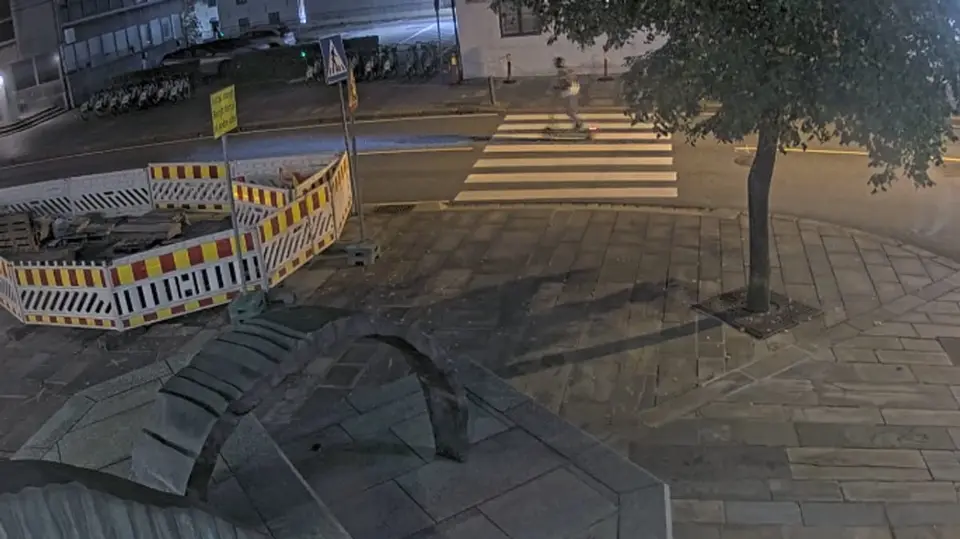
Surveillance cameras at Bergen Police Station captured Ali on an electric scooter on the night in question, which he himself acknowledges belonged to him. Police also found a photograph taken outside Bergen Medical Centre on Ali's own phone, and data from the electric scooter showed it had travelled through Bergen city centre at high speed before stopping abruptly on Vågsallmenningen and then heading towards the medical centre.
"I cannot remember anything about that trip. I was shocked when I saw the images and understood it was me," Ali said in court, adding that the images had given him many sleepless nights.
He maintained throughout the case that he never intended to conceal anything and that he genuinely believed he remembered a racially motivated assault – even though the injuries turned out to stem from a fall.
"I would never have agreed to let police take my phone and see all the technical evidence if I had something to hide," said Ali.
Disagreement among expert witnesses
The District Court acquitted Ali, partly based on neuropsychologist Knut Dalen's expert testimony. Dalen explained that it could not be ruled out that Ali himself believed what he had told police, and that false memories could have arisen as a result of alcohol and head trauma.
Police counsel and former prosecutor Øivind Valland supported this assessment and believed the acquittal was correct. However, Chief State Counsel Jan-Inge Wensel Raanes disagreed and appealed the case to Gulating Court of Appeal, where he himself acted as prosecutor.
In the Court of Appeal, neurologist Halvor Øygarden was called as an additional expert witness. Øygarden completely disagreed with Dalen and believed Ali's blood alcohol level was too low and the injuries from the fall too minor to trigger false memories or significant memory loss. The Court of Appeal supported Øygarden's assessment.
The court's conclusion
Gulating Court of Appeal concluded that Ali deliberately gave incorrect testimony. The court writes in its verdict:
"It is beyond any reasonable doubt that the accused was aware that the assault he testified about to police had not taken place, that is, that it was not his belief at the time of the incident that he had actually been subjected to an assault."
The court pointed out, among other things, that Ali could not specify the number of perpetrators or describe clothing or language. The fact that he had quickly moved to a new location and called his girlfriend was cited as a sign that he had been clear-headed. The court also emphasised that the claim about a racially motivated attack first came two days after the incident, after family and friends had asked him about it – and that in his fourth interview he gave detailed explanations about the perpetrators and sequence of events.
Prosecutor Raanes argued that Ali had a financial motive, among other things related to an expensive dental bill. The Court of Appeal agreed.
The court stressed that false testimony about a racially motivated assault must be met with a strict response:
"The false testimony could have led to innocent persons coming under suspicion and possibly being arrested."
"The incorrect testimony has resulted in significant use of resources by the police that could have been used in other ways."
Prosecutor Raanes is satisfied with the outcome.
"The verdict is in accordance with my view on the evidence issue legally. I believe the verdict is correct and I am satisfied with it," he tells NRK.
Defence counsel Askevold states that she and her client will now review the verdict thoroughly to consider a possible appeal to the Supreme Court.