Drug-related violence on Paraguay-Brazil border: organised crime and state complicity
Three high-impact crimes exposed Paraguay to international scrutiny in 2022, revealing the advance of organised crime. Experts consulted by dw.com warn that violence, previously localised, has now spread across the entire country.
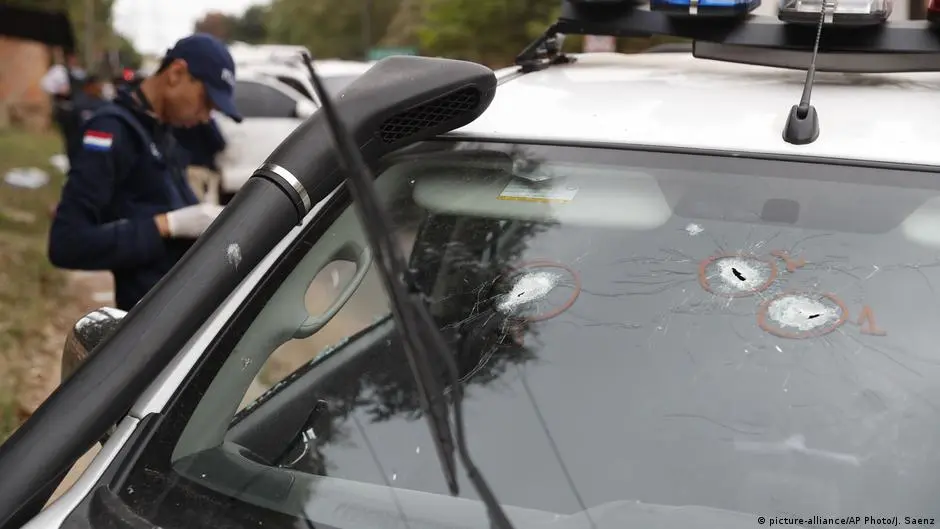
Three crimes that put Paraguay on the organised crime map
The murder of prosecutor Marcelo Pecci during his honeymoon in Colombia on 22 May 2022, the inclusion of Vice-President Hugo Velázquez on a list of corrupt persons by the United States on 12 August, and the killing of journalist Humberto Coronel in Pedro Juan Caballero on 6 September: these three consecutive incidents placed Paraguay under international scrutiny. According to dw.com, the three cases have in common that they reveal deterioration linked to organised crime, visible especially from abroad.
Is this something new or a reality that previously went unnoticed? Carlos Peris, a sociologist and researcher at the National University of Asunción, told DW that three or four years ago violent incidents "were very localised in San Pedro, Amambay and Concepción, which are the departments bordering Brazil". In those areas, says Peris, "the clandestine order of drug trafficking is established, with murders of journalists and other crimes". The difference with the present: "violence has been nationalised, that is, it has spread throughout the country".
Decades of violence on the Brazil border
The history of drug trafficking in the border region is not recent. Landing strips for drug-trafficking aircraft were installed in the seventies under the dictatorship of Alfredo Stroessner, driven by leader Andrés Rodríguez. In the early twenty-first century the scenario became more complex with the arrival of Brazilian criminal organisations such as Comando Vermelho and Primeiro Comando da Capital.
Juan Alberto Martens, a criminologist and director of the Institute for Comparative Studies in Penal and Social Sciences of Paraguay, described to DW a paradox that tends to surprise: "The homicide rate in Paraguay is 7 per 100,000 inhabitants, lower than Uruguay". However, the concentration of the phenomenon on the border distorts that average: in Amambay department, the rate reached 64 deaths per 100,000 inhabitants in 2021.
Paraguay as a drug-trafficking corridor to Europe
For Martens, "organised crime, mainly Brazilian factions, found in Paraguay a territory conducive to their business and, through the Paraná and Paraguay rivers, they move their merchandise, mainly cocaine, destined for Europe, from the ports of Montevideo and Buenos Aires". The route is transnational: the merchandise originates from Bolivia, Peru and Colombia, passes through Argentina and Uruguay, and sometimes stops in Africa before reaching the European continent.
Figures confirm the magnitude of the flow. Peris recalls that in February 2021, 23 tonnes of cocaine from Paraguay were seized at Hamburg port, and that in July of that year a further 5 tonnes were seized in Antwerp.
The explosion of violence, according to Peris, is due to the fact that there are "drug trafficking groups with greater firepower and virulence, with greater territorial aspirations, and all of this alongside political inaction or complicity".
The State present, but not functional
Both experts agree on one central point: violence in Paraguay would be impossible without the tolerance or active participation of sectors of the State. Peris dismantles the usual argument of "state absence": "Amambay is the sixth department with the most police officers and the third with the most judges. The problem is not that there is no State, the problem is that the State does not fulfil its role". The explanation, he adds, is that "the prosecutor is corrupt and police officers act as hitmen for the drug traffickers".
Martens introduces the concept of "criminal governance" to describe the situation: "It is these groups that impose the way of being and existing in these spaces, and there is a complex network, with police officers and journalists too, that operate and that enjoy social tolerance, because they generate employment". For the criminologist, the conclusion is direct: "Without state complicity this could not happen". A scenario from which, both specialists warn, it is practically impossible to exit.
Source: Google News PY — Crime