Brazilian journalist murdered in Paraguay was investigating Glock gun smuggling
Lourenço Veras was murdered in 2020 in Pedro Juan Caballero whilst preparing an investigation into arms trafficking. Forbidden Stories reveals the link between Paraguayan importers and Glock pistols used by the PCC.
Murdered while investigating arms trafficking on the border
On 12 February 2020, two hooded men burst into the home of Brazilian journalist Lourenço Veras in Pedro Juan Caballero, Paraguay, and shot him twelve times while he was dining with his family. On his mouth, the hitmen left a cloth stained with blood, a gesture that the police report—obtained by forbiddenstories.org—interpreted as a deliberate message: silence the reporter.
Veras, known to his friends as "Leo", had spent fifteen years covering organised crime, police matters and trafficking on the Paraguayan-Brazilian border for his news portal Porã News. He had arrived in Pedro Juan Caballero in 2005, at the age of 37, and from then on worked alongside veteran local journalist Cándido Figueredo, correspondent for ABC Color with more than two decades of experience in the region.
A reporter on the front line
Figueredo describes Veras as a first-rate photographer and reporter, capable of arriving before anyone else at a crime scene and documenting it from multiple angles before sharing the images with the rest of the press. "When he arrived, everyone looked at him", Figueredo recalls in conversation with Forbidden Stories, alluding to the first crime scene Veras covered in the city.
His sense of humour was part of his identity. Each time he visited the Figueredo family, he would ask for coffee from his colleague's wife—"Is there coffee there?"—and then, after finishing it, would joke: "I'm going to look for another one, because the one you served me wasn't good, it was cold". A "spectacular sarcasm", according to Figueredo, always delivered with a smile.
But the city was not a safe place to practise journalism. In Pedro Juan Caballero, seven reporters have been murdered since 1991. In a 2017 documentary, Veras reflected on that risk: "We all have to die one day. I just hope it's not in a very violent way; perhaps a single shot, without causing too much damage". Three years later, those words took on a tragic dimension.
The night of the murder and the bullets that spoke
The night he was murdered, Veras and Figueredo had begun to prepare a new investigation into arms smuggling on the border. The weapon used was never recovered by police, but the shell casings found at the scene allowed it to be identified: it was a 9 mm Glock pistol, according to the Brazilian Association of Investigative Journalism (Abraji). The microscopic marks that the weapon imprints on bullets and casings function as a "unique fingerprint", and subsequent forensic analysis revealed that the same revolver had been used in seven other murders or attempted murders, all linked to Primeiro Comando da Capital (PCC).
The PCC is a Brazilian criminal organisation with extensive control over drug and arms trafficking on the border with Paraguay, and with documented links to influential political figures in the neighbouring country. The hitmen in the Veras case were linked to that organisation.
Warned by intelligence sources that he would be the next target, Figueredo packed what he needed and fled with his wife to the United States, where he remains in exile to this day. "We stood there looking at our house for five minutes, just looking at our house, and then we walked away", he recounts. "Everything we had in this world remained there".
The supply chain that forbiddenstories.org traces
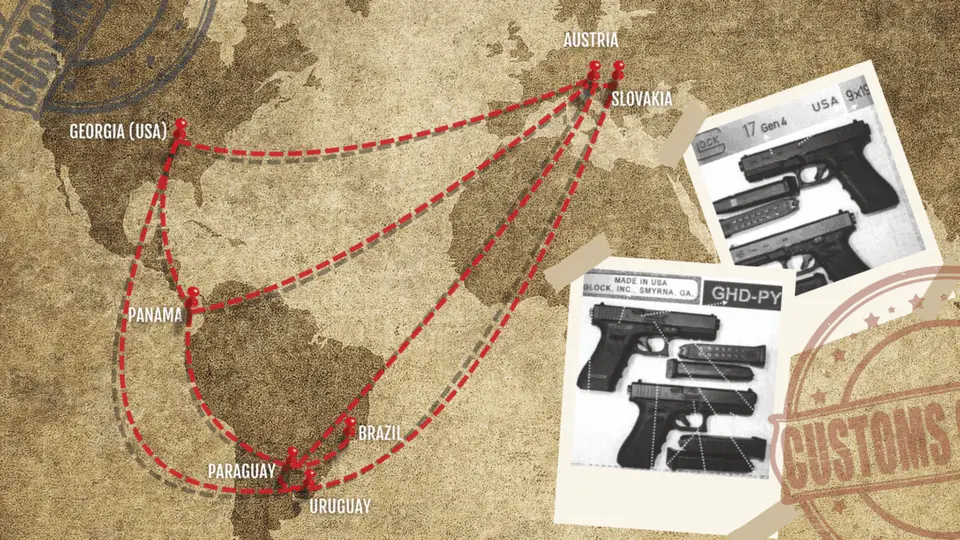
Forbidden Stories, in coordination with OCCRP and seven media outlets brought together in the so-called Paraguay Alliance, continues the work that Veras could not finish. The investigation reconstructs the supply chain for short firearms that supplies criminal gangs in the region: from the countries of manufacture to the importers operating in Paraguay.
The consortium identified three importing companies—represented by the same individuals—that have introduced large volumes of pistols manufactured by Glock, the Austrian company recognised for its semi-automatic firearms, into Paraguay. Glock did not respond to requests for comment sent on several occasions by the consortium. In a subsequent statement sent to Austrian media partner Der Standard, the company claimed that it "strictly complies with all legal and official regulations governing the manufacture and international distribution of pistols".
Police reports in the Veras case mention other pistols seized from properties of the alleged hitmen. Half of them were identified by the consortium as 9 mm Glocks. Although they were legally registered and are not officially linked to previous crimes, they were found in the possession of individuals investigated for arms trafficking and organised crime. Their presence points to a broader trend: the proliferation of Glock pistols within criminal networks active on the border.
For years, according to documentation by forbiddenstories.org, importing companies have flooded Paraguay with more weapons than the country's legal market could absorb, thereby feeding the flow of armaments to regional organised crime. The Paraguay Alliance investigation traces that route from source to final destination of the weapons, with the case of Lourenço Veras as a starting point and symbol of what that trafficking can cost those who attempt to expose it.
Source: Google News PY — Crime