Banned synthetic kratom sold openly in NYC smoke shops, Post investigation finds
A NY Post probe found eight NYC smoke shops selling federally banned synthetic kratom compounds, some linked to recent overdose deaths of two Mississippi students.
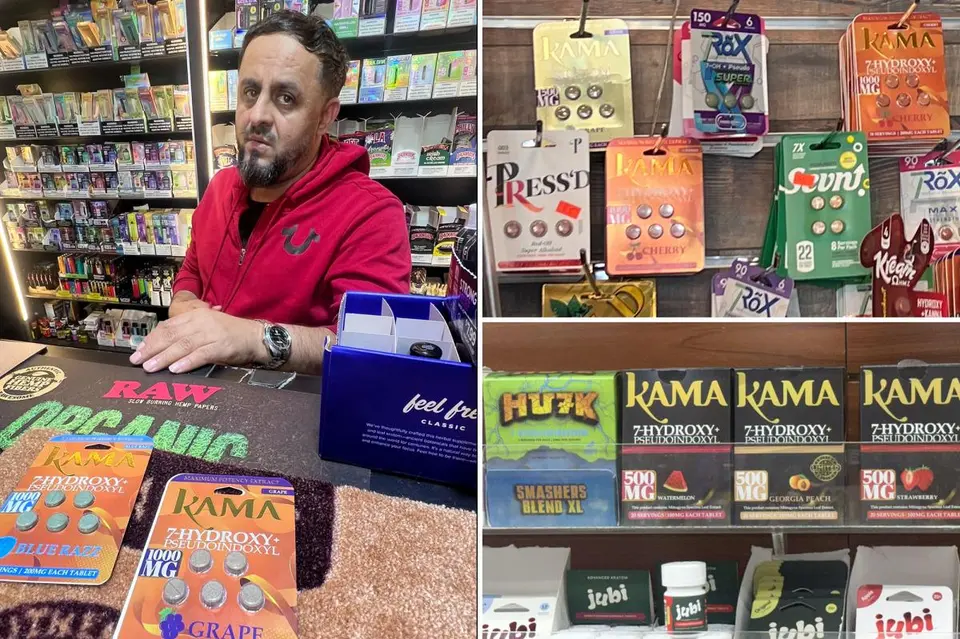
Illegal synthetic kratom compounds found in NYC smoke shops across all five boroughs
A two-week investigation by the NY Post found that at least eight smoke shops across New York City have been openly selling products containing synthetic kratom compounds classified as Schedule I controlled substances under a federal Drug Enforcement Administration emergency order issued in August. Employees at several stores appeared either unaware or unconcerned that the substances they were selling carry federal penalties of up to 20 years in prison.
Over the course of the investigation, Post reporters visited 52 shops — including smoke shops, convenience stores, and dispensaries — across the city's boroughs. Roughly 15% of those locations were found to be stocking products containing mitragynine pseudoindoxyl (MGPI) or dihydro-7-hydroxy mitragynine (MGM-15), two synthetics banned nationwide by the DEA's August emergency order.
Products linked to student deaths in Mississippi
The investigation comes as synthetic kratom faces heightened scrutiny following the suspected overdose deaths of two University of Mississippi students: Aidan Hamilton, 18, and Robert Strang, 20, who died on September 21 in separate incidents. A federal toxicology report found MGPI, MGM-15, and a third compound — 7-Hydroxymitragynine (7-OH) — in the systems of both men. Two men have since been charged in connection with selling the narcotics to the students.
One defense attorney said in court Friday that one of the students died from a combination of substances including cough syrup, while the other died from inhalation asphyxiation, according to WMC-TV. Also this week, Utah health officials issued an urgent warning after four deaths were linked to a substance marketed as "cat's claw," which authorities said contained "dangerous semi-synthetic kratom chemicals."
'Gas station heroin' on the shelves
Each product the Post identified as containing MGPI or MGM-15 also included 7-OH — a kratom-derived compound that remains legal in New York State. According to the National Library of Medicine, 7-OH is 13 times stronger than morphine and is widely referred to as "gas station heroin." MGPI, in turn, is 31 times stronger than 7-OH.
Among the products found on sale was a 1,000 mg pack of a Kama brand item called "7-Hydroxy+Psuedoindyl," which was prominently displayed at New City Smoke Shop on the corner of Park Place and Church Street in lower Manhattan. A worker at that store reluctantly acknowledged that customers gravitate toward the MGPI-containing Kama product because of its greater potency, and added that a health inspector had warned the store months earlier that the tablets would soon be illegal — though he said he remained uncertain about their current legal status.
At East Village Smoke Shop on First Avenue in Manhattan, an employee promoted the same product to a Post reporter by describing it as increasingly scarce because "it's about to be banned" — unaware, apparently, that the DEA had already acted. That store also carried tablets under the Rush brand containing 7-OH, MGPI, and MGM-15.
At an Astoria business called Ditmars Organic Convenience, an employee appeared fully aware that the products were contraband. Rather than displaying them openly, the worker retrieved an iPad to show the Post reporter the available illegal selection.
'Like crack houses,' former ATF official says
Rich Marianos, a former assistant director at the Bureau of Alcohol, Tobacco, Firearms and Explosives and founder of the Tobacco Law Enforcement Network, said city licensing of these establishments without meaningful enforcement had created conditions comparable to drug dens. "We are licensing these places [and they're] like crack houses," Marianos said. "No synthetic narcotic producing a euphoric high like heroin should ever be sold without a doctor's authority."
Workers at some Astoria shops described the effects customers experience. One employee, who identified himself only as Rifa, said customers told him the products made them feel stronger, more awake, and more focused. He added, however, that the physical toll was visible: "When you see him [after they take the tablet] they're too f–king weak. Literally you can see them too weak. If you push them, maybe they're going to fall down."
'It hollows you out'
Greg Kiesow, founder of Kratom Anonymous and a former user based in Illinois, said he had been 18 years sober before becoming addicted to 7-OH — a substance he initially did not know was habit-forming. He described starting with kratom leaf powder before escalating to increasingly potent products. "It hollows you out. It makes you a ghost of yourself. You aren't really capable of feeling joy, love, peace, and connection with others," Kiesow said. "You completely isolate."
Wendy Chamberlain, who founded Kratom Danger Awareness after her son Joseph, 38, died in his upstate New York home in 2020 from an accidental kratom overdose, questioned when the toll would stop. "When's it going to end?" she asked.
Federal ban, patchy enforcement
Kratom originates from a plant native to Southeast Asia and, according to the Mayo Clinic, produces stimulant effects at low doses and sedative or depressant effects at higher doses. Synthetic variants can be tens to hundreds of times more potent than the botanical form. Products made from botanical kratom remain technically legal at the federal level, though they are fully banned in nine states. Malaysia, Singapore, and Myanmar — three countries where the plant originates — have made consumption illegal domestically, though export is not prohibited.
The ingredients found by the Post across the New York City shops were consistent with those in the "SMAX Pseudo-DHM" tablets that officials linked to the deaths of Hamilton and Strang, which were reported to contain MGPI, MGM-15, and 7-OH.
Source: NY Post Metro