Maradona trial: Prosecutor seeks up to 12 years' imprisonment for medical team
Prosecutor Patricio Ferrari has sought sentences of 4–12 years for six defendants in the trial over the death of Diego Maradona.
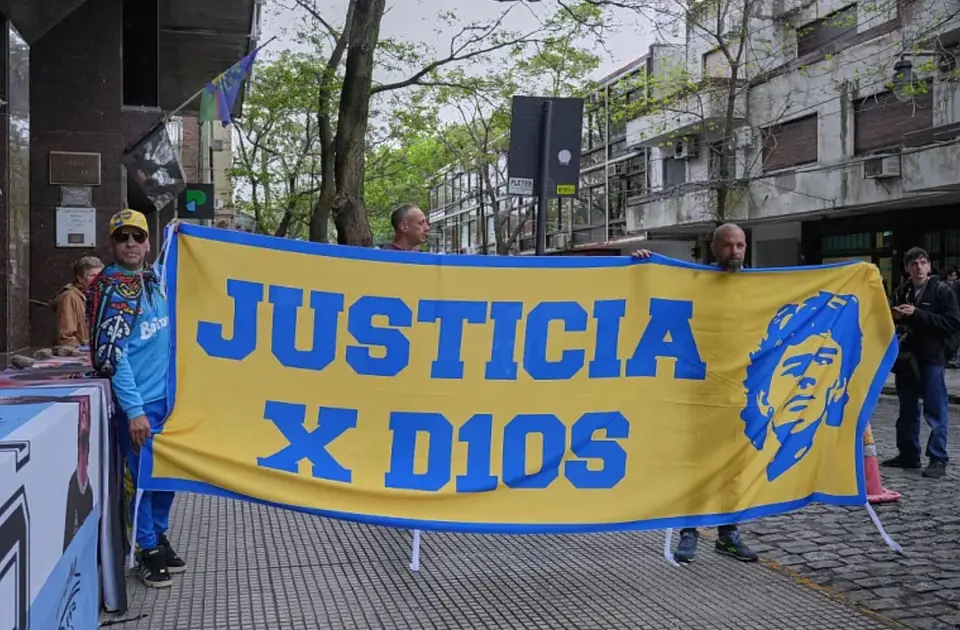
Prosecutor seeks up to 12 years' imprisonment for Maradona's doctors
Sentences of four to twelve years' imprisonment have been sought by the prosecutor from the San Isidro court for the medical team that cared for Diego Maradona in the final weeks of his life, according to reports. The prosecution characterised the care of the football icon as "chaotically organised", leaving him "in a state of neglect" and "abandoned to his fate".
Prosecutor Patricio Ferrari, in closing arguments lasting more than three hours, distinguished between two categories of defendants among the healthcare professionals who cared for Maradona in November 2020, during his post-surgical recovery at home.
Stricter sentences for three — more serious charge for Luque
For the three lead defendants, Ferrari charged manslaughter with possible intent — that is, negligence committed with knowledge of its potentially fatal consequences — and sought sentences of eight to twelve years.
The strictest proposal, twelve years' imprisonment and a ten-year ban on practising medicine, was reserved for neurosurgeon Leopoldo Luque, 44, whom he described as Maradona's trusted physician and principal decision-maker during that period. "His approach was always to do nothing" in the face of warning signs — heart failure and oedema — that the patient presented, the prosecutor noted. "The absence of corrective measures" was highlighted by Ferrari, as "they had foreseen the danger and faced it with indifference".
Ten years' imprisonment and an equal ban on practising the profession were sought for Nancy Forlini, medical coordinator of the private healthcare provider, and eight years for psychiatrist Agustina Cosachov, who was also considered responsible for decision-making alongside Luque. Against all three, Ferrari emphasised "the absence of corrective measures, as they had foreseen the danger and dealt with it with indifference".
Lighter charges for the other three
For the three other defendants, the prosecution opted for the lighter offence of involuntary manslaughter. Five years' imprisonment was sought for psychologist Carlos Díaz and four years each for nursing coordinator Mariano Perondi and nurse Ricardo Almirón.
The seventh defendant, Dr. Pedro Di Spagna, was acquitted of any charge: "He had neither the authority nor the responsibility to make decisions about the patient's health", Ferrari stressed, noting that this particular doctor had seen Maradona only once during the recovery period.
"A chronicle of a foretold death"
In his closing remarks, Ferrari presented for the second time to the San Isidro court — north of Buenos Aires — a photograph of Maradona on his deathbed, with his belly swollen. "El Diez"'s daughters hid their faces with their hands again. "That is how Maradona died, at the sad end on 25 November," Ferrari stated, and added: "We have before us a chronicle of a foretold death".
The prosecutor summed up the case as resulting from "complete disorganisation" and "an almost anarchic structure" around "the most famous patient in the world". He characterised the care team as "amateurs" who "forgot at every step that they were dealing with a vulnerable and complex patient" and who "increased the risk beyond what was acceptable".
Deputy Prosecutor Cosme Iribarne cited the specific signs of deterioration that, according to the prosecution, were ignored: "Oedema, respiratory difficulties, tachycardia. The signs of the fatal outcome began to appear long before".
Home care at the centre
The "Golden Boy" died on 25 November 2020, aged 60, from cardiorespiratory failure combined with pulmonary oedema, in the bed of a residence he had rented for his recovery following neurosurgery.
The trial, which extended over 45 hearings lasting six months, focused heavily on the decision for home care and the inadequate medical equipment of that particular residence, which did not have a hospital bed, defibrillator, readily available intravenous fluids or an ambulance. Several expert witnesses testified that warning signs were ignored by the medical and paramedical team.
The defendants deny any responsibility, arguing that the clinical causes of death were unrelated to their specialities and that their role in Maradona's care was limited. Final closing arguments and defence statements are expected to last another two weeks, with the verdict to be delivered at a later stage.
Source: In.gr