Alias 'Bendito Menor' shot dead in Riohacha alongside three members of his circle
Colombian police killed the leader of the ACSN Naín Andrés Pérez Toncel in a night-time operation in La Guajira. His partner and two logistics commanders also died.
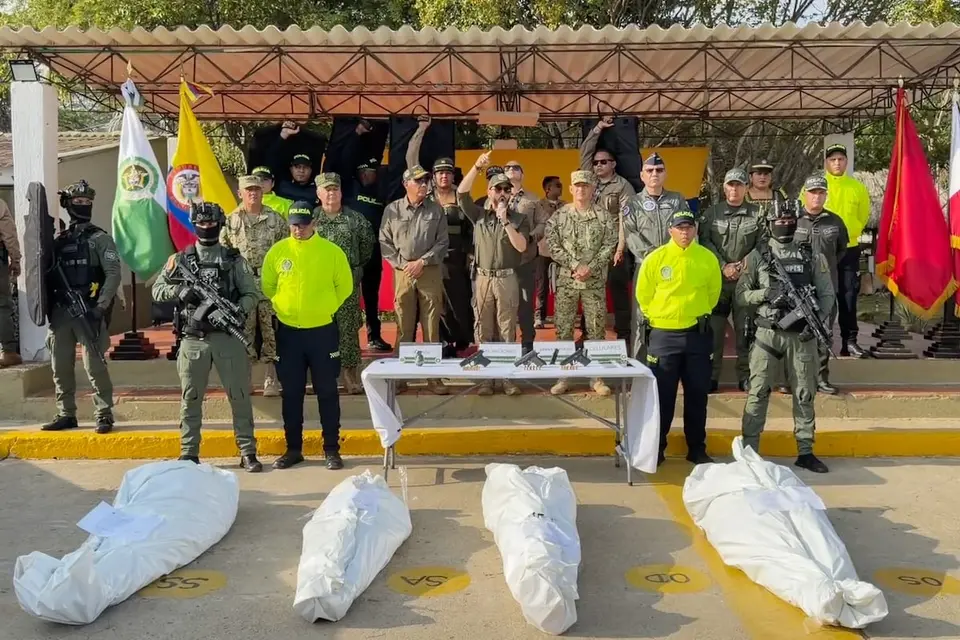
Operation in Riohacha eliminates one of Colombia's most wanted criminals
Naín Andrés Pérez Toncel, alias Naín or Bendito Menor, was shot dead on Thursday night in Riohacha, capital of La Guajira, during an operation by Colombian police, according to elpais.com. Also killed in the same operation were his partner, Rosa Angélica Tarazona, alias Bebecita, and two members of his command circle: alias El Tío, described as a logistics chief, and alias Casiloco, responsible for the financial component.
Pérez Toncel was commander of the Javier Cáceres sub-structure, one of four fronts of the Autodefensas Conquistadoras de la Sierra Nevada (ACSN), an illegal armed group descended from paramilitarism that operates in the north of the country. This sub-structure operated mainly in southern La Guajira. The leader had five active arrest warrants for aggravated homicide, kidnapping, extortion and aggravated criminal conspiracy, as well as a red notice from Interpol.
"Those who do not surrender will end up like this"
President Abelardo de la Espriella travelled to Riohacha on Wednesday to describe the operation as an "impeccable operation". In a video circulated on his social networks he is seen behind a table with seized weapons on it and the four corpses on the ground in front. De la Espriella called Bendito Menor a "narco-terrorist" and one of the most dangerous criminals in the country, and directed a message at other criminal groups: "Those who should feel panic and terror are the criminals. Those who do not surrender will end up like this."
The president confirmed that the operation, named Centinela de la Patria, was carried out by a special unit of the Directorate of Criminal Investigation (DIJIN). The official statement from the Ministry of Defence makes no mention of any foreign collaboration. However, the newspaper El Tiempo reported that the operation was made possible thanks to intelligence supplied by the United States, and that American agents were present hours earlier in Santa Marta, Cartagena and Riohacha, cities where Bendito Menor coordinated drug trafficking and extortion activities.
Mobile phone turned on apparently revealed his location
The key to the operation's success appears to have been Pérez Toncel switching on one of the mobile phones he was carrying, which allowed the authorities to determine his location. Security forces established that he was in his mother's house in the José Arnoldo Marín neighbourhood of Riohacha. An operation was deployed by land and air with several helicopters flying over the area; at 11:30 p.m. on Thursday the special DIJIN unit burst into the residence in an action that lasted several hours.
The day before the operation, reports had circulated that Pérez Toncel had died at the hands of the ACSN itself, after he stopped appearing in the communications interceptions being carried out by the authorities. "For three days he has not appeared in the interceptions we have been conducting in this area where he moves and human sources told us they had killed him because he was not following orders," said an official from the search team in an interview with Semana magazine.
From wanted target to national social media figure
Bendito Menor was on the list of main military objectives of President De la Espriella, who on taking office ordered the Armed Forces to capture or eliminate ten criminal leaders within their first 90 days in government. In the case of Pérez Toncel, it took less than 30 days.
Despite not being the top leader of the ACSN, the commander became a prominent figure owing to his extravagant behaviour and his presence on social networks. In January of this year the authorities linked him to a massacre in which five people died in Maicao, a town in La Guajira bordering Venezuela. Days later a video was circulated on Facebook in which a man, whose face could not be seen, apparently threatened then-president Gustavo Petro: "We are going to slice you up and put you in one of those sugar bags." Pérez Toncel came out to deny authorship on his own social networks, but he was already in the sights of the authorities, who had even offered 1,000 million pesos for information leading to his capture.
In July, when De la Espriella had already been elected and had ordered his future Defence minister to do "everything necessary to capture or eliminate" the commander—whom he called a "scoundrel"—Pérez Toncel responded with a video in which he appears alongside his partner doing motorcycle stunts, apparently in mockery of the warnings from the then president-elect. Less than two months later, De la Espriella presents his death as a triumph of his security policy.
Source: Google News CO — Crime