Former President Uribe appears before Colombian Prosecutor's Office over massacres and murder
Álvaro Uribe denied his responsibility in the massacres of El Aro and La Granja, and the killing of human rights defender Jesús María Valle. The Prosecutor's Office is investigating him formally.
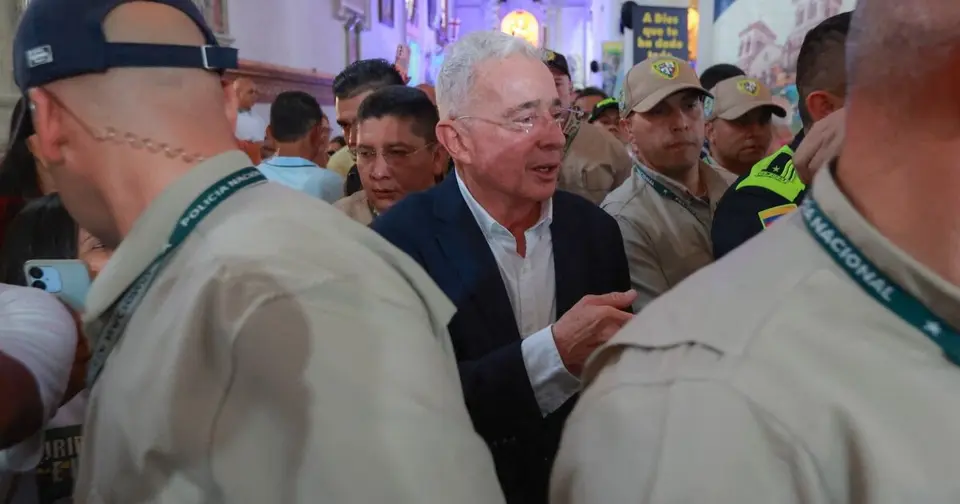
Uribe testifies before Prosecutor's Office over paramilitary massacres in Antioquia
Former Colombian President Álvaro Uribe appeared on Friday before the Attorney General's Office to answer for his alleged involvement in two paramilitary massacres and the murder of a human rights defender that occurred in the 1990s. According to semanariouniversidad.com, Uribe denied all responsibility before entering interrogation.
"I believed that I had served the nation, but today I come to say that I have not been a murderer," declared the 74-year-old politician in Bogotá, surrounded by heavy security detail with bodyguards and shields.
The investigation and the facts being investigated
The investigation formally links the right-wing leader to the legal proceedings and places him once again under scrutiny for his alleged connections to paramilitary groups. The Prosecutor's Office is investigating his role during the massacres of El Aro (1997) and La Granja (1996), both perpetrated in the Antioquia region when Uribe was serving as governor.
The file also includes the murder of Jesús María Valle, a social leader shot in Medellín in 1998, days after he had publicly denounced the massacres.
During these events, paramilitaries killed dozens of peasants, burned their homes and seized their livestock. Victims and witnesses report having seen a helicopter from the Antioquia governorate fly over and escort the paramilitaries during the El Aro massacre.
Links with paramilitaries and family estate as operational base
The Prosecutor's Office accuses Uribe of "facilitating and promoting" the action of paramilitary groups in Antioquia. The investigation identifies the family estate "Las Guacharacas" as an operational centre for these armed structures.
Uribe, who carried out an extensive offensive against guerrillas during his two presidential terms between 2002 and 2010, has been under suspicion of paramilitary links for years. On Friday he once again attributed the proceedings to persecution by his "political adversaries".
Previous conviction and revocation
In August 2025, Uribe was sentenced to twelve years of house arrest for bribing imprisoned paramilitaries to prevent them from linking him to those far-right death squads. A Bogotá court subsequently revoked the sentence.
His brother, Santiago Uribe, was sentenced last year to 28 years in prison for leading a paramilitary group known as "Los 12 Apóstoles".
The former president's legal defence has attempted on several occasions to delay and suspend the investigation against him.
International condemnations and decades of impunity
In 2006, the Inter-American Court of Human Rights condemned the Colombian State for omission in the massacres. Two years later, the same court found it responsible for the extrajudicial killing of Jesús María Valle.
The victims of those crimes have spent decades demanding justice. In the 1990s, Antioquia was the scene of extreme violence fuelled by drug trafficking, paramilitary expansion and the presence of guerrilla groups.
Source: Google News CO — Crime