Impunity against journalists in Latin America begins before murder, experts warn in Bogotá
Press freedom experts warned at the 82nd General Assembly of the SIP that impunity begins with ignored threats, stigmatisation and lack of protection.
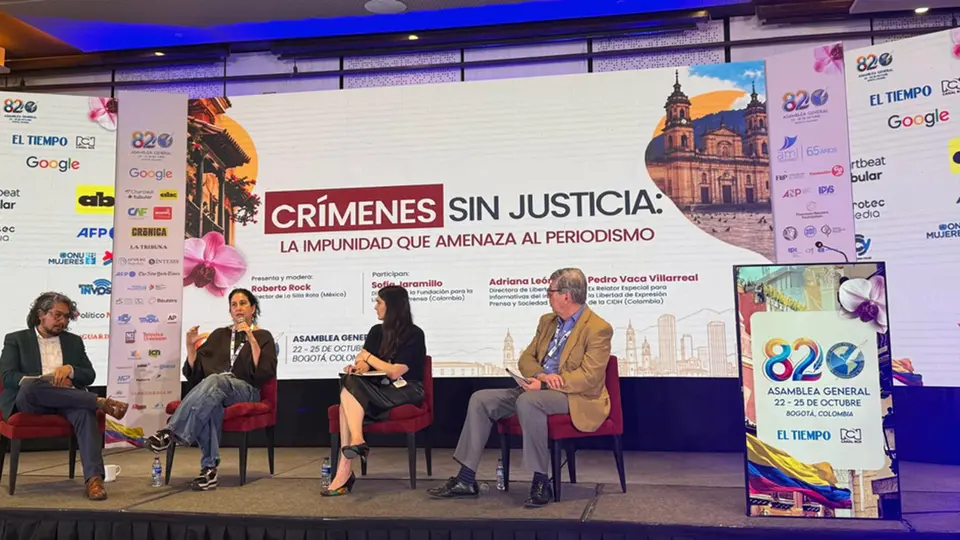
SIP experts: journalistic impunity starts with threats that nobody investigates
Impunity in crimes against journalists in Latin America cannot be measured solely by unsolved murders, specialists warned during the 82nd General Assembly of the Inter-American Press Society (SIP), held in Bogotá. According to sipiapa.org, the panel "Crimes without justice: the impunity threatening journalism" brought together experts from Colombia, Peru and the inter-American human rights system to debate a problem that, in their view, begins long before homicide: with ignored threats, smear campaigns from those in power, digital attacks and the absence of effective protection mechanisms.
The panel was moderated by Roberto Rock, director of La Silla Rota and former president of the SIP. Participants included Sofía Jaramillo, executive director of the Foundation for Press Freedom (FLIP) in Colombia; Adriana León, director of Informational Freedoms at the Institute for Press and Society (IPYS) in Peru; and Pedro Vaca Villareal, former special rapporteur for Freedom of Expression at the Inter-American Commission on Human Rights (IACHR).
Rock highlighted during the introduction the need to move from denunciation to action, and mentioned regional initiatives aimed at breaking cycles of impunity. Among these is the Journalistic Response Unit (URP), a project promoted by the SIP with support from UNESCO's Global Media Defence Fund. The URP investigates and documents cases of murdered journalists whose files remain unresolved, reviews evidence, reconstructs contexts, identifies contradictions and explores possible legal avenues to push for the reopening of stalled investigations.
Impunity does not begin with murder
Jaramillo pointed out that one of the main mistakes by states is understanding impunity solely on the basis of murders of journalists. In Colombia, she recalled, a journalist receives threats on average every two days, and many of those complaints are never investigated. When that occurs, she explained, impunity acts as a factor that facilitates new assaults and, eventually, murders.
As an example, she cited the case of journalist Rafael Moreno, who filed complaints about some 40 threats linked to his investigations into corruption before being murdered in 2022. The absence of effective responses from the authorities, according to Jaramillo, allowed the threats to escalate until they became lethal violence.
The FLIP director also recalled that Colombia has recorded 172 murdered journalists since 1977. Emblematic cases such as those of Guillermo Cano Isaza, Julio Daniel Chaparro, Jorge Torres and Gerardo Bedoya continue to face decades of impunity or incomplete investigations.
Organised crime advances against journalism
Adriana León described the accelerated deterioration of conditions for practising journalism in areas of Peru dominated by criminal networks. The expansion of drug trafficking, illegal mining and other forms of organised crime increasingly affects journalists' ability to investigate matters of public interest.
"We have come across journalists who have information of enormous relevance, but cannot publish it because they are afraid," León said. IPYS has had to strengthen security programmes for journalists, including temporary shelters, specialist assistance and physical protection measures. "Just days ago I had to buy three bulletproof vests for Peruvian journalists," she stated.
León also warned about the phenomenon of "informational silences", increasingly frequent in regions where violence and the absence of state protection limit the ability of local and community media to report.
Stigmatisation from those in power
One of the proposals that generated the greatest consensus among the panellists was the impact of hostile discourse against the press promoted by the authorities themselves. Vaca warned that several countries in the region are going through a particularly critical moment due to the growing use of narratives that present journalists as political adversaries or enemies.
"It is difficult to find today a country on the continent where the presidential figure is not stigmatising journalism in some way," Vaca stated. In his view, that discourse raises risks for the press and creates conditions that facilitate both physical assaults and online harassment campaigns.
Jaramillo agreed that stigmatising statements affect not only the journalists directly targeted, but generate a generalised atmosphere of fear and self-censorship. "Journalists start to watch every word out of fear of threats, attacks or legal persecution," she noted.
Regional journalism, the most exposed
Another central message from the panel was the need to pay greater attention to local and regional journalism. Vaca recalled that the most exposed journalists typically work far from the capitals, in territories where the border between legality and criminality is blurred and where state institutions have less capacity to respond.
"It is a more solitary journalism and much more exposed," he stated. The three panellists agreed that a large part of the gravest attacks against the press occur precisely in communities far from major urban centres, where the absence of the state and the presence of armed or criminal actors make the practice of journalism a high-risk activity without an effective protection network.
Source: Google News CO — Bogotá