Drone attack on Leipzig/Halle airport: federal government holds Russia responsible
Explosives-laden drones were discovered at Leipzig/Halle airport. The federal government sees Russian intelligence services as the instigators.
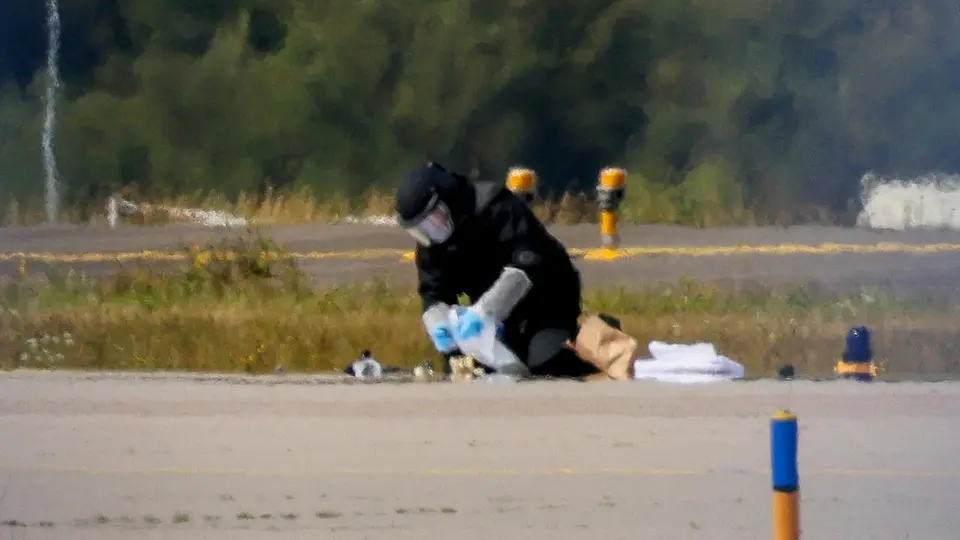
Russian "disposable agents" behind drone attack on Leipzig/Halle airport
The traces of the attempted attack on Leipzig/Halle airport lead to so-called disposable agents of a Russian intelligence service, according to findings by German security authorities. As Tagesschau reports, the federal government needed three weeks to reach this conclusion – out of consideration for the evidence and as a counterweight to Russian propaganda.
Just a few days after the discovery of an explosives-laden drone on the airport grounds, the Russian embassy in Berlin had posted on platform X. It called the incident a "hastily cobbled together provocation" and cast suspicion on Ukraine. The federal government wanted to substantively counter such a narrative only once reliable evidence was available.
Multiple drones, one DNA trace
According to investigations by NDR, WDR and Süddeutsche Zeitung, apparently two explosives-laden drones were deployed in the attempted attack. The first was discovered shortly before midnight on the night of 4 to 5 August near a Ukrainian Antonov aircraft on the airport grounds. A technical defect prevented the explosive from detonating.
Ten days later, police discovered parts of another drone on a field in Kabelsketal, west of the airport. A smaller amount of the same explosive was also secured in the immediate vicinity. Reports of a third drone colliding with a DHL cargo aircraft on the same night have not been confirmed according to the ARD capital studio – investigators believe it was probably a bird.
In the town of Kursdorf, also near the airport, investigators found further traces of the operation: an antenna in a tree, metal parts that may have belonged to another drone, and evidence of an explosion at a specific location. The exact sequence of events there remains unclear at this stage. It is possible that the antenna was used for signal amplification.
The drones found are said to have been equipped with SIM cards to enable them to be controlled via mobile phone. The battery capacity apparently was not designed for longer distances – a possible reason why the operation technically failed. On the drone on the airport grounds, investigators also secured a DNA trace that could be matched to a specific person.
Dobrindt: "Professional technology, low-level execution"
Federal Interior Minister Alexander Dobrindt stated in the afternoon that the components used, the explosive and the detonation technology were known from other hybrid operations by Russia and from the war against Ukraine. "The technology identified on site and the interplay of individual elements must be described as professional," Dobrindt said. It demonstrated a high degree of technical expertise and organisational effort.
At the same time, Dobrindt classified the execution of the action as falling within the category of so-called disposable agents – persons who act on behalf of an intelligence service without being directly connected to it. "The overall assessment fits into the known pattern of Russian hybrid operations in Europe," he said. Findings from intelligence sources showed that persons involved had acted on behalf of Russian state bodies. The federal government therefore concludes that Russia is responsible for the hybrid attack in Leipzig.
Investigations ongoing, no arrests
According to information from the ARD capital studio, investigators came across at least one person who is believed to have connections to a Russian intelligence service during the course of the investigation. Arrests of concrete suspects have not been made so far. The Federal Office for the Protection of the Constitution, which works closely with friendly European domestic services, and the Federal Criminal Police Office are particularly engaged in investigating. The Federal Prosecutor General is conducting criminal proceedings.
According to their own statements, security authorities are convinced that disposable agents under Russian leadership are behind the attack, even without arrests. Since the underlying network is believed by authorities to remain active, not all findings can be published – particularly as investigations are still ongoing.
Another factor: many of the available clues come from intelligence sources, some from abroad, which are not accessible for disclosure. According to reports, Russian services deliberately rely on the system of disposable agents and straw men because it makes it nearly impossible to identify them as contractors in court. Whether the evidence gathered so far is sufficient for a formal attribution remains open according to information from security circles.
Source: Tagesschau