Two Russian suspects in Leipzig drone attack: one with links to Lithuania
German media has identified two suspects in connection with an explosive drone incident at Leipzig airport. One is a Belarusian citizen with a Russian passport, the other held Latvian and Russian passports.
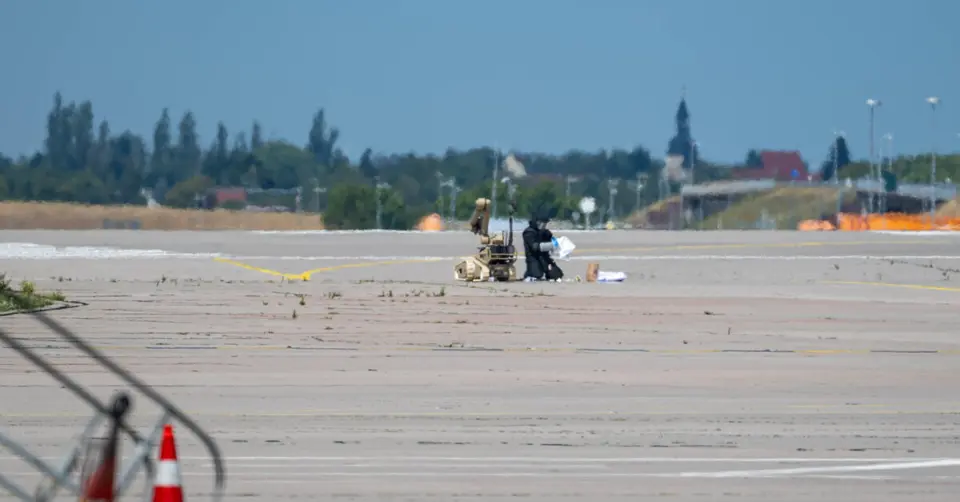
Germany identifies two suspects in drone attack at Leipzig airport
Police have identified two suspects in connection with a hybrid drone attack carried out at Leipzig airport last month, reported 15min on Wednesday, citing German media. One of these suspects has links to Lithuania.
According to the newspaper Süddeutsche Zeitung (SZ) and regional public broadcasters NDR and WDR, the first suspect is a Belarusian citizen who also holds a Russian passport. It is believed he entered the Schengen area on an Italian tourist visa issued in Minsk. His DNA, reportedly, was found at the airport, and he had previously drawn attention due to crimes committed in the Baltic states.
The second suspect, reported to hold Latvian and Russian passports, acted in the role of logistics coordinator and instructor. Having arrived at Berlin airport in late July, he rented a car and travelled to the Leipzig region, leaving Germany two days before the suspected attack.
Both men were identified based on DNA traces found on the drone, the container filled with explosives, and on an antenna attached to a tree. European databases made it possible to identify matches first in Lithuania and Finland, which were confirmed by information from intelligence services.
The drone was detected in a secure cargo operations zone, near an aircraft belonging to Ukrainian company Antonov Airlines. Later, another drone with traces of explosives was found near the airport. This airport plays an important role in transporting military goods, including cargo for Germany's armed forces and NATO allies.
On Tuesday, the German government accused Russia of the incident, stating that "low-level agents" had been involved in this operation. As a countermeasure, Berlin announced the closure of Russia's consulate in Bonn and the Russian cultural centre in Berlin. Russian President Vladimir Putin called Germany's response "a mistake, and a very serious one". Moscow in turn summoned Germany's chargé d'affaires to protest against "anti-Russian actions by German officials".
German investigators, following last month's incident, also determined that a DNA trace found matched one discovered after a July 2024 incident at the DHL logistics centre in Leipzig, when a shipment transported through that centre caught fire.
Lithuanian Prosecutor General Nida Grunskienė on 19 August confirmed the connection between the drone incident in Leipzig and a case being investigated in Lithuania into incendiary parcels sent abroad. "I will not comment, as I do not wish to prejudice the success of the investigation," said Grunskienė when asked about a possible DNA link to a specific individual.
The investigation is being carried out by a joint task force, which includes officials from the United Kingdom, the Netherlands, Latvia and other countries. The incendiary device case is currently being heard by Vilnius Regional Court – charges have been brought against five individuals who are considered perpetrators and intermediaries. The organisers of the crimes, according to officials, are in Russia and are currently unreachable. It has been established that the operations were organised by Russia's armed forces' Main Intelligence Directorate.
In 2024, four parcels containing incendiary devices were sent from Lithuania to the United Kingdom and Poland – two of them were transported via DHL.
Source: 15min