First-person shooters and terror: how gaming platforms contribute to radicalisation
Several attackers were excessive gamers – according to author Dirk Laabs, this is no coincidence. The real problem is the platforms where perpetrators network and radicalise.
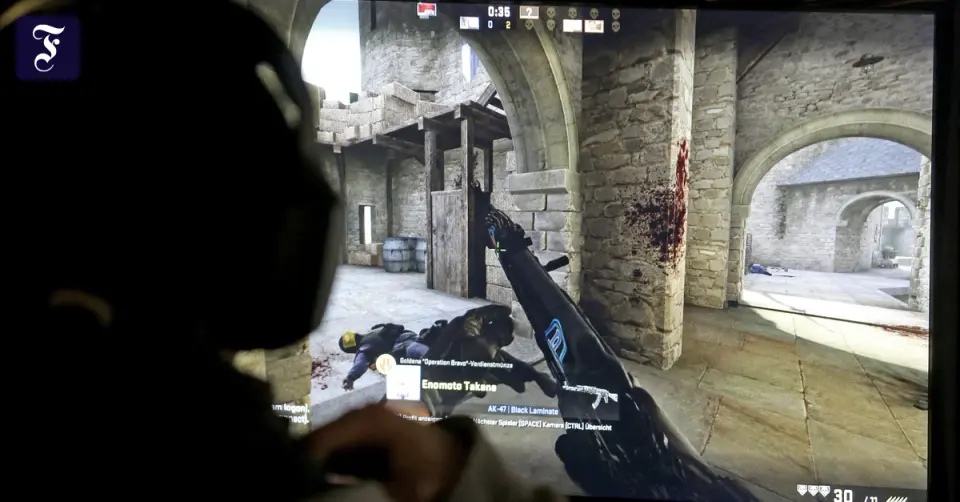
When digital violence and real attacks form a pattern
A player throws grenades, reaches for an assault rifle, aims at opponents. The nearly ten-minute video on Youtube shows scenes from the first-person shooter "Counter-Strike 1.6" – more than twelve million people have watched it, many with nostalgic feelings. For Ali Sonboly, the game was far more than entertainment. According to the Frankfurter Allgemeine Zeitung, filmmaker and author Dirk Laabs described it as Sonboly's "life's purpose": the then right-wing young man spent over 4,000 hours on the Valve platform Steam playing "Counter-Strike". In July 2016, he killed nine people in Munich and injured five others.
Sonboly is not an isolated case. Laabs, who published the documentary series "World White Hate" and the monograph "Army of Lone Actors" in 2025, puts it directly: "Every terrorist I looked at more closely was an excessive gamer." This does not mean that first-person shooters automatically turn people into attackers. But there is a pattern – and it ranges from Erfurt in 2002 to Emsdetten in 2006 to Winnenden in 2009, each time perpetrators with a pronounced passion for killer games.
Reflexive debates without answers
After each of these attacks, calls for bans followed reflexively, followed just as reflexively by criticism of the critics – and in the end, the questions remained unresolved: Do first-person shooters brutalise young people? Or is this an unsubstantiated claim by people who cannot tell the difference between a pistol and a mouse button?
According to Laabs's assessment, the debate is heading in the wrong direction as long as it focuses solely on depictions of violence. For killer games are not only an art form with its own ambitions – depending on perspective, they are also dubious. The fact that digital worlds in which people are killed have become so widespread that one can speak of a distinct culture does not automatically make them harmless. A liberal attitude risks tipping over into indifference at this point.
The Atchison case: from Steam account to school
William Atchison, born in 1996 in New Mexico, played a modified version of "Grand Theft Auto" in which he killed figures who looked like Orthodox Jews. He posted screenshots of this on his Steam account with comments like "Kill the Jew". At the age of 19, he wrote publicly in a forum that he was planning a "mass shooting" and was looking for cheap weapons.
A user forwarded this statement to the FBI. Two agents visited Atchison in spring 2016. He showed them internet sites on which attackers like Anders Breivik and Dylann Roof – who killed nine African Americans during a Bible study in Charleston in 2015 – were worshipped. He had named his Steam username after mass murderer Adam Lanza, who killed 20 children and six staff members at Sandy Hook Elementary School in 2012. To the agents, Atchison explained that his statements were merely jokes. He only possessed replica weapons and did not want any trouble. In the FBI report, it subsequently stated that he posed "no threat to the security of the United States".
In December 2017, Atchison typed into his computer: "If everything goes according to plan, I will die today. … I set out on foot, disguised as a student. I … then take a class as hostage and go berserk before I blow my brains out." He then drove to his former school, shot two students and took his own life. Ali Sonboly – the Munich attacker – was among his online contacts.
The real problem: the platforms
Laabs emphasises that attacks of this kind are not new. What has changed is the cross-border networking of perpetrators: "They have each other in their ears all day long and cultivate a sense of belonging together. And that amplifies the effect of the game."
At peak times, 40 million users are simultaneously active on Steam. These platforms create an infrastructure in which young men reinforce each other, exchange information about weapons and come up with the idea of live-streaming a mass murder – as the Christchurch attack in 2019 demonstrated, when the perpetrator broadcast his act via live stream and deliberately oriented himself towards video game aesthetics.
The debate also includes the game "Hatred", released in 2015, in which the sole objective is to kill as many civilians as possible. It stands exemplarily for content that operates beyond any artistic ambition – and that is distributed on the same platforms through which potential perpetrators network.
No simple cause-and-effect principle
It would be wrong to condemn all video games with depictions of violence. It would be equally naive to dismiss all forms of digital violent spectacle as insignificant. In retrospect, it is hardly possible to prove whether a particular game turned a particular player into a murderer. Remarkable nonetheless is the fact that so many young men enjoy blasting their way through digital worlds – and that a small portion of them transfer this impulse into reality.
According to Laabs, a different debate is therefore needed: not primarily about game content, but about the platforms that function as networking and radicalisation spaces. The old debates about killer games, according to his findings, are simply too narrow.
Source: Frankfurter Allgemeine Zeitung