Commemoration in Fürstenfeldbruck and Munich: 54 years after the Olympic massacre
At memorial ceremonies in Fürstenfeldbruck and Munich, speakers remembered the twelve victims of the Palestinian attack in 1972 and called for action against antisemitism.
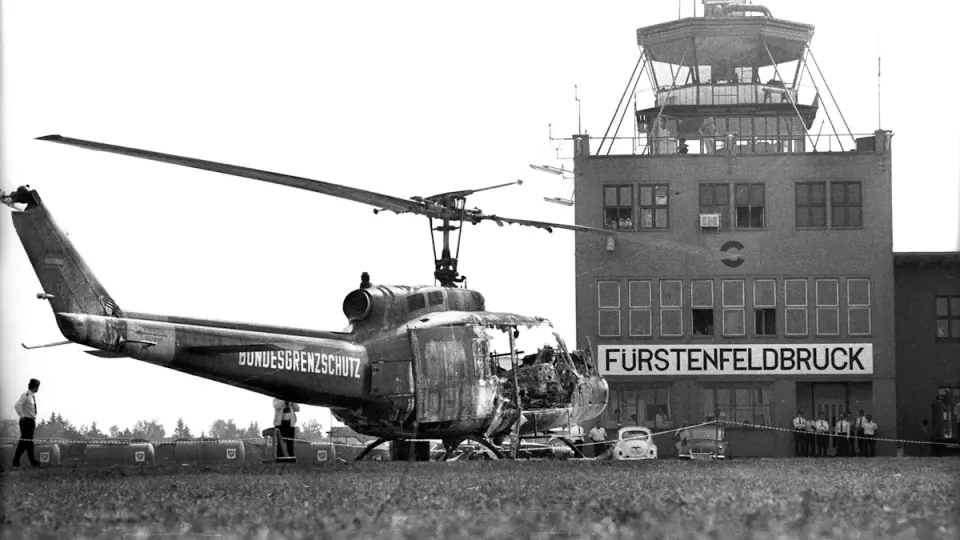
Memorial and commemoration: Munich and Fürstenfeldbruck remember the 1972 Olympic victims
On Friday, representatives from politics, religious communities and civil society remembered the twelve victims of the Palestinian terrorist attack on 5 September 1972. According to the Süddeutsche Zeitung, the memorial ceremonies took place both at the memorial site in the Olympic Village in Munich and at the memorial at the airbase in Fürstenfeldbruck.
In the attack 54 years ago, eleven Israeli athletes and a Bavarian police officer were killed. The motivation of the perpetrators was "hatred of Israel and hatred of Jewish people," said Charlotte Knobloch, president of the Israelite Community of Munich and Upper Bavaria, at the main memorial ceremony in Fürstenfeldbruck. "This hatred confronts us to this day, in Munich, in Germany, throughout the whole world."
Around 50 participants at the memorial
Around 50 participants gathered at the memorial in Fürstenfeldbruck, including relatives of the victims, local politicians and representatives of the police and armed forces. Sculptor Fritz König, who had designed the memorial, was also present. The twelve forged flame rays of the memorial symbolise the twelve victims of the attack and the twelve tribes of Israel.
Fürstenfeldbruck deputy district administrator Martina Drechsler (CSU) stated that we still live, or once again live, "in uncertain times". The attack obligated us to remain vigilant. State Secretary Sandro Kirchner (CSU) from the Bavarian Interior Ministry called for combating antisemitism in every form. He recalled that two Israeli athletes had already been killed in the Olympic Village; the remaining hostages as well as the police officer died during the "rescue operation" at the airbase, which "failed catastrophically".
Continuity of antisemitism
Holocaust survivor Knobloch recalled that in 1972 Munich, as the former "capital of the movement" of the National Socialists, wanted to create a new image of itself with cheerful games. The only "offence" of the victims was that they were Jews. Antisemitism was again a major problem today and had "lost none of its poison".
Both Knobloch and Talya Lador-Fresher, Consul General of the State of Israel for Southern Germany, drew a line from the 1972 attack to the pogrom of 7 October 2023, in which Hamas and its allies murdered more than 1,200 people in southern Israel and abducted more than 240 others. Lador-Fresher, who had watched the hostage-taking as a child on television, called the Munich attack a turning point: it was the first terrorist act to be broadcast live on television. Hamas represented a new level of atrocity — its perpetrators filmed with body cameras as they tortured, raped and murdered victims, and posted the footage online immediately.
Names of the murdered read aloud
All speakers read out the names of the twelve victims: David Berger, Yossef Gutfreund, Amitzur Shapira, Andrei Spitzer, Eliezer Halfin, Kehat Shorr, Yakov Springer, Ze'ev Friedman, Yossef Romano, Mark Slavin and Moshe Weinberg, as well as police officer Anton Fliegerbauer. Rabbi Shmuel Aharon Brodman, Vice Dean Reverend Otto Gäng and Reverend Matthias Biber then prayed for the victims.
Commemorative walk in the Olympic Park
Earlier in the morning in Munich, representatives of Jewish and Israeli organisations, Consul General Lador-Fresher, Police President Thomas Hampel and Sapir von Abel from the Jewish Museum Munich had met for a commemorative walk through the Olympic Park. The annual tour of the crime scene led from the memorial site to Connollystrasse 31, the former quarters of the Israeli delegation.
The walk also included contemporary witness Godel Rosenberg, who had experienced the 1972 Games on site as a young reporter and later became Press Secretary to Franz Josef Strauß. Following his remarks, Lador-Fresher said: "It was the first terrorist attack to be broadcast live, and it should have been a sign for all of us: about how much terror can change our lives, and about what we must do in response to it."
Source: Süddeutsche Zeitung