Memorial service in Munich: 25 years after NSU murder of Habil Kılıç
The Turkish Council commemorated Habil Kılıç at Bad-Schachener-Straße, the NSU's first victim in Munich. He was shot in his vegetable shop on 29 August 2001.
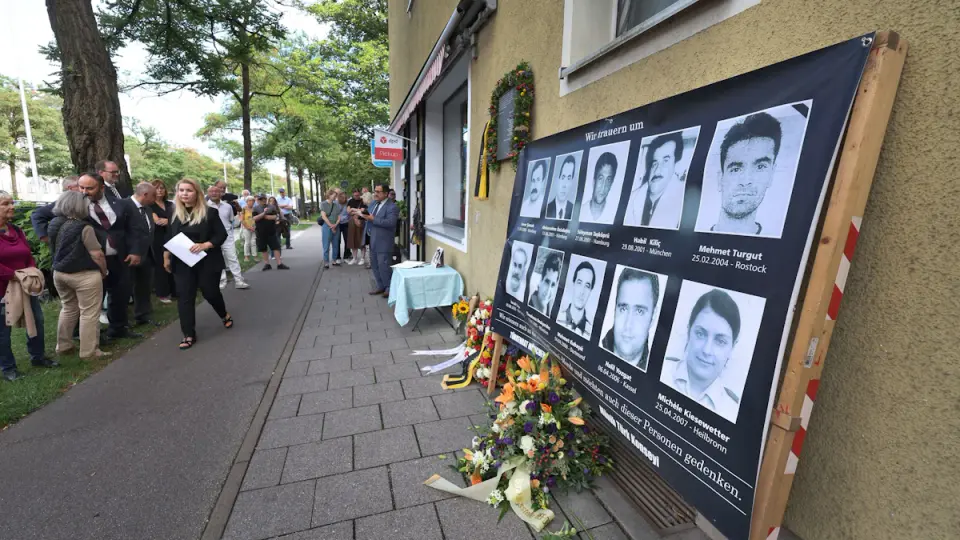
Silent commemoration at Bad-Schachener-Straße
A small memorial service took place on Saturday in front of the house at Bad-Schachener-Straße 14 in the east of Munich — precisely where Habil Kılıç was shot in his vegetable shop on 29 August 2001. According to the Süddeutsche Zeitung, the Turkish Council Munich organised the event to mark the 25th anniversary of the murder.
Kılıç was the fourth victim of the far-right terrorist group "National Socialist Underground" (NSU) and the first in Munich. Four years later, Theodoros Boulgarides was also shot in the city. Of the ten NSU victims in total, all except police officer Michèle Kiesewetter had a history of migration.
Appeal against racism and fanaticism
Sami Demirel from the Turkish Council appealed to society to "be sensitive to any form of growing racism, violence, fanaticism, antisemitism and Islamophobia". The Turkish Council had leaned a poster with photos of all ten NSU victims against the house wall. Mayor Mona Fuchs (Green Party) laid a wreath on behalf of the city on Saturday morning without press accompaniment. Someone left a small bouquet next to it with a handwritten note: "Habil, we have not forgotten you!"
Kılıç was 38 years old when he died. His daughter lost her father at the age of twelve. The family members continue to avoid the public eye.
"Historical guilt of the state"
Markus Rinderspacher (SPD), Vice President of the Bavarian State Parliament, recalled that the Kılıç family had also lost their economic livelihood at the time. The widow had once expressed that she felt she had died herself. Rinderspacher described the fact that society and security authorities had failed to recognise the emergence of a murderous far-right terror cell as "historical guilt of our state".
For too long, state institutions had met events "with indifference". He also pointed out that many families of NSU victims had been suspected by the police at the time — a second, profound violation. As a consequence, Rinderspacher called for an intensification of political education, particularly for young people. Regarding the murder of Kılıç: "No forgetting. No line drawn under it."
Islamophobia on the rise
Mehmet Hacısalihoğlu, professor and head of the Chair of Turkology at Ludwig Maximilians University, reported a troubling observation: since his arrival in Germany in 1992, he had never overheard as many Islamophobic conversations as he currently does. Racism, according to Hacısalihoğlu, affects not only the group being marginalised — it quickly damages all people in Germany.
Emeritus professor of economics Kemal Orak broadened the perspective to structural failures in dealing with the NSU murders: "Truth also includes the violence of non-recognition, the violence of disbelief" and that "of a gaze that does not first see the person, but their supposed origin". Orak promised to keep the memory alive: "Fortunately, one cannot murder memory."
Source: Süddeutsche Zeitung