Acquitted men in double murder case trigger criticism of police use of encrypted messages
Two men were acquitted by the Eastern High Court in a case concerning a double murder in Kalundborg. Defence lawyers are now criticising the police's handling of SKY ECC evidence material.
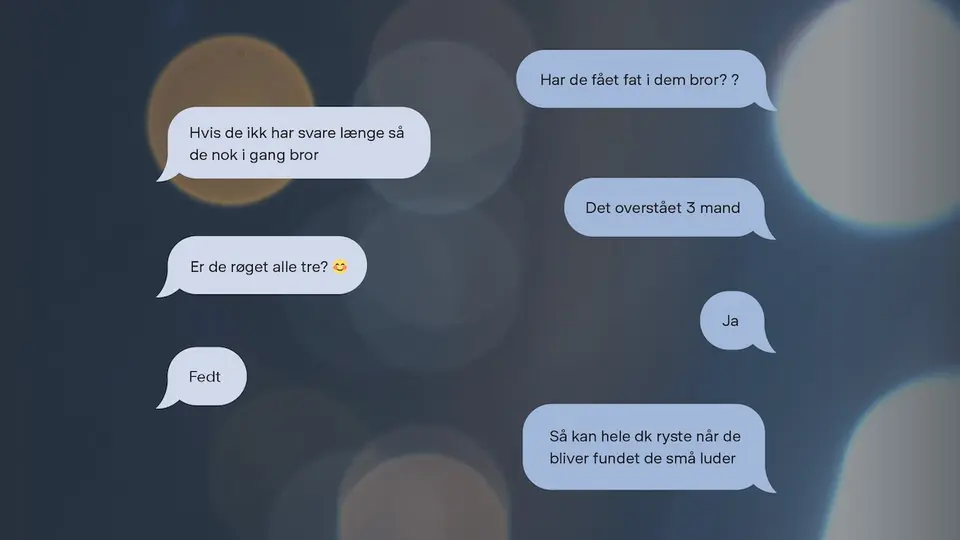
Lawyers: SKY ECC material provided an incomplete picture
When European police authorities cracked the encryption in SKY ECC in 2021, it opened up thousands of messages that criminals never expected others would read. In Denmark, the material has so far resulted in prison sentences totalling over 1,000 years, including life sentences for six people for a double gang murder near Meny in Kalundborg.
Yet two men have since been acquitted by the Eastern High Court in the same case. The court found that the chat material from SKY ECC could not stand alone as evidence that they had planned the murder. This is reported by DR.
Lawyer: Half conversations create a misleading picture
Defence lawyer Thomas Brædder, who represented one of the acquitted men, points to a fundamental problem with presenting only one party's messages from an encrypted chat thread.
He provides an example: If you write to a friend and suggest going to the cinema in the evening, and the friend replies by moving the arrangement to the next day, a reader who only sees the sender's part of the conversation would believe that the arrangement is still for the same evening.
"It illustrates very simply — with just four lines in a chat correspondence — that what we assume cannot be relied upon," says Thomas Brædder.
Increasing number of messages raised suspicions
The other defence lawyer, Peter Secher, who represented the second acquitted man, describes how during the course of the case he received messages from the police on three occasions — and the volume increased markedly each time.
"First I receive approximately 9,000 messages. The second time I receive around 14,500 messages, and the third time I receive 21,000 messages," says Peter Secher.
He attempted to clarify why the number increased, but did not receive a satisfactory answer from the police. Moreover, he observed that the same message appeared up to 21 times in the material, and that a group chat apparently continued with activity after it had been marked as "terminated" — that is, closed.
"There were incredibly many things that looked very strange," says Peter Secher.
Criticism of tunnel vision during investigation
Both lawyers believe that the police and prosecution may have a tendency to develop tunnel vision in cases involving SKY ECC material.
"Sometimes one is too busy trying to confirm a theory one already has, and forgets to include what points the other way. It happens occasionally that one looks through the wrong end of the telescope, unfortunately," says Peter Secher.
Supreme Court approved the evidence in 2023
The question of whether SKY ECC and EncroChat evidence should be used in Danish criminal trials at all was previously decided by the Supreme Court. Peter Secher and two colleagues argued that the correspondence was obtained through what is known as a fishing expedition by French police, and that Danish rules were therefore not followed.
In January 2023, however, the Supreme Court established that there are no legal safeguard concerns about using the evidence, as it was a purely French operation, and the material reached Denmark via official judicial requests.
Deputy State Prosecutor: Old wine in new bottles
Kristian Kirk, deputy state prosecutor at the State Prosecutor's Office for Serious Crime, fundamentally rejects the criticism from the two defence lawyers.
"I will venture the claim that this is old wine in new bottles," says Kristian Kirk.
He emphasises that the material from EncroChat and SKY ECC together has resulted in prison sentences totalling well over 1,000 years, and that the prosecution only brings cases where there is assessed to be a prospect of conviction.
"If one had assessed that the material was incomplete, and that one would not be able to say that it was X who had used the profile, then of course one does not bring the case," says Kristian Kirk.
He adds that chat correspondence unconnected to concrete, verifiable circumstances in reality constitutes weak grounds.
"Because if one has some correspondence that is completely detached and does not point to anything concrete in reality, then one has a problem."
Police deny bias
The case was investigated by Central and West Zealand Police. Deputy Chief Constable Lars Krogsgaard previously rejected to DR that the investigation was characterised by tunnel vision.
"There is no room for bias in the way we conduct investigations today. Everything is hypothesis-driven. Everything is transparent," said Lars Krogsgaard.
Thomas Brædder's client was convicted in the district court — the Holbæk Court — solely on the basis of SKY ECC material, before the Eastern High Court later acquitted him.
Source: DR