370 tonnes of drugs seized in Spain in 2025: hashish in the south, MDMA in Valencia
Spain's Interior Ministry recorded 370 tonnes of drugs seized in 2025, with cocaine declining and synthetic substances surging. Andalusia and Valencia concentrate the main trafficking routes.
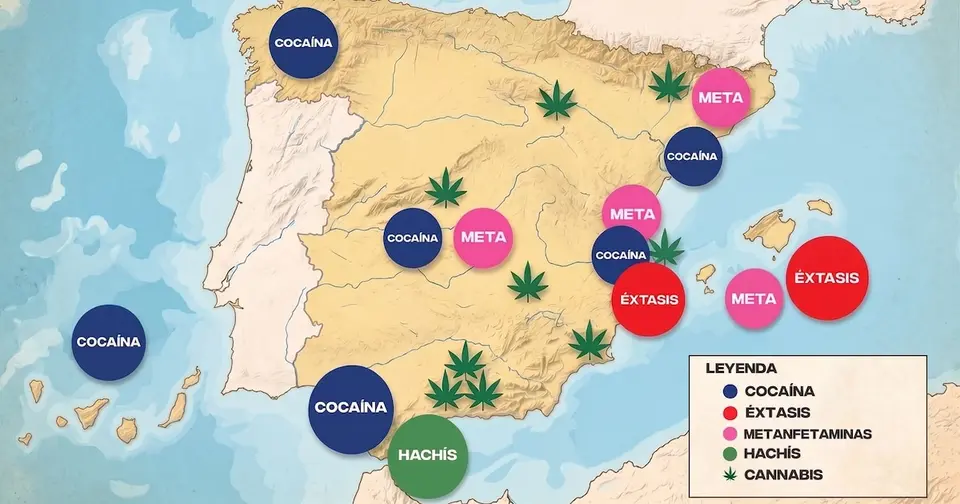
Drug trafficking in Spain 2025: geographical routes and variations by substance
Google News ES — Crime (es) reports data from the latest Interior Ministry report, which describes a scenario of territorial contrasts in drug trafficking during 2025. Spanish authorities seized a total of 370 tonnes of illicit substances throughout the year, a figure marking a clear decline compared to previous years and accompanied by a fall in the number of arrests.
The document points to a generalised decline in seized cocaine, a notable uptick in hashish and significant growth in synthetic drugs compared to 2024. Geographical variations are redefining the map of drug trafficking in the country, which functions in several locations as an entry point to Europe.
Hashish: Andalusia accounts for 77% of the national total
The southern peninsula continues to be the main entry route for hashish, and 2025 marked a sharp uptick. Seizures reached 257,283 kilos, an increase of 29.14% compared to the previous year. Andalusia concentrated 77% of the national total, consolidating the Strait of Gibraltar and the southern border as the most active access point to the European continent. Ceuta increased its seizures sevenfold to 12,688 kilos, ranking second on the national scale.
The Campo de Gibraltar remains the most affected area in recent years. The entry of hashish through the Cádiz municipalities, a historical constant, is now beginning to extend to cocaine as well.
Cocaine: 37% decline and territorial redistribution
Authorities seized 77,010 kilos of cocaine in 2025, representing a reduction of 37.82% compared to the previous year. Andalusia retained its leading position as the point of arrival, although its volume fell to 25,610 kilos, half that of 2024. The Canary Islands, Catalonia and the Valencian Community also registered declines, each standing at around 12,000 kilos. Galicia, which had ceased to be the major importer from Latin America, grew again to 9,338 kilos.
MDMA: the Mediterranean arc concentrates 89% of units
MDMA trafficking saw one of the largest increases of the year. Authorities seized 658,443 units, 40.78% more than in 2024, though similar figures had already been recorded in 2022 and 2023. The epicentre was the Valencian Community, with 375,474 units seized, whilst Murcia and the Balearic Islands experienced exponential jumps. Madrid, which had been a central node in this trafficking, saw its figures reduced to less than one third. The Mediterranean arc—Valencia, Murcia and the Balearic Islands—accounted for nearly 89% of the national total.
The Port of Valencia figures in the report as one of the hotspots across all of Europe in synthetic substance trafficking.
Methamphetamines: 178% increase in a single year
In 2025, Spain recorded the entry of 340,698 units of methamphetamines, an increase of 178.79% compared to 2024. Madrid led the volume with 133,183 units, followed by the Valencian Community with 79,107 and Catalonia with 73,763.
The overall figures for 2025 indicate that drug trafficking in Spain adapts routes and strategies according to police pressure and changes in consumption patterns, with Galicia, Catalonia, Madrid and the two archipelagos completing the top positions by seized volume.
Source: Google News ES — Crime (es)