Murder of Bartolomé García: the forgotten police crime of the Canarian Transition
In September 1976, barely a year after Franco's death, police killed student Bartolomé García in Santa Cruz de Tenerife. The incident triggered massive protests that exposed the weakness of the judicial system in prosecuting those responsible for repression.
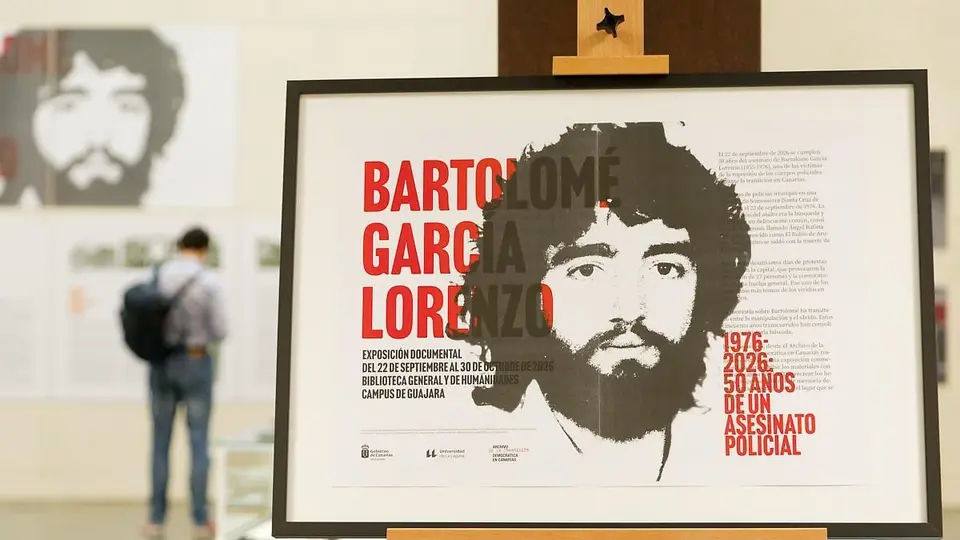
The student who died in a failed police operation
According to eldiario.es, on 22 September 1976 a group of police officers broke into a home in Santa Cruz de Tenerife seeking to capture Ángel Batista Cabrera, known as El Rubio. They fired pistols and submachine guns. Bartolomé García Lorenzo, a 21-year-old teaching student who lived in the building, died in the operation. The shots were directed at the first person to open the door without the officers identifying themselves as police.
The death triggered massive protests in Tenerife and Gran Canaria that lasted several days and led to a general strike. Police arrested 27 people during the clashes. The incident exposed the severity of the repressive practices that the dictatorial regime had normalised and which continued without immediate changes after Franco's death.
An investigation marked by police incompetence
Domingo Garí, a History professor at the University of La Laguna, has documented this case in his book The case of Bartolomé García Lorenzo and other studies of recent history. In his investigation he emphasises that the operation was marked by "grave incompetence committed by the officers involved, coupled with a police practice typical of the era called trigger-happy".
Investigators never corroborated that Bartolomé had any relationship with Ángel Batista Cabrera or that he was the target of the operation. According to the case summary, when the police entered without identifying themselves, the young man closed the door after seeing them armed. Already wounded by gunfire, he shouted to his cousin Antonia: "Lock the doors and get the girls" and then "watch out for the child because bullets are coming into the bedroom".
Garí emphasises that "Bartolomé was a mistaken victim, collateral damage of the system of impunity and generalised repression in which the repressive bodies of the dictatorship operated".
The weakness of the judicial system
The most significant aspect of the case was the impunity of those responsible. The trial demonstrated "the weakness of the judicial system in punishing those responsible for the murder". The police officers involved received derisory sentences: none was sentenced to prison nor did their professional careers suffer.
Jenny del Pino García, a Journalism professor at the University of La Laguna, has investigated how the Canarian press covered the incident under restrictive conditions. During the Transition, the media were governed by the Fraga Law, which required newsrooms to publish notes from the authorities and prohibited the dissemination of information deemed contrary to "public order". "After prior censorship, journalism looked favourably on the Fraga Law, but we had a law that could result in publication being withdrawn and even fines to both the editor and the media outlet," explains del Pino.
The lack of official information and obstacles from the authorities made it difficult for the Canarian press to provide more exhaustive coverage of the crime. The media were obliged to insert "the mandatory notes from the civil governor".
The context of a turbulent Transition
Del Pino García stresses that the social context of 1976 was "very turbulent". Although dictator Franco had died in 1975, the civil governments, police and judiciary remained the same. "We did not yet have the Spanish Constitution, but society was already beginning to mobilise, wanted change and wanted real change," she notes.
Massive protests were particularly intense in working-class neighbourhoods, where there was greater social movement. Garí stresses that "the matter expands socially as a social and political protest because the regime at that point is exhausted by the majority of society".
The need for memory
Del Pino García stresses that it is important to remember who Bartolomé García Lorenzo was beyond the circumstances of his death. He was "a teaching student, lover of mountaineering, lover of music," according to his siblings. He was a young man who "wanted to take on the world," participated in all possible activities in his neighbourhood and was integrated into his community.
"We cannot forget the case of Bartolomé. He is not the only person murdered during the Transition. It was not a model Transition," del Pino emphasises. The story of the Canarian student remains as testimony that the political change in Spain was not accompanied by an immediate break with the repressive practices of the dictatorial regime.
Source: Google News ES — Crime (es)