Four arrests for drug trafficking in Torre Pacheco amid persistent social tensions
Anti-drug operation in Murcia dismantles a network distributing narcotics in a municipality marked by intercommunal violence since summer 2025.
Four arrests for drug trafficking in Torre Pacheco amid persistent social tensions
A Guardia Civil operation has concluded with the detention of four people in Torre Pacheco, Murcia, who are linked to running an organisation dedicated to the illegal supply of narcotics. During the search, officers seized significant quantities of cocaine and crack. This intervention takes place in a context of growing insecurity that has plagued the municipality for months.
Just weeks ago, a Senegalese man was admitted in serious condition to a hospital in the Murcia capital after being struck with a hammer in an occupied house in the urban centre. The aggressor, of Algerian nationality, remains on provisional release whilst judicial proceedings advance. In another recent incident, a secondary school teacher publicly reported suffering a beating by a student during a PE class. Days later, four young people—one of them a minor—were brought before the courts for assaulting and robbing a resident following a traffic dispute.
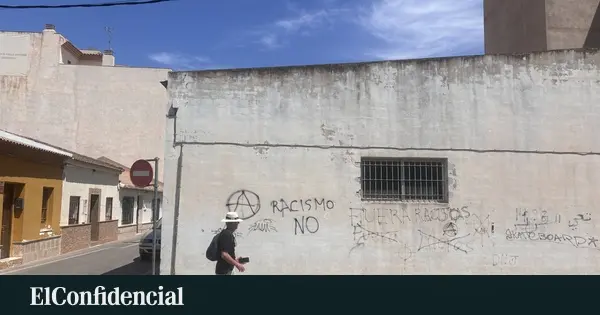
Summer 2025 turned this locality in the Campo de Cartagena into the epicentre of an unprecedented coexistence crisis in contemporary Spain. Street confrontations between residents of Spanish origin and Maghrebi communities triggered a spiral of violence that transcended media boundaries. Twelve months later, the wounds remain open: judicial proceedings for the multiple assaults progress at a crawl, many residents avoid passing through certain areas after nightfall, and the fracture between ethnic groups has crystallised into a palpable territorial segregation.
A team from El Confidencial approached the occupied building where the savage assault with a blunt instrument was perpetrated. From within emerged three individuals of foreign origin who, without a word, adopted a hostile posture and slammed doors and windows shut. The property, located on a central thoroughfare, displayed extreme deterioration: rubble, accumulated rubbish and nauseating odours. Pedestrians walking on the opposite pavement quickened their pace to avoid crossing.
The origin of the socioterritory conflict dates back to the launch of the Tagus–Segura Transfer in 1979, which revitalised the agricultural sector and attracted foreign labour. Initially, workers arrived from other Spanish provinces; subsequently, the demand for day labourers brought with it a wave of migration from the Maghreb, especially from Morocco. The nineteen nineties incorporated contingents from Romania and Latin America, shaping the current demographic map.
Paulino Ros, a chronicler born in the municipality itself and a scholar of immigrant populations, traces the origins of the current disturbances to past decades. In the mid-nineteen nineties, a local association attempted to programme a concert featuring a renowned Moroccan musical group for the foreign community settled there. The initiative met with outright rejection from sectors of the native population, who wielded xenophobic slogans, and could not materialise until four years later.
Activists for coexistence denounce that exclusion not only persists but has become institutionalised. Young people born on Spanish territory but children of parents from North Africa assert that public administrations and mainstream society treat them as foreigners, despite holding nationality from birth.
The early morning of 9 July passed without incident following the elimination of the Moroccan national team from the football World Cup. However, the tension was palpable: shops closed earlier than usual and police patrols increased their presence in neighbourhoods considered sensitive. The sporting defeat averted another night of disturbances, but no one in Torre Pacheco rules out that a new spark might rekindle the powder keg. Between anti-drug raids, racial assaults and fractured neighbourhoods, the Murcia municipality faces yet another summer in the shadow of violence.
Information obtained from El Confidencial
Source: Google News ES — Crime (es)