The book revealing the secret operations of the UCO, the Guardia Civil's elite
A new book documents the most unknown investigations of the Central Operational Unit, from serial killers to drug trafficking and cyber crime.
The UCO beyond political corruption: serial killers, mafia and organised crime
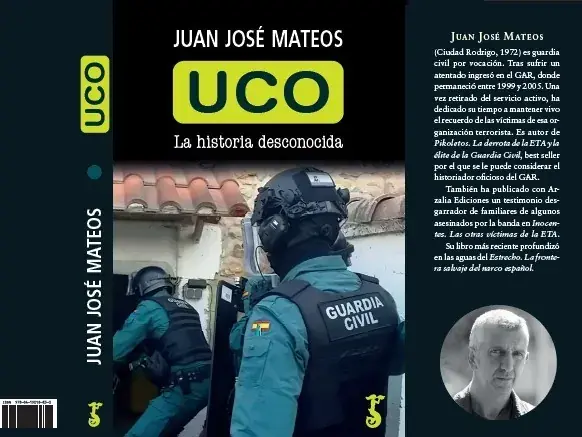
According to El Mundo, only around 10% of the cases investigated by the Central Operational Unit (UCO) of the Guardia Civil are related to political corruption, despite this being the area that attracts the most public attention. The remainder encompasses drug trafficking, mafia, large-scale robberies, cyber crime and infiltration operations, according to details in the book UCO, the Unknown History, published by Arzalia publishing house and authored by Juan José Mateos.
The work documents investigations, surveillance operations, arrests, interrogations, confessions and convictions of several serial killers, including one described as the bloodiest in Spain. The common thread is an investigator known as Quini, presented as one of the best professionals not only in the Guardia Civil, but across all Spanish police forces.
The interrogation technique: logic before protocol
In one passage of the book, Quini exposes his philosophy to a detainee: "You must speak to the detainee alone, and you should only put on the table what you know and are sure is real, because if they observe that you don't have good information, they think you don't know what you're doing and that gives them a big advantage".
The investigator attributes his method not to specialisation courses, but to the veterans he worked with in his early years: "Back then it was the street that gave you experience, it's pure and hard logic". He particularly recalls a sergeant named Eulogio and several post commanders who, in his words, "treated detainees as if they were poor souls, they got all the information out of them with a sandwich, a glass of wine and kind words".
Quini acknowledges that times have changed: "Nowadays they train you already, there are real experts and courses on the subject, although each person or criminal is very different".
A night-time surveillance operation in a nightclub
The book details a surveillance operation in which the UCO team located a murder suspect inside a nightclub. The agents, undercover and with codenames such as "Barbi" and "Pelu", communicated in an agreed-upon language whilst tracking the target's movements.
"Attention, the target is moving, looks like he's going to leave", transmitted Barbi number 1 at one point during the surveillance. "The girl has been talking to another guy for a while... she's constantly moving, now she's heading towards the door, she's going outside."
The agents described extreme proximity to the suspect: "I've got him in front of me, his back to me, bloody hell, how this guy perfumes himself, he smells posh", one of them reported in internal communication. The target, according to the account, had been watching a young woman who was alone for some time, the same one he had watched in a nightclub the previous weekend, following her afterwards to the car park.
The pursuit on the seafront promenade
The situation became critical when the suspect put the young woman into his vehicle, a white Seat Ibiza, and left the car park in the wrong direction. The narrator, at the wheel of a van with company advertising on it, followed behind with the lights off.
"The most important thing was the state of that girl", writes Mateos. "We thought he was going to take her somewhere to commit rape and kill her." The team coordinated the operation along the seafront promenade until number 4, who was driving ahead, was able to block the vehicle and proceed with the arrest.
Quini describes the detainee as "evasive and cautious", which explains, according to him, how long it took to arrest him. The judge authorised the exhaustion of the seventy-two hours of detention without objection.
The confession that astonished the judge
When the defence lawyer arrived, the interrogation had already concluded with an unexpected result. "She was surprised that he incriminated himself for everything", the book relates. The judge and the unit's commanders also reacted with astonishment: initial reports indicated that the detainee had only admitted attempted assault against two of the victims.
The reconstruction of the facts added another twist to the case. The suspect guided the agents from the first scene to the last, marking the exact points where he had acted in each of the murders. "We did the exact route he took in all the murders", Quini recounts.
A unit operating away from the political spotlight
UCO, the Unknown History draws a portrait of the unit removed from its most media-friendly image. Through the cases documented by Mateos, there emerges a structure dedicated mainly to organised crime in its various forms, with investigators who built their craft on experience accumulated on the streets before specialised training programmes that the force now offers existed.
The book, available from Arzalia publishing house, offers a reading of the UCO from within, with direct testimony from those who conducted some of its most complex and, until now, least known investigations.
Source: El Mundo