Civil Guard unions demand reactivation of OCON-Sur with data: arrests fall 15% in Andalusia
Civil Guard associations are calling for the return of OCON-Sur four years after its dissolution, backed by statistics showing a 15% drop in drug-related arrests in Andalusia.
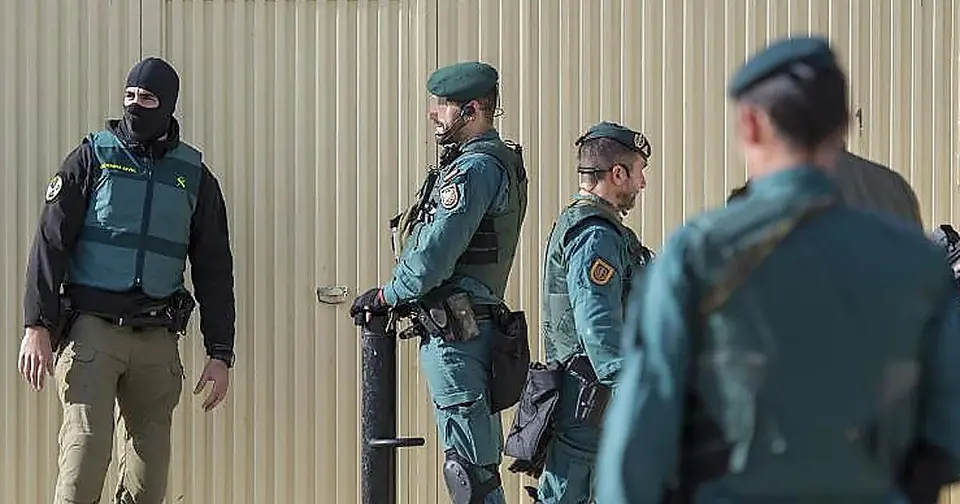
Four years without OCON-Sur: drug figures in Andalusia support calls to reactivate it
Civil Guard associations have renewed their demand to reactivate OCON-Sur, the special anti-drugs operation dissolved in 2022, providing statistical data that, according to them, demonstrate the deterioration in investigative capacity in Andalusia since its disappearance. This is reported by ABC, which has had access to the formal requests from these organisations.
The Unified Association of Civil Guards (AUGC), the largest in the Armed Institute, demands that the operation return with a "stable and permanent" organisational structure. Its central argument rests on a comparison between the evolution of drug-related arrests at national level and those recorded in the Andalusian community: "Whilst drug-related arrests grew by 5.6% across Spain as a whole, in Andalusia they fell by 15.0%. The divergence is 20.6 percentage points," the AUGC recalled.
The association emphasises that "the fall is continuous and without exception since 2021", the last full year of the operation's activity. In cumulative terms, "Andalusia has lost 11.16 percentage points of national share and 34.8% of its arrests compared with the 2021 peak". The AUGC states that "Andalusia deviates from the national trend precisely from the year of dissolution" and demands that the Interior Ministry provide disaggregated data proving that investigative capacity remained stable, as it claimed at the time.
"Four years later, that data has not been published," they complain. OCON-Sur had around 150 specialist officers and made more than 12,000 arrests over four years. It was dissolved, moreover, against the opinion of the Prosecutor's Office, which considered that decision a step backwards.
Zone of Special Singularity and reinforcement of personnel
The AUGC, along with other Civil Guard organisations such as Jucil and AEGC, is calling for the declaration of a "Zone of Special Singularity" for the Andalusian coast, Huelva and the course of the Guadalquivir river. The request, which in 2018 was limited to the Campo de Gibraltar, has gradually expanded as drug trafficking has spread to new territories. According to these associations, the problem is no longer confined to the coast, but has penetrated inland. The unions warn that it is only a matter of time before the Guadiana river is also included in the request.
At the same time, the AUGC denounces the lack of structural reinforcement of personnel with fixed postings and updated catalogues. The Civil Guard's maritime service has, according to the association, ageing personnel and no significant changes since its creation. Interior Minister Fernando Grande-Marlaska once justified the dissolution of OCON-Sur as a restructuring aimed at reinforcing commandancies with those officers. However, the reinforcements for Anti-drugs Teams (EDOA) never materialised.
Naval resources and compensation for extreme risk
With around 600 drug-trafficking speedboats operating in Mediterranean waters, the AUGC urges the creation of a multi-year plan for the renewal of naval resources. The request includes high-speed interception vessels, ballistic armour, bulletproof vests with buoyancy for crew members, a minimum team of four officers per vessel during boardings, and the replacement of unprotected semi-rigid boats in hostile operations. The organisations are also demanding earmarked funding for fleet maintenance and repairs, with public publication of days of inoperability due to breakdowns for each unit.
Officers facing armed narcos with military-grade weapons also do not receive specific compensation for "extreme risk" nor are they recognised as a "high-risk profession", another shortcoming the associations are demanding be remedied.
Intimidation of officers and their families
The AUGC incorporates into its demands a protection protocol against the targeting of officers and their families. The association denounces the existence of closed messaging groups used for systematic counter-surveillance of the Security Forces and Bodies, where the position of patrols is warned of in real time. Four such groups have been documented on the Guadalquivir and around a dozen in the Strait.
In the Campo de Gibraltar the situation is more serious: narcos carry out surveillance of law enforcement and exercise coercion involving the families of officers. According to the AUGC, "they tell them they know where they live or that they know their children". ABC has already reported a case in which several narcos tried to intimidate an officer during his son's birthday. The association demands that these episodes stop being treated as anecdotes and calls for a specific risk assessment for each officer exposed and their family environment.
Asset investigation and judicial response
The associations are also calling for greater specialisation and reinforcement of the judicial response, as well as asset investigation and effective seizure of the property of criminal organisations. On this last point, OCON-Sur was pioneering: it not only dismantled networks, but attacked their sources of financing. Investigators arrested lawyers and relatives of traffickers for money laundering and froze all their assets, targeting the social branch that profited from drug trafficking.
Source: ABC