Just four patrol boats to counter 600 drug-running speedboats on Andalusian coast
The Civil Guard has only four operational Aister HS60 patrol boats to monitor the entire coast of Andalusia against more than 600 active drug-running speedboats.
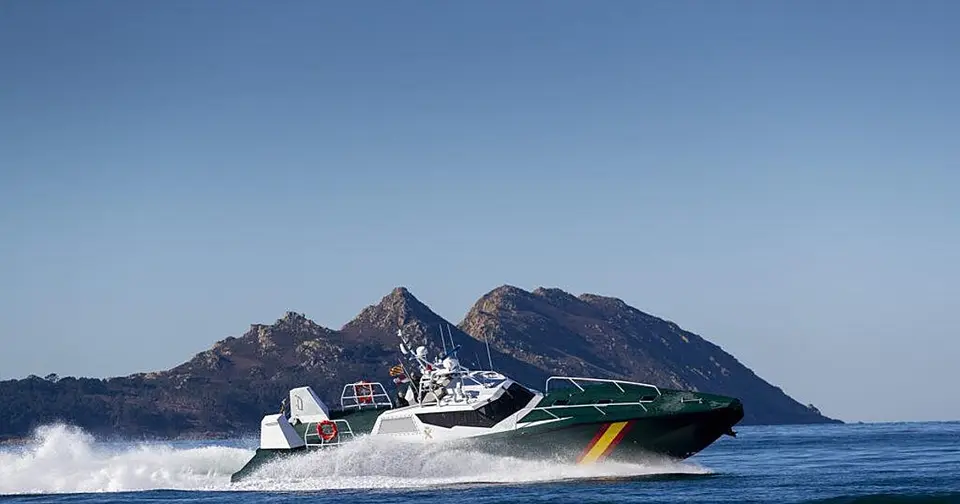
Four boats for a thousand kilometres of drug-trafficking coast
Only four Aister HS60 patrol boats are in service across Andalusia to contain a swarm of more than 600 drug-running speedboats engaged in drug trafficking, according to ABC. Agents of the Civil Guard's Maritime Service acknowledge the disproportion: the narcos' speedboats constantly trigger the Integrated Exterior Surveillance System (SIVE) along the coastline with the certainty that, at worst, they will only have to race to 12 nautical miles from the beach.
"You cannot shoot them to disable their engines. Legally we are not protected. So they go. We do not pursue them any further, because when we enter Moroccan waters and we encounter their navy, they have shot at us," says one of the Maritime Service agents consulted by ABC.
The HS60: technical capacity at operational limits
The Aister HS60 patrol boat is the most effective vessel available for intercepting drug-running speedboats. With 18.12 metres in length and 4.50 metres in beam, its aluminium hull displaces just over 20 tonnes powered by two inboard motors of 1,800 horsepower. It reaches 55 knots and is capable of stopping in two hull lengths from that speed, with a turning radius of less than two hull lengths to execute the zigzagging manoeuvres required during a pursuit. Its range exceeds 400 nautical miles at cruising speed above 40 knots, sufficient for twelve hours of service at sea.
The power is similar to that of four-engine drug-running speedboats. However, the agents themselves warn of the structural risk of ramming manoeuvres: "When you collide with them the aluminium hull can crack".
Territorial distribution: half the coastline without coverage
Of the four operational patrol boats, three are deployed in Cádiz province. One covers from the Cádiz capital to the hotspots of Barbate, Conil and Chiclana. The second operates from Algeciras for the Gibraltar Strait area. The third is fixed at the mouth of the Guadalquivir to prevent drug entry via the river towards Seville.
The fourth belongs to the Strait Maritime Authority and is responsible for patrolling the nearly 1,000 kilometres of coastline between Punta Umbría in Huelva and Pulpí in Almería. Neither Almería nor Granada has any vessel of this model. The patrol boat that has its assigned berth in Málaga is precisely the one that is "loaned" to Cádiz monitoring the Guadalquivir.
Cape Gata has become one of the main logistical points for what is called "petaqueo", that is, the refuelling of the speedboats, given the lack of resources in the area. Its coves also serve as shelter during storms. This week a speedboat collided with a Customs vessel in the area, in another episode of the impunity displayed by the narcos in that coastal strip.
Two more patrol boats, but out of service
There are two additional HS60 units in Andalusia, but none are operational. One is in the workshops for structural damage: "The aluminium frames were deformed by hours of pursuit at full speed across open sea and the manoeuvres executed to stop the drug-running speedboats," explains another Maritime Service agent to ABC. The second is the vessel that collided with a speedboat during a pursuit in Huelva, an incident in which two Civil Guard officers recently died. That patrol boat remains immobilised as evidence in a court.
More than 600 drug-running speedboats according to the Interior Ministry
The latest Interior Ministry report on National Security puts the number of active drug-running speedboats off Andalusian coasts at more than 600. The document notes that they "present growing vulnerability for Spain". Most are "go-fast" type vessels used in logistical functions: diesel fuel supply, transport for repairs or food supplies. The most powerful are destined for direct cocaine and hashish smuggling, or for transporting people, at 6,000 euros per passenger.
A single one of these speedboats can cost up to 400,000 euros depending on the outboard motors installed. Models with four 70,000-euro motors each exceed 65 knots, a speed that makes them practically unreachable.
Europe tightens restrictions on legal manufacturing
European Union countries have been progressively restricting the legal manufacturing of this type of vessel. Spain was the first to ban it through the Special Security Plan for the Gibraltar Strait. Following that measure, production moved to Portugal, where it operated with total impunity until 2025, when the Portuguese country approved restrictive legislation. Production then shifted to clandestine shipyards in Galicia. Spain has now requested its European partners for a coordinated ban, backed by all EU Interior Ministers.
Thirty shots fired at police in Vélez-Málaga
The violent dimension of the business was exposed this week in Vélez-Málaga, when agents of the National Police's Drugs and Organised Crime Unit (Udyco) raided a warehouse to arrest the custodians of several speedboats. A group of drug traffickers opened fire up to 30 times against the police officers before fleeing in two vehicles. Inside the warehouse several vessels ready to operate were found.
Source: ABC