Extradition of alias Toto revives the crime of the DEA agent and the Bogotá cartel
Jorge Enrique Figueroa Monroy, alias Toto, was notified of an extradition order to the US for the murder of a DEA agent that occurred in 1998 in the Zona Rosa of Bogotá.
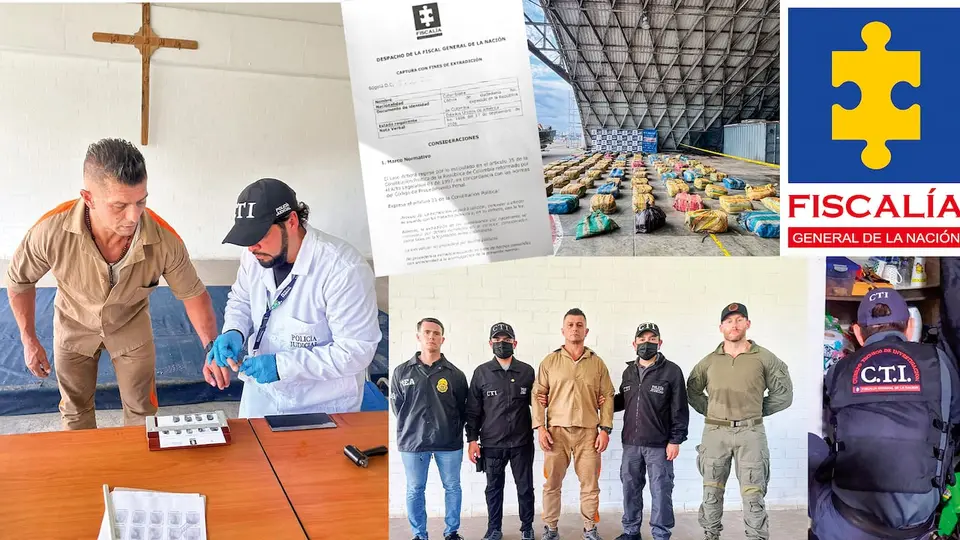
Alias Toto, the DEA and the Bogotá cartel: an extradition that reopens a file more than twenty years old
Jorge Enrique Figueroa Monroy, alias Toto, received formal notification of an extradition request on the first of October whilst serving his sentence in Guaduas prison in Cundinamarca. According to semana.com, the request originates from a federal court in the United States and is linked to the homicide of Francisco Arnoldo Moreno, a special agent of the DEA murdered on 22 November 1998 in the vicinity of the establishment El Divino, in the heart of Bogotá's Zona Rosa.
The case had remained in the files of Colombian justice for more than two decades, until the capture of alias Toto in February 2018 brought it back to the forefront. Since then he has remained deprived of liberty in prisons such as La Picota in Bogotá, and subsequently in Guaduas, where agents of the DEA and the Technical Investigation Body (CTI) arrived at midday to deliver him the notification. Figueroa signed the document and, according to the report known to semana.com, attempted to contact his father to inform him of the new international case he was facing.
The murder of agent Moreno and the cartel hypothesis
In its early stages, the death of agent Francisco Arnoldo Moreno Aguilar was presented as a brawl. Over the years, however, the investigation pointed to a drug trafficking network based in Bogotá—referred to as the Bogotá cartel—that was operating in association with Israeli traffickers. Moreno was investigating that organisation during his commission in Colombia, which, according to the authorities, motivated the order for his murder.
A DEA report known to semana.com describes that organisation as a "transnational OCG engaged in drug trafficking led by an Israeli, in charge of sending narcotics (cocaine) from Colombia to the United States and Europe, as well as responsible for the death of DEA agent Francisco Arnoldo Moreno Aguilar".
Conviction in Colombia and charges in the United States
Almost twenty years after the homicide, Colombian justice convicted Figueroa Monroy to 30 years in prison for the murder of the DEA agent. However, the proceedings in the United States continued in parallel. In 2003, the District Court for the District of Columbia already held an advanced file against alias Toto. The extradition request, according to the report, "is based on charges of indictment of 29 April 2003, filed before the District Court of the United States for the District of Columbia, for the charge of homicide of an internationally protected person, second degree, related to the death of special agent Moreno Aguilar".
For the DEA, the murder of one of its agents was a matter of institutional honour. United States authorities did not consider the conviction in Colombia as closure of the case, but as a stage within a process that should also have a response before their own courts.
Reconstruction of the file
To sustain the extradition request, investigators had to reconstruct the case from its foundations. They traced for months judicial documents, testimonies and expert reports filed in Colombian courts, with the objective of organising the evidence and sharing it with United States authorities.
"The current investigation had the purpose of integrating open sources, judicial actions, statements, expert reports and documents from the file, with which it was possible to verify the consistency of the information, identify investigative gaps and strengthen the analysis of the international dimension of the case," states the document to which semana.com had access.
CTI agents also highlighted the importance of that institutional work in strengthening judicial relations with the United States, even in cases that occurred decades ago. Through that reconstruction it was possible to establish not only Figueroa's responsibility for the homicide of agent Moreno, but also his involvement with the narco-alliance that operated alongside Israeli traffickers.
The defence: non bis in idem
The defence of alias Toto announced that it will request a review of the case. The central argument revolves around the principle of non bis in idem: in Colombia, the murder of the DEA agent was already investigated, tried and convicted. His legal representatives argue that Figueroa Monroy cannot be charged twice for the same act.
The legal discussion, however, faces a fundamental obstacle: the charge formulated by United States justice is homicide of an internationally protected person, a category that the authorities of that country consider a direct attack on the fight against drug trafficking and which justifies North American federal jurisdiction independently of what transpired in Colombia.
Seven years imprisoned, a new front
Alias Toto has been deprived of liberty for seven years in Colombia, arguing before local justice a hypothesis of self-defence for the charge of aggravated homicide. The notification of extradition opens a new legal front for Figueroa Monroy, who will now have to answer before two judicial systems for the events that occurred that November 1998 evening in Bogotá's Zona Rosa.
The federal court in Washington expects to recover the Colombian file as additional evidentiary material, added to the evidence gathered over two decades by investigators from both countries. The case of the so-called Bogotá cartel, with its international connections and the homicide of a DEA official, thus returns to the courts after more than twenty years in the files of justice.
Source: Google News CO — Bogotá