Ecuador approves law against child recruitment: penalties rise to 26 years
Ecuador's National Assembly approved a 62-article law that increases sanctions for recruiting minors into organised crime. The measure still requires presidential approval from President Noboa.
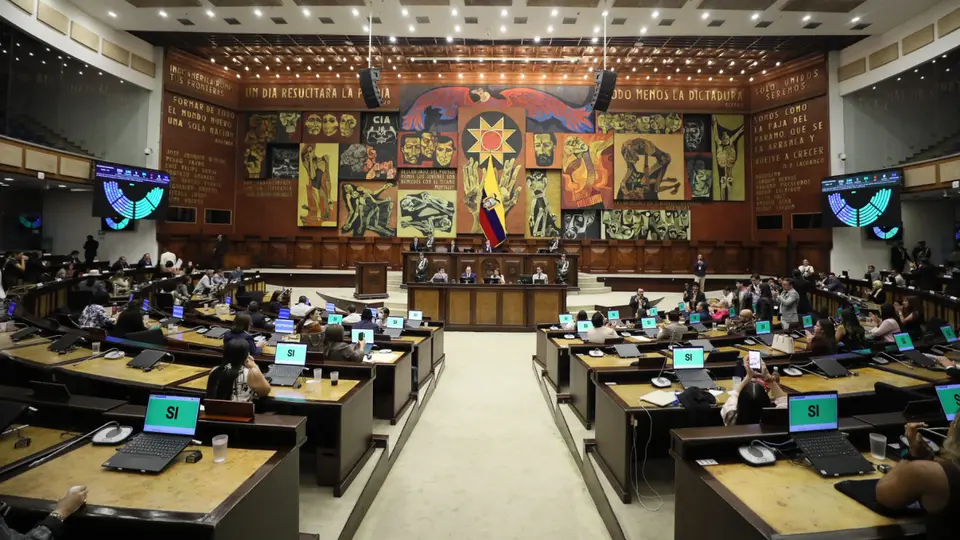
National Assembly toughens sentences for child recruitment in organised crime
Ecuador's National Assembly approved on Tuesday, 29 September 2026 a law aimed at preventing and eliminating the recruitment of children and adolescents by criminal groups, reports extra.ec.
The regulation, submitted by the Government in January 2026, comprises 62 articles that reform 15 existing laws, including the Penal Code (COIP), the Code of Childhood and Adolescence, and standards related to drugs, health, education, culture and sport.
The most significant change affects the COIP: sentences for those who recruit or use minors to commit crimes will rise from a range of 10 to 13 years imprisonment to a range of 22 to 26 years.
Government-aligned assemblywoman Diana Jácome, during the debate, noted that more than 2,000 minors have been detained in 2026 so far. "Because they are vulnerable, because the criminals, the leaders of the criminal structures, know how to recruit them," Jácome stated.
The law was approved with 88 votes from the Government caucus and its allies. Legislators from the Citizen Revolution, the main opposition bloc, chose to abstain.
The regulation also includes mechanisms for monitoring, alerting and blocking digital content linked to the recruitment of minors. According to Jácome, the measure will allow temporary blocking of IP addresses, domains, URLs and other digital identifiers that disseminate material designed to recruit children and adolescents.
Opposition assemblywoman Paola Cabezas indicated that her caucus shares the objective of toughening sentences, but considered that the law does not address the problem comprehensively. Cabezas also questioned the fact that security of juvenile detention facilities remains under the responsibility of penitentiary officers, officials who, in her view, are not prepared for that responsibility.
Ecuador's Unicef representative, Arturo Romboli, had previously described the approval of the regulation as a "key step" for child protection in the country.
The law has not yet come into force: it must be submitted to President Daniel Noboa, who will have the power to sign it or veto it.
The context surrounding its approval is critical. According to the Observatory for Childhood, Adolescence and Youth, 305 minors were murdered in Ecuador during the first half of 2026.
Source: Google News EC — Crime