US Military in Drug War: Ground Operations and Air Strikes in Ecuador
The US military is conducting raids against drug cartels together with Ecuadorian forces according to n-tv.de – despite questionable effectiveness.
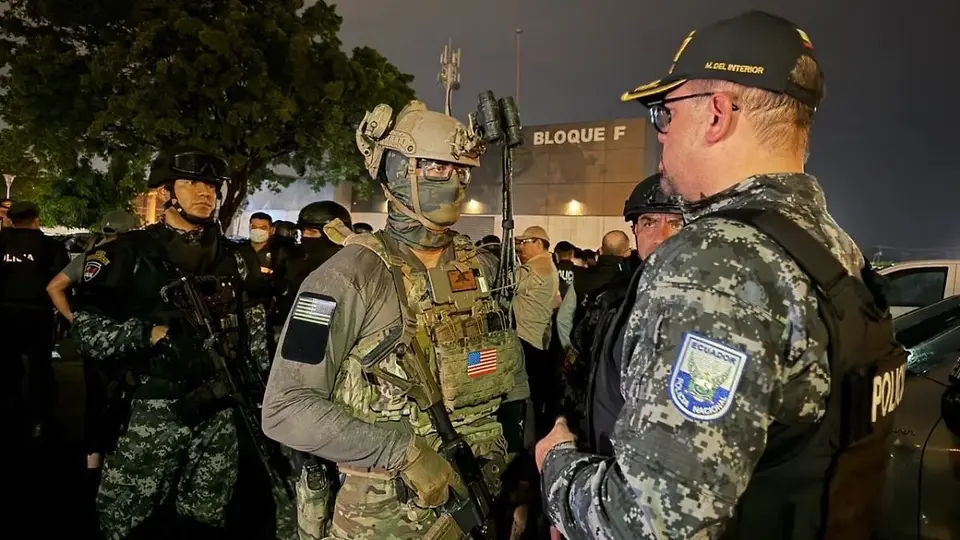
US Army Active on the Ground: Joint Raids with Ecuador Against Cocaine Smuggling
Ecuador's President Daniel Noboa proudly posted photos on social networks: blood-soaked corpses of suspected cartel members next to an SUV riddled with bullet holes. According to Noboa, among those killed was a "logistics and finance manager of international drug trafficking networks". The operation was one of the first joint operations of Ecuadorian and US armed forces. As n-tv.de reports, the US military is significantly expanding its drug war in South America – and is now striking not only from the air, but also on the ground.
During a raid last week, according to Ecuadorian Interior Minister John Reimberg, 50 members of the US Southern Command and the US anti-drug agency DEA were involved. Together with hundreds of personnel from the National Police, they attacked an offshoot of a Mexican cartel.
Ecuador in the Crossfire: Transit Country with One of South America's Highest Murder Rates
Ecuador is geographically situated between the world's two largest cocaine producers, Colombia and Peru. The country serves criminal organisations as a transit and transhipment point for drug shipments to the USA, Europe and Asia. Rival gangs fight over smuggling routes and territories, which has now led to one of the continent's highest murder rates.
Under President Noboa, Ecuador has assumed a central role in "Shield of the Americas", the security alliance of the Trump administration. The alliance includes several Latin American states, predominantly governed by right-wing administrations. Most recently, Colombia joined the alliance following the electoral victory of right-wing hardliner Abelardo de la Espriella in August.
"No state can defeat alone an enemy that knows no borders," Noboa said before the UN General Assembly. The Trump administration designates cartels and other criminal groups as "narco-terrorists" and has now designated more than 20 organisations as foreign terrorist organisations. Trump openly speaks of a "war" against the cartels – without a formal declaration of war by Congress, as critics note.
Air Strikes on Smuggler Boats: More Than 200 Dead, But No Evidence
Last month, several Ecuadorian fishing boats in the Pacific were destroyed that allegedly served drug trafficking. The US military has been conducting attacks on suspected smuggler boats for around a year. In these legally controversial attacks in international waters, more than 200 people have been killed according to US media reports. Washington has not provided evidence of links between the attacked boats and drug cartels. In March, the USA had already supported Ecuador in bombing alleged smugglers at the border with Colombia.
Effect Remains Absent: Cocaine Quantities and Street Prices Unchanged
The wave of military strikes has so far had no measurable impact on drug smuggling. According to a DEA report, neither the quantity nor the purity of cocaine smuggled into the USA has decreased. The black market price also has not changed, reported the Washington Post in July citing DEA analysis. A price increase would indicate a shortage of supply.
According to the DEA, US attacks merely lead to a strategic shift among the cartels: instead of relying on smaller speedboats on open water, they are now using larger ships that move along the coast and thus avoid the risk of attacks in international waters.
"Operation Southern Spear": General Donovan Hunts Cartels in Jungle and on High Seas
Responsible for leading the anti-drug campaign in South America is General Francis Donovan, commander of the US Southern Command. Donovan previously served for years in the Middle East; now he hunts drug cartels in the jungle and on the sea with "Operation Southern Spear".
"It is an incredible challenge," Donovan told the Wall Street Journal. "When you add the river networks, their daily flow volumes and tidal differences of up to 20 feet, you get a unique combination of geographical and topographical challenges that we simply have not faced before."
The unit, originally planned as temporary, has since been converted into a permanent rapid response force coordinating joint operations. "These measures can involve raids, arrests or the dismantling of a hideout. It could even be something as routine as the increased use of cargo scanners at border checkpoints," Donovan explained. The goal is to confront the cartels with "comprehensive, systemic resistance".
Reaper Drones and Counter-Terrorism Tools: Southern Command in New Role
Tools and weapons systems from counter-terrorism operations are increasingly being used in the drug war. According to US media reports, additional MQ-9 Reaper drones are to be deployed to the region. They can be used for both reconnaissance and – equipped with missiles – conduct air strikes, a method familiar from the Middle East.
The growing operational role marks a significant shift for Southern Command, which until now has mostly been present in the region with limited forces. Whether the expansion of military engagement can actually halt the drug flow remains open based on results so far.
Source: Google News LU DE