Murder of Olga Sangrador in 1992: how Valentín Tejero raped and killed a 9-year-old girl
In the early hours of 25 June 1992, Valentín Tejero kidnapped Olga Sangrador in Villalón de Campos and buried her in a pine forest near Tudela de Duero.
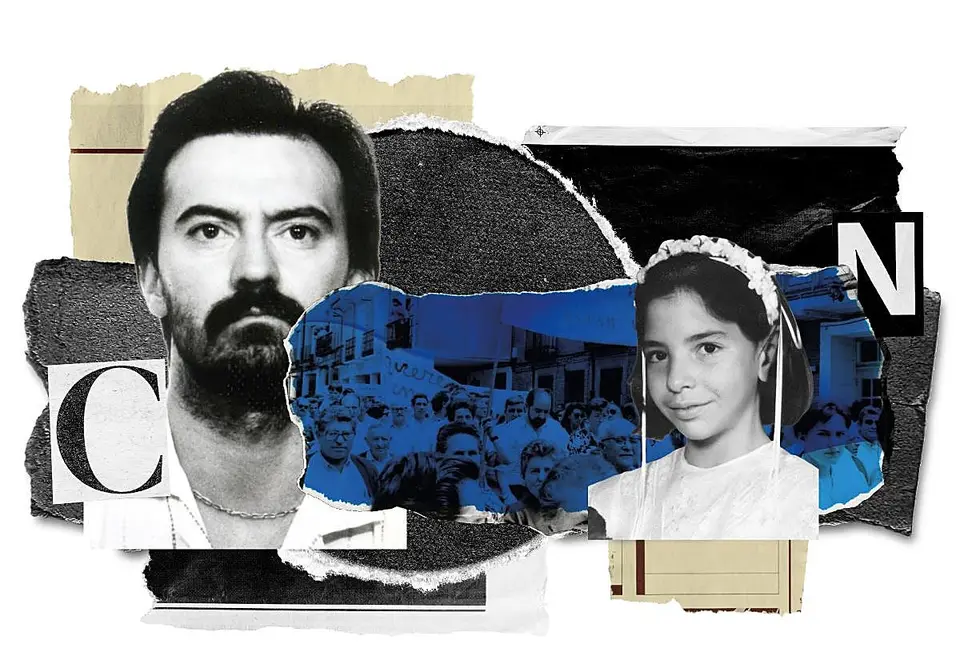
The night Valentín Tejero took the life of Olga Sangrador in Villalón de Campos
In the early hours of 25 June 1992, a 9-year-old girl disappeared during the patron saint festivities of Villalón de Campos, in the province of Valladolid. According to Ideal, her father, Domingo Sangrador, closed the family inn at three in the morning and went out to search for her after failing to find her: Olga's friends were already at their homes and the last time they saw her was around one thirty, when she said goodbye to them saying she was leaving so her mother wouldn't scold her. Domingo then called the Guardia Civil.
A couple who were in the vicinity had seen her shortly before two in the morning walking in the opposite direction to her parents' inn, as if she were heading back towards the Plaza Mayor. The woman who spotted her stated that the girl was accompanied by a man whose characteristics she did not take note of: "The girl was calm and we couldn't think that this was going to happen." The family ruled out voluntary flight from the outset. "We've taught her not to trust anyone," her father said.
The trail of the black four-wheel drive and the identification of the suspect
The entire village and the surrounding region mobilised to find Olga, but the hours passed without any trace of her. The investigation took a decisive turn thanks to a radio enthusiast who had seen a black Suzuki four-wheel drive vehicle with eye-catching stickers in the surroundings of the town. The vehicle had been parked for hours on a street in the municipality and had not gone unnoticed by several neighbours.
The Guardia Civil cross-referenced this information with the investigations it was carrying out among prisoners enjoying prison leave and who had been convicted of sexual assaults. All the evidence pointed to the same name: Juan Manuel Valentín Tejero, aged 30, resident of the La Victoria neighbourhood in Valladolid, with numerous previous convictions for sexual assaults on minors. At the time of the events, he was at liberty on a six-day prison permit. He was detained on the night of 26 June.
The confession and the discovery of the body
Early in the afternoon of the following day, the police organised a secret identity parade and interrogation in a restaurant in Villalón, in the presence of the duty judge and several witnesses, including a waiter who claimed to have seen Tejero in the town that morning. The security measures were designed to prevent neighbours from attacking him once his identity became known. Tejero remained unmoved for four hours and denied any involvement until, according to the authorities, he "broke down, under psychological pressure and without any violence," and confessed to the crime.
He then indicated the place where he had buried the girl: a pine forest five kilometres from Tudela de Duero, in a difficult-to-access area. The body was found that same night, around ten o'clock, buried between five and ten centimetres deep.
The account of the murderer himself
Tejero stated that he approached Olga after one thirty in the morning with the phrase "Will you help me put up some posters?" After convincing her, he put her in the four-wheel drive. According to his version, the girl cried asking to return to her parents and then fell asleep. Half an hour later he stopped at the La Mudarra petrol station to refuel and continued to the pine forest, eighty kilometres from Villalón, near Herrera de Duero.
There he raped the girl and attempted to strangle her. Upon discovering that she was still moving when already half buried, he struck her on the head with an iron bar, fracturing her occipital bone. He drove over the spot several times with the vehicle to compact the ground and hinder the discovery of the body.
Tejero did not return to his home until eight in the morning. He told his wife that that night he would have to sleep in prison; she believed he was returning from the penitentiary centre, as he usually did when he was not on leave. Shortly afterwards he went to open the kiosk that the family ran.
An extensive and repeated criminal history
On 28 June, Valentín Tejero returned to Villanubla prison. The centre's management decided to isolate him to prevent attacks from other inmates. Three days later, the Prison Service ordered his transfer to the maximum-security prison of Herrera de la Mancha, in Ciudad Real.
Tejero's criminal profile was extensive. In 1976, aged 15, he was brought before the courts for attempted rape of a 9-year-old girl. In November 1982 he was arrested for indecent exposure and creating a public disturbance. In 1986, Valladolid police attributed four sexual assaults committed in a short space of time to him: rape with anal penetration of an 11-year-old girl, abuse of an adult woman, an attempted abuse of a 12-year-old girl in the La Rondilla neighbourhood and an attempted rape—with vaginal and oral penetration—of another 12-year-old girl.
For this latter fact he was sentenced to prison. Already in 1989, during a prison permit, he raped a 16-year-old girl. In April 1991 he was granted an open regime: he worked in his kiosk and returned to sleep at the prison. From then on, he enjoyed six-day permits every fifteen days. The last of these was authorised by Ignacio Sánchez Yllera, then judge of Prison Oversight in Valladolid.
His method of action with victims always followed the same pattern: he would show a police badge and a dummy pistol when girls entered their apartment buildings, and would proceed to commit the abuses. He was married and had two children at the time of the crime.
Source: Ideal