Illegal car races in Spain: 147 operations dismantled in six months
The Guardia Civil dismantled 147 illegal vehicle competitions in the first half of the year. Eleven arrested in Madrid, aged between 18 and 25.
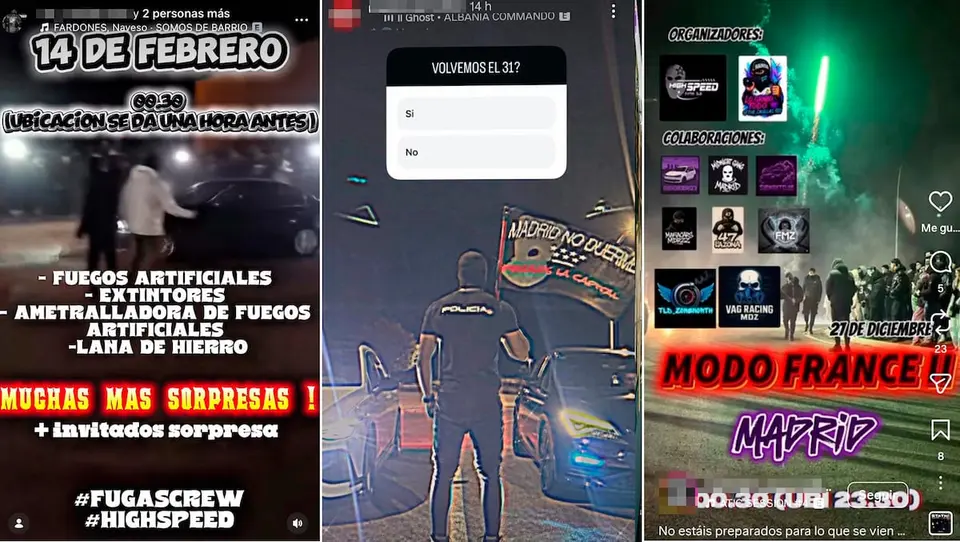
Clandestine races in Fast & Furious style spread across Spain
Eleven men aged between 18 and 25 were arrested in Madrid following an operation by the Traffic Accident Investigation Group (GIAT), which since the beginning of 2025 has been systematically monitoring so-called kedadas: illegal gatherings of modified vehicles competing at high speed. According to El País, the Guardia Civil's Traffic Grouping has shut down 147 of these races in the first half of the year across the national territory.
The detainees are accused of reckless driving, document falsification, simulation of crimes, serious disobedience to authorities and membership of a criminal organisation.
Social media, betting and flares
The logistics of these groups always follow the same pattern. Through Instagram, WhatsApp and Telegram, organisers circulate an announcement with the basic details of the event. The preliminary meeting point is set in large car parks with quick access to high-capacity roads. In Madrid, those at the Metropolitano stadium, the Xanadú shopping centre—on the Extremadura motorway in Arroyomolinos—and La Gavia, near the A-3 towards Valencia, are habitually used.
To be accepted into the group, it is necessary to pass a questionnaire and send photographs of one's own vehicle. The criminal activity has escalated over time: participants finance the organisation costs through crowdfunding among attendees, with which they pay for flares, smoke canisters, fireworks and even Taser pistols to confront the Police and Guardia Civil in the event of intervention.
Balaclavas, hidden number plates and attacks on officers
"At the races they use balaclavas and cover their licence plates so they cannot be identified. Some have even more sophisticated devices, such as electronically reversing the number plate. That way they avoid fines and being identified," explains Martín Hervás, the GIAT lieutenant in charge in Madrid.
Hervás, who directs the group alongside eight officers, describes a change in attitude from October or November 2025 onwards: "We noticed that another group was taking control of the races. They became more aggressive." In Borox (Toledo), two Civil Guards patrolling in an official vehicle were sprayed with a fire extinguisher; the officers had to reverse at full speed to avoid being attacked. The lieutenant puts attendance at the latest gatherings at over 500 people.
Any night, any road
Weekend and bank holiday evenings are preferred, although in summer the activity can occur "any day", according to the captain in charge of the Central GIAT, José Luis Sánchez. Once gathered at the starting point, the organisers communicate the exact location of the race, which can be situated anywhere in the country. Some gatherings have resulted in movements from Madrid to Navarre, with participants joining from the Basque Country or Navarre.
The journey to the destination is carried out at dizzying speeds and serves in itself as an informal competition. It is not uncommon to see these vehicles circulating in the early hours on the M-40 weaving between traffic. "More than once they do it in the opposite direction of traffic, with serious risk to other drivers. It is very difficult to stop them in those circumstances," notes Captain Sánchez. On other occasions they opt for the opposite extreme and block a motorway by circulating at less than 10 kilometres per hour. "They do whatever they like," summarises Lieutenant Hervás. What attendees do not know, he adds, is that there are plainclothes GIAT officers among the public who film and document everything.
Volkswagen Polo, Seat León and tuned engines
The vehicles involved range from economical saloons—Volkswagen Polo, Seat Ibiza or León—to mid-to-high-range models such as Golf, Audi A3 or A5 and BMW Series 3. All are equipped with mechanical modifications: exhaust changes, incorporation of nitrous oxide, lowered suspensions and various speed boosters. "When they have to pass the MOT they remove it all and then put it back on again," indicates the lieutenant.
"They are young people who work and dedicate all the money they earn to modifying their car," points out Captain Sánchez. In the case of two-wheelers, the range goes from tuned mopeds that reach speeds for which their chassis is not designed, to large-capacity motorcycles capable of exceeding 200 kilometres per hour.
The staging
Once at the chosen point, the cars accelerate and burn rubber whilst flares and torches illuminate the area. Smoke canisters add visual effect. Two vehicles position themselves in parallel and an organiser positioned between them gives the starting signal. The race concludes when one of them first reaches a marked point in the route, where another group member waits as a finish judge.
Source: El País