Ceuta: 200 daily complaints and 16 sexual assaults one month after the Great Jump
The courts in Ceuta shifted from 20 to over 200 complaints per day following the mass arrival of migrants. Sixteen sexual assaults have been recorded, with the migrants themselves being the primary victims.
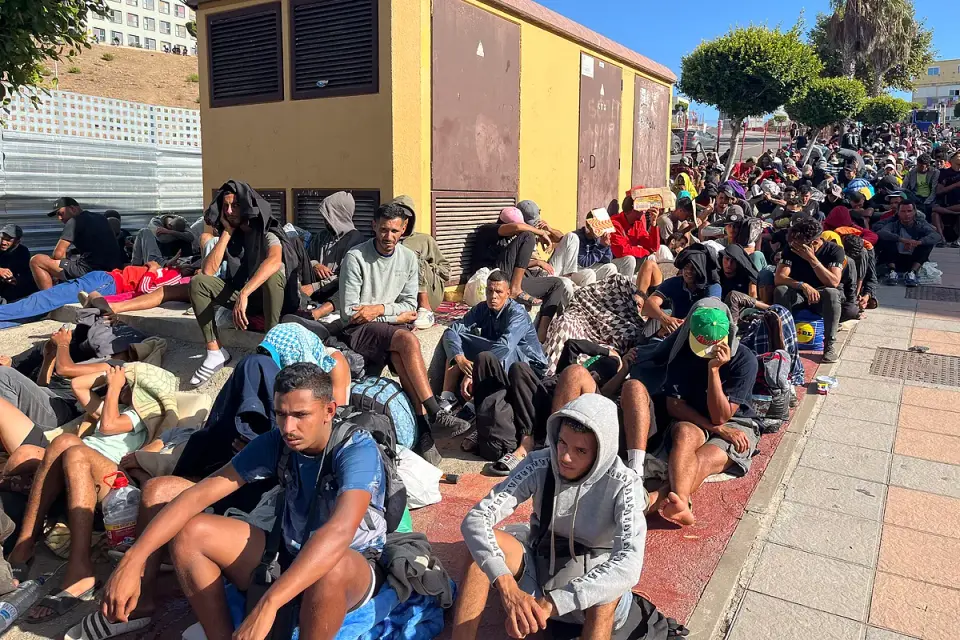
Judicial overwhelm and surge in crime in Ceuta one month after the Great Jump
The courts in Ceuta today record more than 200 daily complaints, compared with the 20 that were customary before 30 July, when approximately 80,000 North Africans and Sub-Saharan Africans crossed the border during the days known as the Great Jump. According to El Mundo's findings, the increase is equivalent to a 900% rise in complaints filed with the enclave's courts, completely overwhelming the judicial system's management capacity.
Among the most frequent crimes are robbery with violence, robbery with force, offences against sexual freedom and crimes against public order. In the 27 days since the Great Jump, 31 offences against public order have been recorded, including disobedience and assault on law enforcement officers.
16 sexual assaults, with migrants as primary victims
Since 30 July, a total of 16 sexual assaults have been reported. In only four of those cases have migrants been arrested in connection with the incidents, according to data gathered by El Mundo. A particularly striking fact is that the majority of the victims of these sexual crimes are the migrant women themselves who entered Ceuta through El Tarajal—swimming or walking across the border, which Moroccan authorities kept open at certain points during the influx.
Among the victims is a 15-year-old Moroccan minor who reported a gang sexual assault. To date, the perpetrators have not been identified, according to what this newspaper was able to establish. The progression was rapid: by 7 August, six sexual assaults had already been reported, with several minors attended to by health services; by 18 August, eleven Moroccan minors had filed complaints of sexual assault.
On 21 August, the police arrested a Moroccan citizen accused of sexual assault, reported by a 22-year-old woman, on the Ceuta beach of Calamocarro—the same location that the mayor-president Juan Jesús Vivas had offered to the central Government as a possible reception area, according to a draft Royal Decree approved that Tuesday to which El Mundo had access.
Imprisonments and expulsions since the Great Jump
By 12 August, nine migrants had already been sent to prison and two expelled for crimes committed since the Great Jump: five for assault on law enforcement officers and three for sexual assaults—one of them involving penetration of a minor. Of those three latter cases, two were held in provisional prison and one was expelled. Additionally, one was being investigated for drug trafficking, another for breaking and entering and another for aggravated assault.
Security forces in precarious conditions
Officers from the State Security and Police Forces themselves regularly convey to El Mundo the conditions in which they work. They describe constant exposure to risk in every intervention with migrants who, as their money and supplies run out, may act unpredictably. Law enforcement officers note that their capacity is limited to "shepherding" them and asking for their cooperation, without being able to adopt more forceful measures.
Mayor-president Vivas has been warning for weeks, both to the media and in institutional forums, that the security the local Government is demanding from the central State is not only for the residents of the enclave, but also for the newly arrived.
No official count and no unified command for four weeks
On the verge of completing four weeks since the beginning of the crisis, the central Government has still not drawn up an official count—neither from police nor from the Ministry of Migration—on how many people are living rough in Ceuta's barely 20 square kilometres. The Executive typically uses the figure of "more than 5,000". Police sources conveyed to this newspaper three days ago a different calculation: 8,000 people, distributed across 2,000 on Trampolín beach, 1,500 in makeshift tents, 2,500 uncontrolled minors and the rest dispersed throughout the city. The local Government raises that figure to 10,000.
The situation has finally led the Government to activate the National Security Act, after nearly a month in which it denied the need for a unified command capable of coordinating all State resources to address what the mayor himself describes as an extreme situation. The approximately 10,000 migrants who, according to the local Government, are living in poor conditions on the streets of the enclave do so in conditions of absolute insanitary circumstances, awaiting a swift response that, one month after the Great Jump, has still not arrived.
Source: El Mundo